Episode Details
Back to Episodes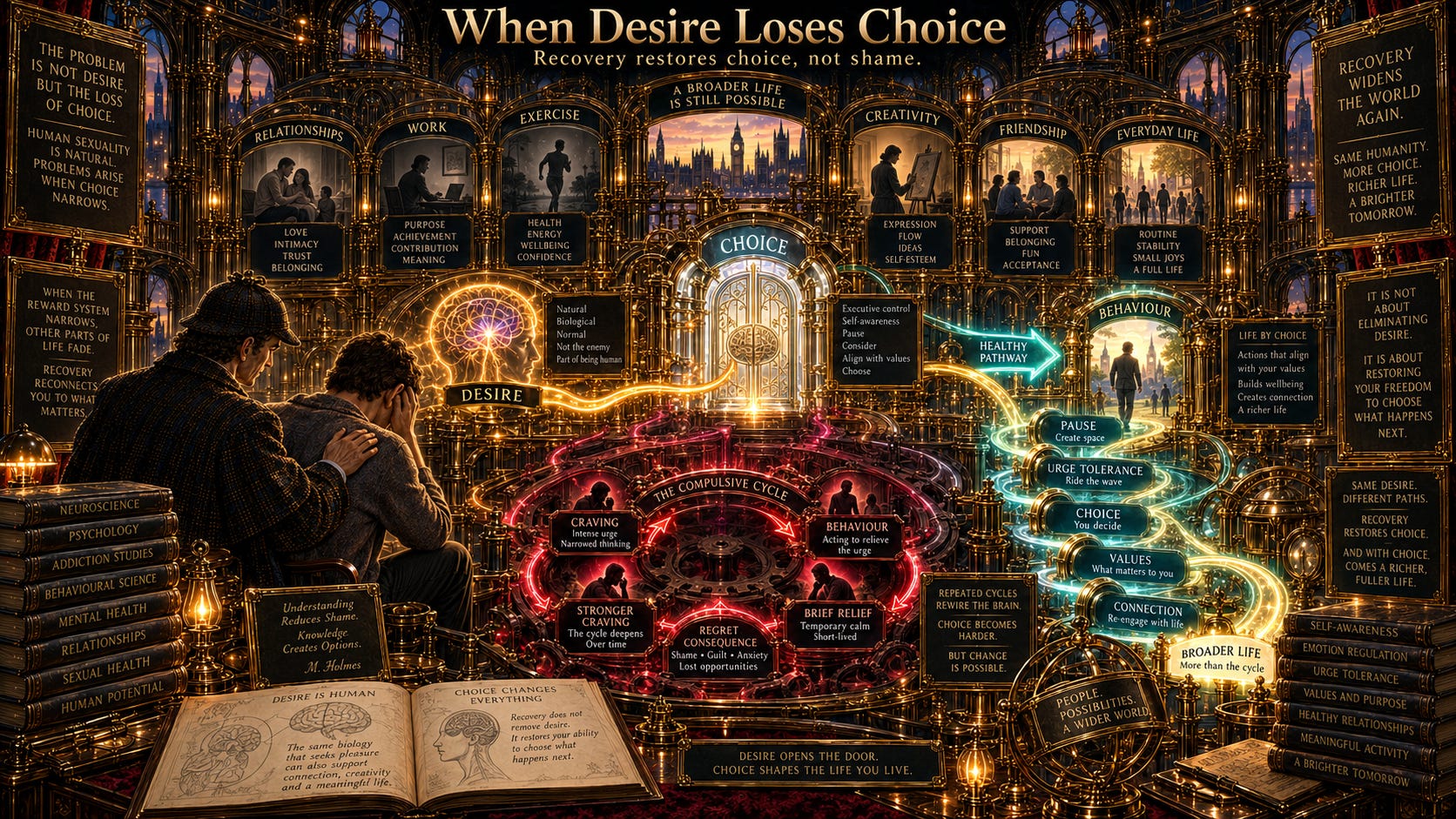
PSYCH 134: Sexual Addiction
Description
The central clinical question is not “How much sex is too much?” but “Has sexual behaviour become the person's primary way of regulating distress, reward and self-experience?”
Medlock Holmes enters an immense Neo-Victorian institution called The House of Driven Behaviour.
At first, nothing in the building looks inherently pathological.
There are rooms devoted to:
sexual fantasy
masturbation
romantic attachment
pornography
partnered sex
sexual exploration
All of these can occur within ordinary human sexuality.
But in one wing, the machinery behaves differently.
A person vows:
“I won’t do this again.”
Hours later, they do.
The behaviour causes:
* financial loss
* relationship breakdown
* occupational failure
* legal risk
* emotional collapse.
Still it continues.
Holmes discovers the two features around which the chapter builds its concept of sexual addiction:
RECURRENT FAILURE TO CONTROL THE BEHAVIOUR
and
CONTINUATION DESPITE SIGNIFICANT HARMFUL CONSEQUENCES
The chapter deliberately distinguishes this from simply having a high libido. A person may want sex frequently, behave in ways their partner dislikes, or pursue socially controversial sexual choices without demonstrating an addictive pattern.
Frequency alone is not the diagnosis.
Nor is the particular sexual behaviour.
What matters is the relationship between the behaviour and the person’s life.
The chapter also makes an important terminological argument. Sexual behaviour of this kind is often called compulsive sexual behaviour, but the source argues that addiction better captures its dual psychological function.
A compulsion classically reduces distress without being performed primarily for pleasure.
Addictive sexual behaviour can do both:
PRODUCE PLEASURE
and
REDUCE PAINFUL AFFECT
Sex can therefore become simultaneously a source of reward and an emotional anaesthetic.
Holmes enters the Reinforcement Engine.
One gear reads:
POSITIVE REINFORCEMENT
The behaviour creates:
* pleasure
* excitement
* arousal
* gratification.
The other reads:
NEGATIVE REINFORCEMENT
The behaviour temporarily relieves:
* anxiety
* loneliness
* shame
* emptiness
* abandonment feelings
* dysphoria.
Together, the gears make the behaviour exceptionally powerful.
The chapter proposes provisional diagnostic criteria modelled partly on substance-use disorders, including:
* behaviour occurring more intensely or for longer than intended
* repeated unsuccessful attempts to reduce it
* substantial time spent preparing for, engaging in, or recovering from it
* craving
* failure to meet responsibilities
* giving up important activities
* continuing despite interpersonal or psychological harm
* hazardous behaviour
* tolerance
* withdrawal-like states.
But it also explicitly acknowledges that sexual addiction is not a DSM-5-TR diagnosis, and the proposed criteria are provisional rather than established diagnostic standards.
Holmes therefore writes above the diagnostic desk:
“Clinically useful concept - contested nosology.”
The differential diagnosis hall becomes essential.
Sexual disinhibition can occur in:
* mania
* schizophrenia
* temporal lobe epilepsy
* frontal-lobe disease
* dementia
* substance use
* neurological illness
Listen Now
Love PodBriefly?
If you like Podbriefly.com, please consider donating to support the ongoing development.
Support Us