Episode Details
Back to Episodes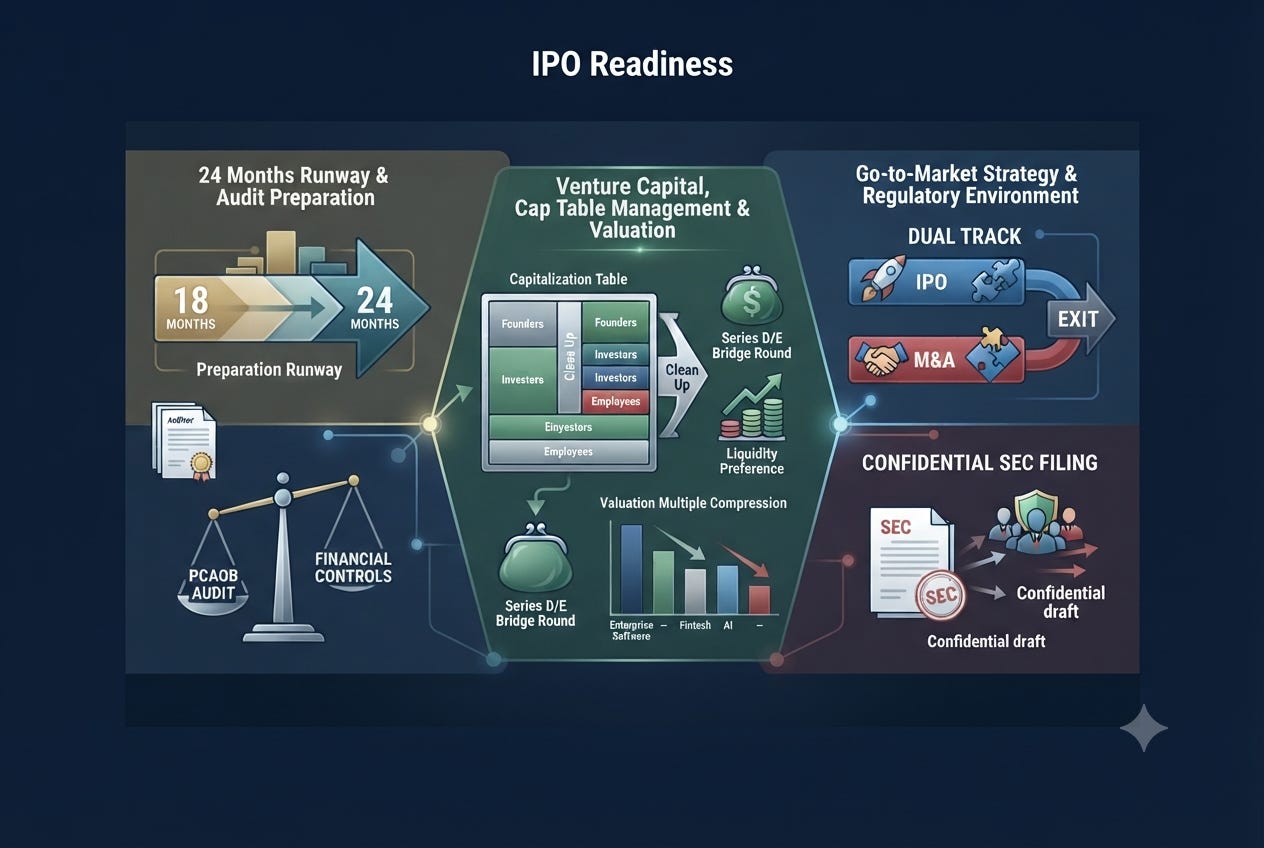
When Should A Startup Start IPO Preparation
Description
A venture backed company should start its initial public offering readiness work in 2026 even though the 2026 listing window itself is already narrowing, because the audited financials, internal controls, and board composition a public offering requires take eighteen to twenty four months to build regardless of when the market cooperates. That runway, not this year’s headline numbers, is the variable a founder or general counsel actually controls.
I have sat across the table from a company that signed its underwriter engagement letter before it had finished converting its revenue recognition schedules to public company standards. The bankers wanted a filing in four months. The audit remediation alone took nine. The company did not miss its window because investors turned cold. It missed because nobody started the accounting work early enough to have a choice.
That is the mechanic most founders overlook when they read that United States companies raised $251 billion across 86 listings through late July 2026, more than five times the $47.4 billion raised in all of 2025. The number is real. It is also almost entirely a story about a handful of enormous deals. SpaceX’s $85.7 billion June 2026 offering, priced at a $1.75 trillion valuation, accounted for roughly one third of the year’s total proceeds by itself. Fifty eight venture backed companies listed at $1 billion or higher in the first half of 2026, more than double the 27 that did so in the first half of 2025, but that volume concentrated in artificial intelligence infrastructure, semiconductors, and a small number of aerospace and defense names. Databricks already pushed its own listing to 2027 instead of competing for attention inside that concentration, with its chief executive describing 2026 as an unfavorable year to go public while the company instead pursued a private financing round reported in the $165 billion to $175 billion range.
None of that tells a mid sized venture backed company anything about whether it should start preparing this year. It tells the company something much narrower: that the current window rewards companies that already did the work, and punishes companies that show up hoping the market will wait for them. Before March 3, 2025, only companies that qualified as Emerging Growth Companies could submit a draft registration statement for confidential SEC staff review. Since that date, under Release Nos. 33-11265 and 34-99418, every issuer can use that confidential process, with no limit on how many drafts a company can submit and no clock forcing it to commit to a public offering date once it starts. Anthropic used exactly that structure, filing confidentially on June 1, 2026, following a funding round near $65 billion, and OpenAI filed confidentially on June 8, 2026, at an $852 billion private valuation. Neither filing commits either company to a listing date. Both let the company test its disclosure package against SEC comment letters on its own schedule, which is the entire commercial point of starting early.
The readiness work itself has three phases, and the first one, an assessment of SEC filer status, audit readiness under Public Company Accounting Oversight Board standards, and a comparison of the company’s books against public company norms, is supposed to start eighteen to twenty four months before a target listing. The second phase, roughly six to eighteen months out, is where a company converts to quarterly reporting, tests internal controls, and recruits board members who have actually sat on a public company audit committee before. A company that starts this work in September 2026 is not racing this year’s window at all. It is building toward a listing no earlier than the first half of 2028, on a calendar that has nothing to do with whether SpaceX or Anthropic crowds out attention this quarter.
That calendar math changes what preparation is actually for. A cap table carrying stacked liquidation prefere