Episode Details
Back to Episodes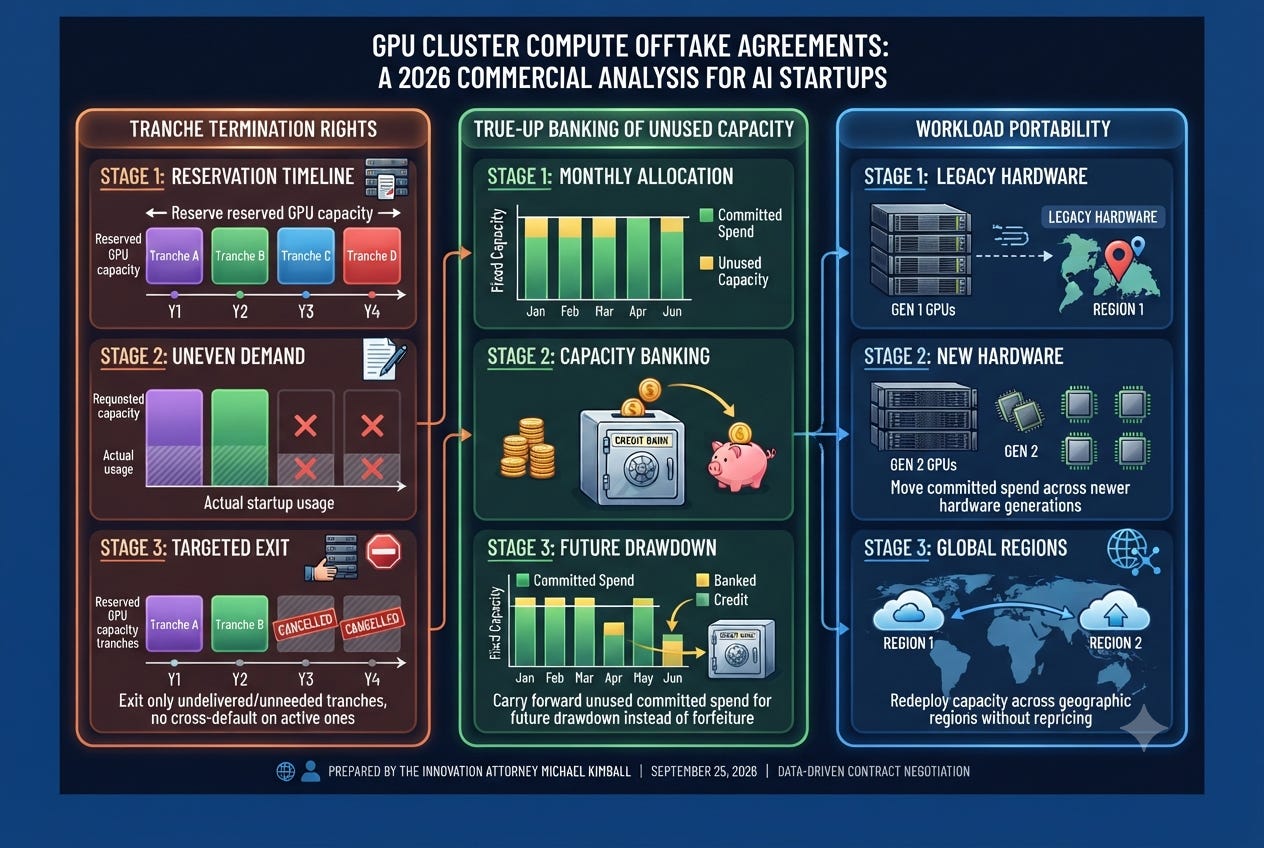
How To Negotiate A GPU Cluster Reservation Contract
Description
A cloud provider that finances a GPU cluster against a six year depreciation schedule, while selling that same cluster under a four year customer contract, has already decided who absorbs the difference, and it is not the provider. That mismatch, not the headline dollar figure on the term sheet, is the mechanic an AI startup’s own negotiating team should study before signing a multi year GPU cluster reservation in 2026. CoreWeave’s own reported book, 96 percent of 2024 revenue from take or pay agreements averaging about four years against GPUs the company depreciates over six, shows exactly how the provider closes that gap: through contract language, not through better forecasting.
Founders signing these agreements in 2026 are operating inside a compute market where the backlog is enormous and the delivery timeline runs for years. CoreWeave reported $103.7 billion in unsatisfied remaining performance obligation as of June 30, 2026, with only 41 percent of that backlog expected to convert to revenue within 24 months. The dollar figures attached to Oracle’s roughly $300 billion, five year Stargate commitment from OpenAI, or to CoreWeave’s own capacity agreement with OpenAI that grew from an initial $11.9 billion in March 2025 to $22.4 billion combined by that September, describe capital commitments measured in years, not contracts a customer can walk away from on a bad quarter. A startup signing its own, far smaller, version of that same paper needs to know which of those years it is actually on the hook for.
Most provider paper permits termination for cause and nothing else: an uncured material breach, a sustained service level failure, occasionally a force majeure lasting past a defined outside date. CoreWeave’s $6.5 billion addendum extending capacity to OpenAI through May 2031 carries termination for cause and no broader walk away right, and a startup with a fraction of OpenAI’s balance sheet needs more room than that, not less. The workable fix splits the cluster into tranches, so a missed delivery date or a service failure lets the startup exit the affected block of GPUs without unwinding capacity that is already running well. Nebius’s roughly $2.9 billion, five year GPU capacity agreement with Meta lets Meta terminate only the tranches a delivery shortfall actually affects, after a defined grace period, rather than the full five year commitment. That is the shape a startup’s own termination clause should take: narrow, tranche specific, and triggered by objective, defined events rather than left to the provider’s discretion.
A true up provision is the second piece, and it solves a different problem: the reserved capacity a startup is not using in a given month because a launch slipped or a training run finished early. Without a true up right, that unused reservation is simply gone, a sunk cost paid for and nothing received in return. With a true up right, the unused portion of the committed spend carries forward for a defined window and draws down later against future usage, so a slow quarter does not permanently waste months of paid for capacity. SF Compute built an entire offtake model around this problem, separating ownership of the physical cluster from the operating contract so that outside capital, rather than the startup’s own cash, carries the asset risk while the customer negotiates for shorter, more exit oriented terms. A startup that cannot get true up language into its own paper should at minimum negotiate the right to resell or sublease unused capacity to a third party at its own price, converting an idle GPU allocation from a fixed bill into a recoverable asset.
Portability closes the loop: the right to redirect committed spend across hardware generations as newer chips displace the fleet originally reserved, and across regions as the startup’s own customer base moves, without the provider repricing the unused balance at a worse rate once it has the startup locked in. Startups placi