Episode Details
Back to Episodes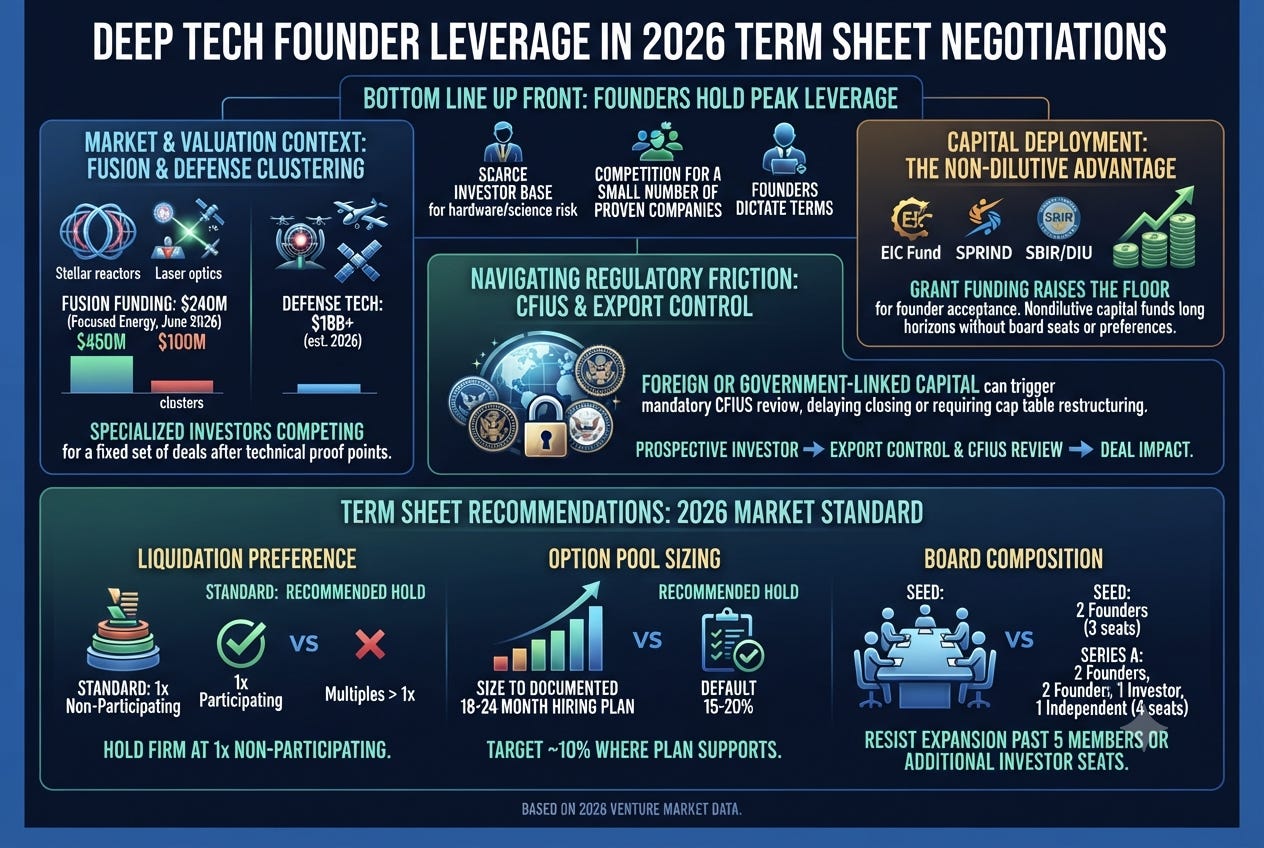
Why Deep Tech Founders Have More Leverage In 2026 Term Sheets
Description
Deep tech founders raising capital in 2026 hold more negotiating power over their term sheets than at any point since the sector became a distinct venture category, and the reason has almost nothing to do with the technology itself. It has to do with how few investors can actually underwrite reactor physics or laser optics, and how many of those investors are now chasing the same handful of companies at once.
Most founders think of their capital stack as one number: the size of the round. Focused Energy, a German laser driven fusion company, closed a $240 million Series A in June 2026 that was oversubscribed, and that round sits on top of $200 million in grant funding the company had already secured, plus capital from the European Innovation Council Fund and direct investment from the utility RWE. The grant money did not just extend the runway. It gave the company a funding source that cost no board seat and no liquidation preference, and a founder who does not need the next check on any particular timeline negotiates differently than one who does.
Focused Energy was not alone. Inertia Enterprises closed a $450 million Series A the same year, and Thea Energy, a Princeton University spinout, closed $100 million in May 2026. Three fusion companies closing rounds above $100 million within a few months of each other reflects real scarcity on the investor side. The number of funds and strategic corporates with the technical staff to evaluate a laser target chamber or a stellarator is small, and it has not grown nearly as fast as the number of credible deep tech companies asking for capital.
The same scarcity shows up in defense technology, where venture funding topped $15 billion in 2025 and is on pace to exceed $18 billion in 2026. Anduril now carries a valuation near $61 billion, and Shield AI is valued near $12.7 billion. When investor demand concentrates this heavily in a handful of companies, the companies that clear the bar do not compete against each other for capital. They watch capital compete for them.
That shift shows up first in liquidation preference. The market standard has been a 1x nonparticipating preference for years, but participating preferences, structures that let an investor collect the preference amount and then also share in remaining proceeds as if converting to common stock, have crept back into weaker markets whenever investor leverage rose. Heightened competition for deep tech allocations pushed the terms the other way in 2026, with industry guidance reporting that participating preferences became less common as investors offered cleaner economics to win the deal. A founder with more than one term sheet in hand should hold at 1x nonparticipating and treat any multiple above 1x, or any participating structure, as a term worth losing the deal over rather than a term worth trading away.
The option pool is the second lever, and it is the one founders give away without noticing. The typical pool sits between 10 and 15 percent of the company, with 10 percent the most common figure, and investors often require that pool to be created before the new money comes in, which lowers the founder’s effective price per share without changing the headline valuation. The median gap between a seed round and a Series A now runs about 620 days, close to 20 months, which gives a founder real data to negotiate from. Size the pool to the specific hires the company will make in that window, not to a round number an investor proposes from habit, and push to have any later top up shared across the full cap table rather than carved only from the founder’s side of the table.
Board composition is the third lever, and the leverage point inside it is easy to miss. At seed, the standard is two founder seats to one investor seat on a three person board. At Series A, the standard holds at two founders, one investor, and one independent director, still founder controlled, though some rounds push towa