Episode Details
Back to Episodes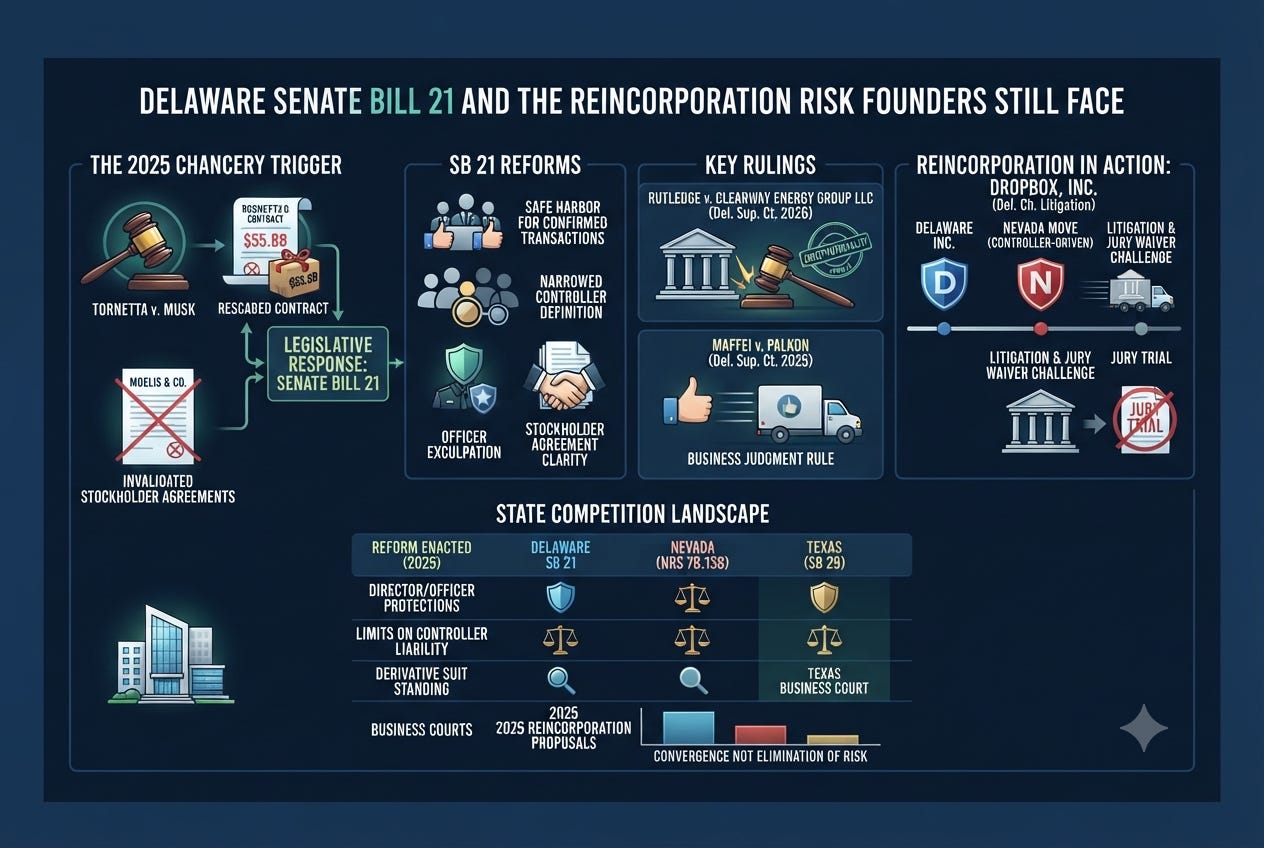
Does Delaware Still Carry Legal Risk After Senate Bill 21
Description
The Delaware Supreme Court upheld Senate Bill 21’s Section 144 safe harbor on February 27, 2026 in Rutledge v. Clearway Energy Group LLC, but the reincorporation risk survives.
The ruling shields a director, an officer, or a controlling stockholder from money damages and most equitable claims once a conflicted transaction clears an informed, disinterested committee or a fully informed majority of the minority vote. It says nothing about the separate claim still pending in the Delaware Court of Chancery against Dropbox, Inc.’s board, where a pension fund argues the company’s move to Nevada was itself the conflicted transaction. Nevada and Texas spent 2025 writing comparable officer and director protections into their own corporate codes, so the gap Delaware just defended is narrower now than it was when Tesla left in 2024.
Senate Bill 21 exists because of a string of Court of Chancery decisions that made Delaware corporate law feel unpredictable to the founders and controlling stockholders who had chosen it. In Tornetta v. Musk, Chancery rescinded Tesla’s $55.8 billion compensation package for its chief executive in January 2024, even after Tesla’s stockholders had ratified it, holding that the board process lacked independence and the proxy disclosures were misleading. A month later, in West Palm Beach Firefighters’ Pension Fund v. Moelis & Co., Chancery invalidated common provisions in stockholder agreements that gave a founder pre approval rights over board decisions, holding that Section 141(a) vests management authority in the board alone and a contract cannot reassign it. Tesla reincorporated in Texas by June 2024. Delaware’s legislature answered with Senate Bill 21 in March 2025, narrowing the definition of a controlling stockholder, creating the Section 144 safe harbor, and legislatively reversing Moelis through an amendment to Section 122(18).
The reincorporation decision itself already had a separate answer before Senate Bill 21 reached the Delaware Supreme Court. In February 2025, the court ruled in Maffei v. Palkon that a controller’s decision to move a company’s domicile out of Delaware to reduce litigation exposure, made without existing or threatened litigation against it, gets reviewed under the deferential business judgment rule rather than the entire fairness standard that normally governs a transaction benefiting a controller. That holding, not Senate Bill 21, is why TripAdvisor’s reincorporation to Nevada survived a stockholder challenge, and it is the reason a founder holding majority voting power can move a company by written consent without triggering the heightened review that would otherwise apply.
Dropbox took that path in early 2025. Its founder and chief executive, who controls 77 percent of the company’s voting power through dual class stock, reincorporated the company in Nevada by written consent. Delaware’s written consent rules counted that as a stockholder vote; in practice, one founder’s signature moved a public company’s domicile without asking any other stockholder anything. A pension fund sued in the Delaware Court of Chancery that same April, and its amended complaint, filed in July 2026, alleges the move was a controller driven transaction meant to insulate the founder and the board from an activist investor’s campaign, points to roughly $69 million in stock the founder sold during the process, and argues that Senate Bill 21’s own reforms undercut the board’s stated reason for leaving in the first place. The suit seeks rescission of the move or damages for the stockholder protections lost in it. In May 2026, Dropbox’s board went further and adopted a charter amendment eliminating jury trials for disputes over corporate management, a provision Nevada’s 2025 legislation newly permits. A California court has already refused to enforce a similar waiver, reasoning that a jury trial right cannot be signed away in a corporate charter, so whether Nevada’s version holds u