Episode Details
Back to Episodes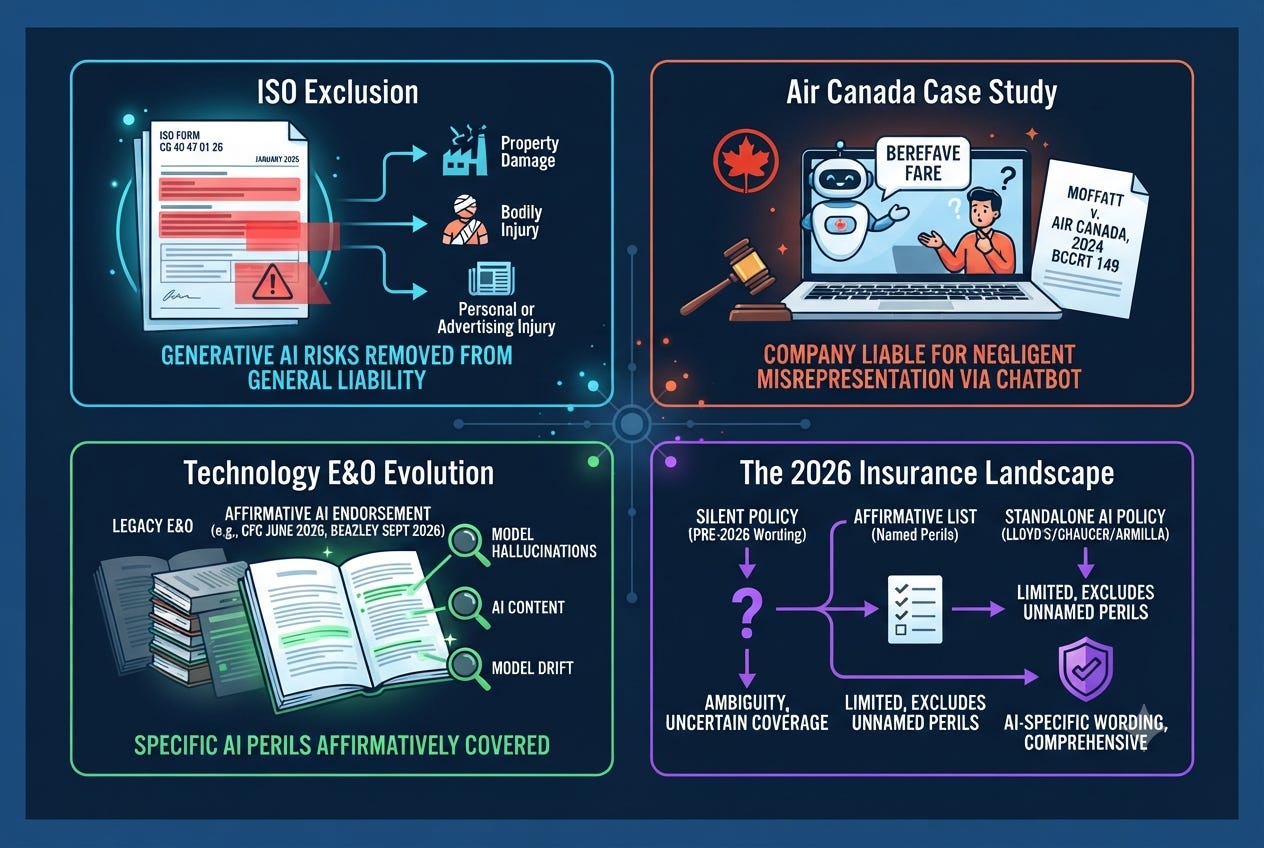
Does Tech E&O Insurance Cover AI Chatbot Mistakes
Description
A startup can still buy technology errors and omissions insurance that pays a claim over its AI product’s bad output in 2026, but only from the specific carriers, CFC and Beazley among them, that added affirmative artificial intelligence endorsements this year rather than relying on a legacy policy that never mentions the word model.
The mechanic most founders miss is that the exclusion making headlines this year does not live inside the policy that actually pays their claim. The Insurance Services Office released form CG 40 47 01 26 in January 2026, and it strips commercial general liability policies of coverage for bodily injury, property damage, and personal or advertising injury tied to generative artificial intelligence. A founder who reads that headline and checks the box, we carry general liability, we are covered, has checked the wrong policy. General liability responds to a customer who slips on a wet floor at a company office or whose warehouse catches fire because of a faulty product. It was never the policy that responds to a customer who loses money because a chatbot gave the wrong answer.
The policy that responds to a wrong answer is technology errors and omissions, sometimes called professional liability, and that is where the real change is happening, form by form rather than through a single standardized filing. No equivalent to form CG 40 47 exists yet for technology errors and omissions, so each carrier is rewriting its own exclusionary language on its own schedule. Some are widening decades old software and professional services wording into a blanket carve out for any claim arising out of artificial intelligence, machine learning, automated decisioning, or model output. Others are moving the opposite direction. CFC’s June 2026 policy update names model hallucinations, AI generated content, and model drift as affirmatively covered exposures across seven product lines, including technology errors and omissions. Beazley followed on September 17, 2026, adding its own affirmative AI endorsement inside its cyber and technology errors and omissions policies.
The claim these endorsements are built to catch already has a face. In February 2024, the British Columbia Civil Resolution Tribunal held Air Canada liable for negligent misrepresentation after its website chatbot told a grieving passenger he could apply for a bereavement discount after he had already booked, contradicting the airline’s own policy. Air Canada argued the chatbot was a separate legal actor responsible for its own words. The tribunal rejected that argument outright, and the airline paid. Moffatt v. Air Canada shows the shape of an AI output claim precisely: ordinary negligence and misrepresentation, filed against the company that deployed the tool, not the vendor that built it.
In reviewing vendor and customer contracts this year, the assumption embedded in most indemnification clauses has not caught up to the insurance market underneath it. A customer’s counsel drafts an indemnity for any inaccurate output and assumes the vendor’s technology errors and omissions policy will pay it. Whether that assumption survives contact with the actual policy now depends on which carrier wrote it and when the endorsement was added, not on whether the vendor can produce a certificate of insurance at all. A certificate proves a policy exists. It does not prove the policy covers the specific failure the contract just promised to indemnify.
A second complication cuts the other way. Naming a peril can narrow coverage as easily as it can broaden it. An undefined, silent policy sometimes gets construed in the policyholder’s favor when a court has to guess what the parties meant, since ambiguity in an insurance contract is traditionally read against the carrier that wrote it. An endorsement that lists hallucinations, drift, and generated content as covered perils replaces that ambiguity with a fixed list, and whatever the underwriter