Episode Details
Back to Episodes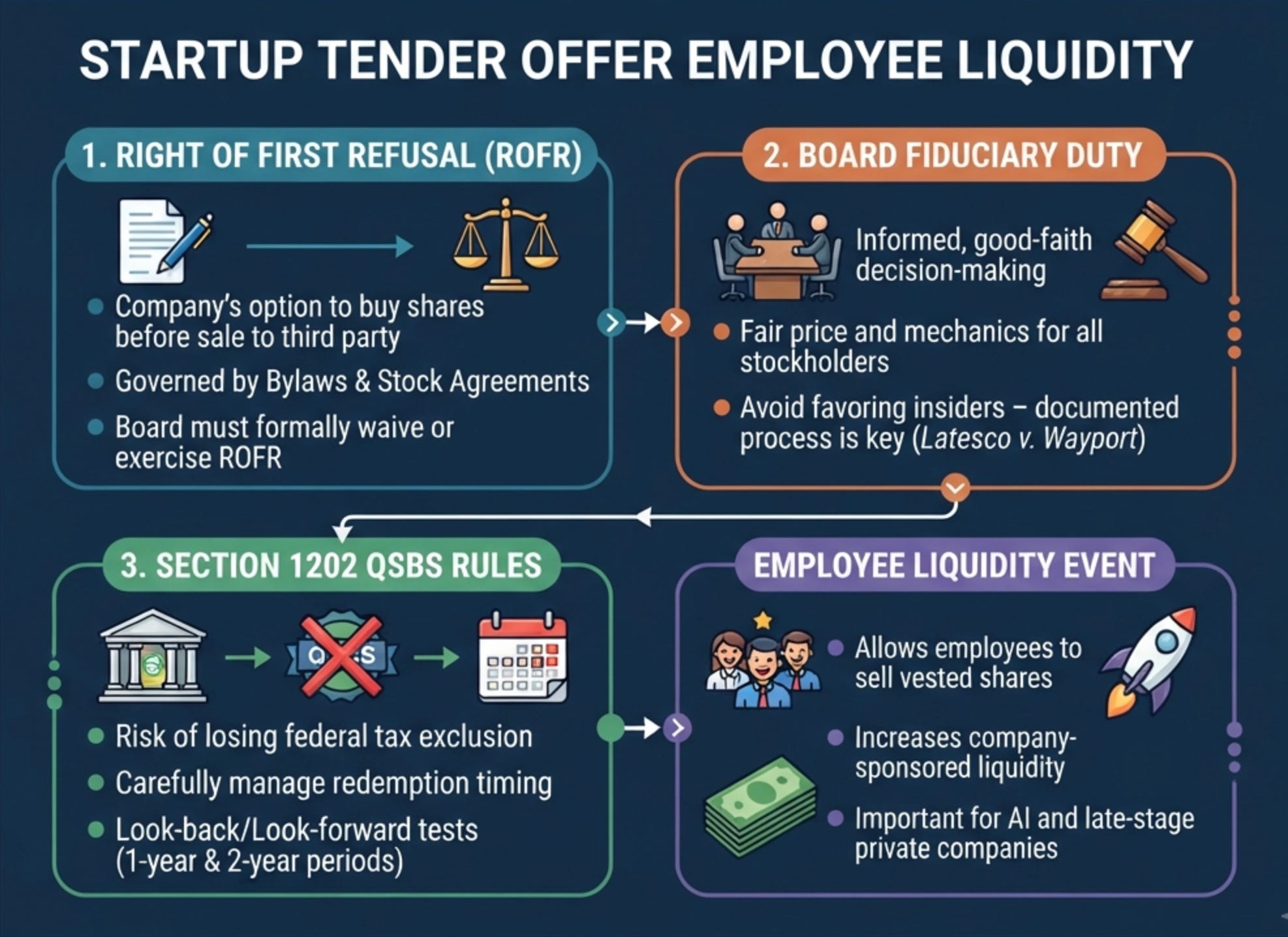
Do Tender Offers Affect the QSBS Tax Exclusion
Description
A tender offer that lets employees sell part of their vested stock can strip the federal tax exclusion off shares that were never part of the sale at all. Internal Revenue Code Section 1202(c)(3) tests every stock redemption a company makes against the shares it issued in the surrounding two years, and a founder who authorizes a well intentioned liquidity event without running that test first can leave people who never sold a single share holding a tax bill they did not create.
Tender offer volume reached $3 billion across 71 transactions in the first half of 2026 alone, the highest six month total in at least six years, with transaction counts up 34 percent and dollar volume up 200 percent from the same period a year earlier. Decagon closed its first employee tender offer in March 2026 at a $4.5 billion valuation, letting more than 300 employees sell a portion of their vested stock to investors including Coatue, Index Ventures, and a16z. Stripe pushed its own valuation to $159 billion in February 2026 through a tender offer open to current and former employees, a year after an earlier round priced the company at $91.5 billion. Extended private timelines, an artificial intelligence valuation cycle that has outrun the traditional path to an acquisition or a public offering, and venture funds under pressure to show their own investors some return of capital have combined to make the company sponsored tender offer a standard tool at well funded startups.
Before a board authorizes that kind of sale, the company’s own right of first refusal has to be cleared first. Nearly every startup stock agreement gives the company, or an assignee the company names, the option to buy shares before an employee can sell them to anyone else, whether that right sits in the bylaws or in the transfer restriction section of the option agreement signed at grant. A company that waives the right so outside investors can buy directly from employees is making a deliberate decision, not a housekeeping step, since a waived right does not reinstate itself automatically for the next transaction. Delaware Chancery Court held in Latesco, L.P. v. Wayport, Inc. on July 24, 2009 that a company exercising its right of first refusal owes a selling stockholder only the duties stated in the contract, not broader fiduciary disclosure duties. That limit lifted in the same case once insiders asked the stockholder to sell shares outside what the right actually covered, while holding undisclosed information about an asset sale.
The board resolution authorizing a tender offer carries more weight than most founders assign it. An informed decision, made in good faith, that the transaction serves the stockholders as a whole is the same standard that governs any board action touching the company’s capital structure. A board that lets a company insider set the price without independent review, or that allows some employees to participate while excluding others without a stated business reason, is building a record a departed employee’s lawyer can use later. A current valuation dated close to the offer, a written resolution naming which class of stock is eligible, and a stated cap on how much of an individual’s vested stock can be sold, commonly around 10 percent, belong in that record before the offer document goes to a single employee.
The federal tax consequence sits underneath all of this, and it is the one most founders discover only after the fact. Internal Revenue Code Section 1202(c)(3) disqualifies Qualified Small Business Stock when a company redeems more than 5 percent of its equity value from any stockholder in the year before or after a new issuance. A separate rule reaches redemptions from the specific person who received new stock, or a related party, within two years on either side of the issuance date. A company that redeems shares in a tender offer inside that window, shortly after issuing new stock to a recently hired executive, can di