Episode Details
Back to Episodes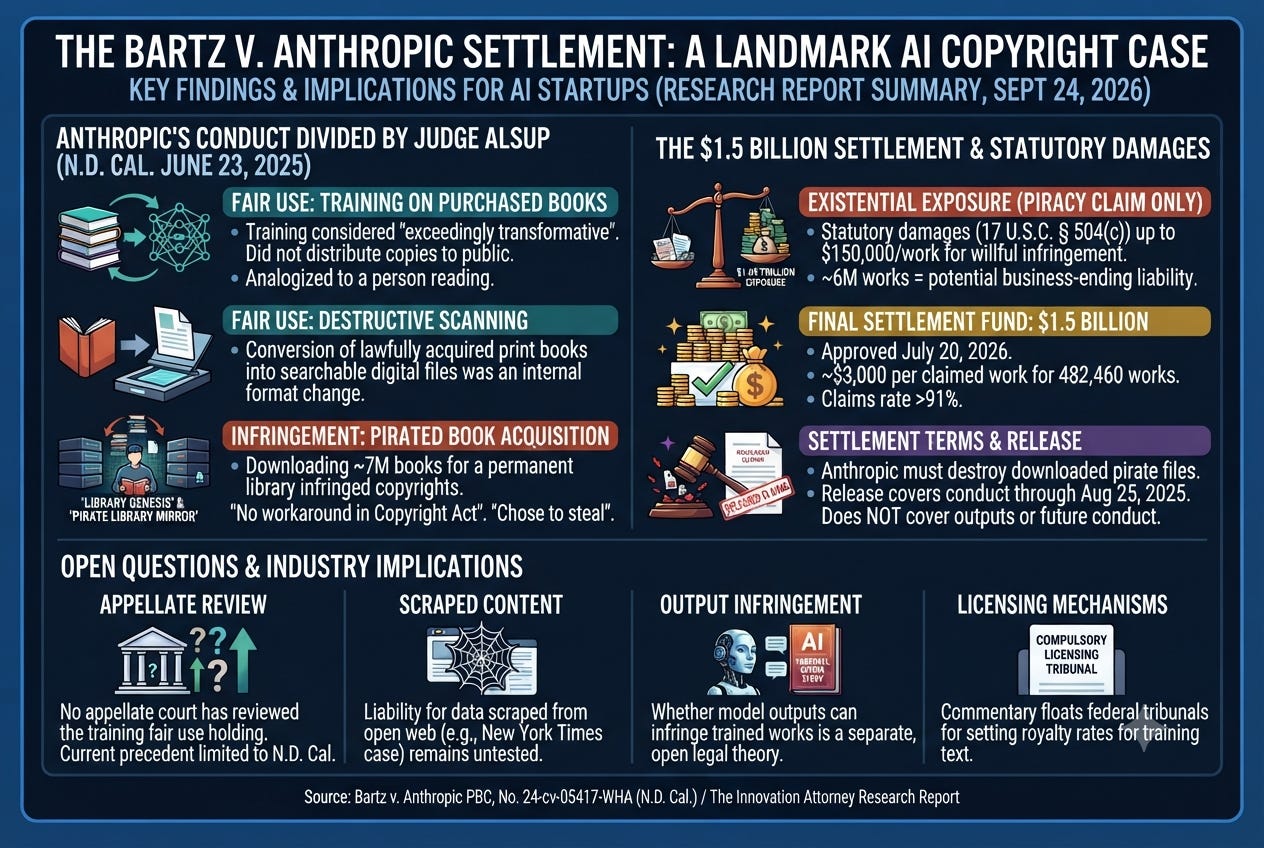
What Does The Anthropic $1.5 Billion Settlement Mean
Description
Anthropic agreed to pay $1.5 billion to settle Bartz v. Anthropic PBC, No. 24-cv-05417 (N.D. Cal.), a class action brought by author Andrea Bartz and other writers over the books Anthropic downloaded to train Claude. The federal court granted final approval on July 20, 2026, closing the largest copyright class action settlement in United States history. The fund pays roughly $3,000 for each of 482,460 works on the court certified list. It resolves a single, narrow claim: that Anthropic built a permanent library out of more than seven million books copied from the pirate repositories Library Genesis and the Pirate Library Mirror. It does not resolve whether training a model on copyrighted text is lawful in the first place. That question was already answered, by the same judge, more than a year earlier, and the answer surprised almost nobody who read the order carefully.
Senior United States District Judge William Alsup issued that earlier ruling on June 23, 2025. He split Anthropic’s conduct into three separate acts and judged each one on its own terms. Training Claude on books Anthropic had purchased was, in his words, “exceedingly transformative” fair use under the Copyright Act. Converting those purchased print books into searchable digital files through destructive scanning was fair use as well, an internal format change rather than a new act of distribution. Downloading seven million books from a shadow library to build a permanent internal repository was neither. Alsup wrote that there was “no workaround in the Copyright Act” that let a company skip paying for material it could have bought, and he said Anthropic “chose to steal” the books instead. That third finding is what sent Anthropic toward a $1.5 billion check. The training question had already been resolved in Anthropic’s favor, in the same order, months before the parties reached that number.
The distance between those two outcomes is where the real lesson sits for any startup building a language model. Training on lawfully acquired text carried no price tag in Alsup’s order. Copying text from an unauthorized source carried a price tag measured in the trillions. The Copyright Act’s statutory damages provision, 17 U.S.C. § 504(c), lets a plaintiff seek between $750 and $30,000 per infringed work for ordinary infringement, and up to $150,000 per work if a jury finds the infringement willful. Law professor Ed Lee, writing after Alsup’s order, estimated that a jury verdict finding willful infringement across roughly six million pirated books could have exposed Anthropic to as much as $1.05 trillion. Reporting on the case quoted Lee describing that exposure as carrying “at least the potential for business ending liability.” Anthropic’s revenue at the time ran around $4 billion a year. A damages verdict at even a fraction of the trillion dollar estimate would have ended the company as a going concern.
That trillion dollar estimate is the number that should shape how a founder reads this settlement. It measures the liability Anthropic escaped by settling. The settlement itself priced the piracy claim at roughly four times the statutory minimum for ordinary infringement, and Anthropic could afford to pay it because Anthropic had raised the capital to survive a nine figure loss. A seed stage or Series A company copying training text from a shadow library, a scraped archive of paywalled articles, or any other source it did not have the right to copy is exposed to the same per work statutory range with none of Anthropic’s balance sheet behind it. Statutory damages attach at the moment of unauthorized copying. They do not require the plaintiff to prove the copied work ever appeared in the model’s output, and they multiply by every work in the class, which is precisely the mechanism that turned seven million books into a trillion dollar hypothetical.
The settlement also tells a founder what it did not buy. The release Anthropic obtained covers only c