Episode Details
Back to Episodes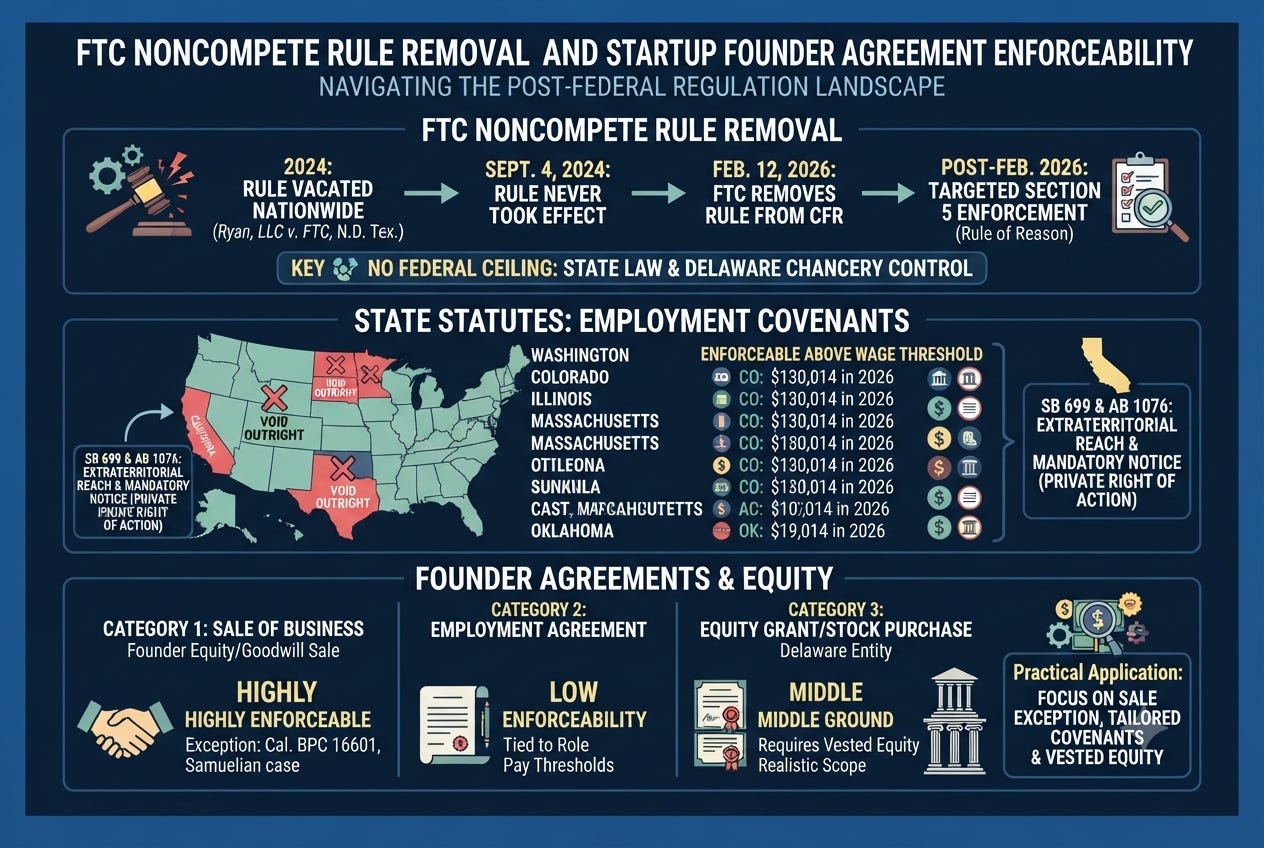
Are Founder Non-Compete Agreements Still Enforceable
Description
The Federal Trade Commission erased its own noncompete rule from 16 CFR Part 910 on February 12, 2026, leaving founder noncompetes to state law and the Delaware Court of Chancery.
A noncompete written into an ordinary employment agreement now lives or dies by the statute of the state where the employee works. A noncompete tied to the sale of a founder’s shares or a company’s goodwill survives in nearly every state, including California, under sale of business exceptions such as Business and Professions Code section 16601. A noncompete written into a Delaware startup’s equity grant faces new scrutiny from the Court of Chancery, which has refused since 2022 to narrow overbroad terms down to something enforceable.
The sequence matters to anyone still drafting from a 2024 template. The Commission adopted a nationwide noncompete ban in 2024, set to take effect that September. The United States District Court for the Northern District of Texas stopped it first, holding in Ryan, LLC v. FTC that the agency lacked statutory authority under Section 6(g) of the FTC Act, and that the rule was arbitrary and capricious besides. A second court, reviewing Properties of the Villages, Inc. v. FTC, reached a similar result on major questions doctrine grounds. The FTC held onto its appeals for a year, then dropped them on September 5, 2025, and formally accepted the vacatur. The Federal Register notice removing 16 CFR Part 910 followed on February 12, 2026. No federal regulation now caps, bans, or defines a noncompete.
That does not mean the FTC walked away from the topic. On September 4, 2025, it filed its first case under the new approach, against Gateway Services, Inc. and Gateway US Holdings, Inc., a pet cremation company that had required nearly 1,800 of its roughly 1,900 employees, most of them hourly workers outside California, to sign twelve month noncompetes as a blanket condition of hire. The Commission built its complaint under Section 5 of the FTC Act around four specific facts: no individualized assessment of role or access to sensitive information, coverage that reached facility level labor rather than executives, a full year of exclusion from an entire industry, and a policy applied without negotiation. A founder or a startup general counsel reading that complaint will notice how little of it describes a typical Series A employment offer, where compensation, title, and the specific competitive concern are documented and individually negotiated by design.
The Commission has said it intends a steady stream of further actions built the same way, defining lawful boundaries case by case instead of through a rule. It has not yet brought one against a venture backed company or a negotiated executive covenant.
With the federal rule gone, the state where an employee actually works decides most of the outcome. California voids an employment based noncompete outright under Business and Professions Code section 16600. Minnesota did the same by statute in 2023. Colorado permits one only above a compensation floor the state raised to $130,014 for 2026, with a separate $78,008.40 floor for a narrower customer nonsolicitation covenant. Illinois sets its own floor at $75,000 and backs it with a statutory penalty of up to $5,000 per violation. Massachusetts requires garden leave pay or other negotiated consideration under its Noncompetition Agreement Act. California added two more layers in 2024: Senate Bill 699 reaches a California based remote employee no matter which state’s law the agreement selects, and Assembly Bill 1076 required employers to notify employees by February 14, 2024, that a noncompete clause is void, backed by a private right of action for damages and attorney fees.
Founder agreements deserve their own look, because the same person can be bound by a noncompete in three separate documents that draw on three separate legal theories. An offer letter noncompete rests on employment law and gets t