Episode Details
Back to Episodes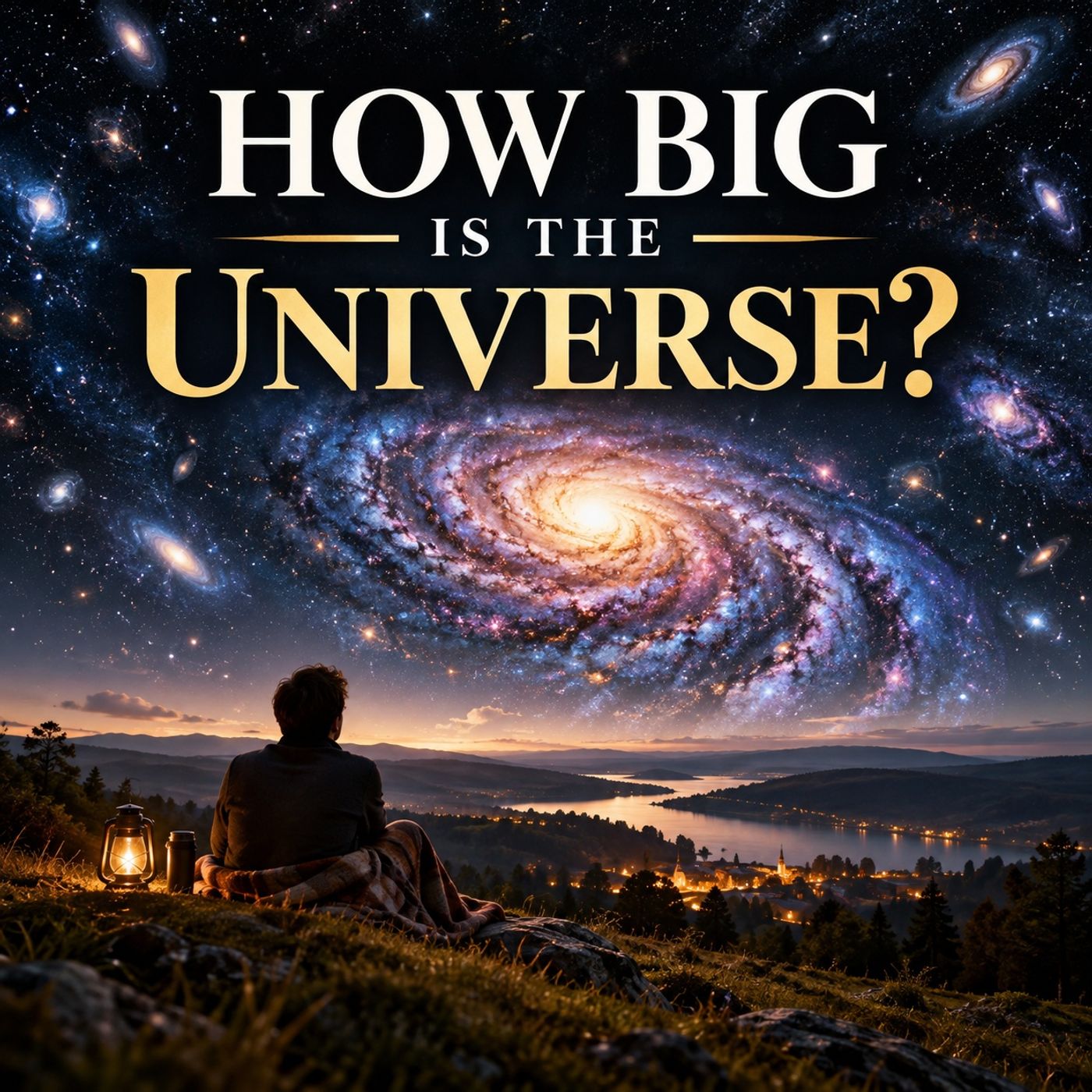
How Big Is the Universe? A Journey Through Space for Sleep
Published 3 weeks, 2 days ago
Description
How do you measure a universe you can never travel across?
Settle beneath the stars for a calm, carefully researched journey through the history of how humans learned to measure the cosmos — from the size of the Earth to the farthest light we can observe.
Tonight, we begin on an imagined autumn hill beneath the stars, with a blanket, a flask of tea and the warm lights of a village below. From there, we begin to build a ruler long enough to measure the universe.
We start close to home with Eratosthenes and his estimate of the size of the Earth. Then we follow Ole Rømer and the discovery that light takes time to travel, before visiting the eighteenth-century observations of the transit of Venus that helped astronomers establish the scale of the Solar System.
As the distances grow, we meet Friedrich Bessel and the first reliable measurement of stellar parallax, Henrietta Swan Leavitt and the variable stars that became crucial cosmic yardsticks, and the astronomers whose observations transformed Andromeda from a mysterious nebula into evidence of a universe filled with galaxies.
Along the way, we encounter Edwin Hubble, Vesto Slipher, Georges Lemaître, Milton Humason and others whose work helped reveal an expanding universe. We travel through the Milky Way, neighbouring galaxies and the cosmic web before reaching the oldest electromagnetic light we can observe: the cosmic microwave background.
Eventually, we arrive at one of cosmology’s strangest facts. The universe is about 13.8 billion years old, yet the observable universe today is more than 90 billion light-years across. The explanation lies in the expansion of space itself.
This journey also explores Voyager 1, the observable horizon, why looking farther into space means looking farther into the past, what science can and cannot tell us about what lies beyond the observable universe, and why enormous cosmic scales can produce the psychological experience of awe.
The hillside and framing story are imagined. The history and science are real. Where the evidence is uncertain, that uncertainty is preserved rather than turned into fact.
This podcast edition contains around 67 minutes of calm narration. There is nothing you need to memorise and nowhere you need to get to. Simply settle in, follow the journey for as long as you like, and let the universe continue without you when sleep arrives.
Sleep Stories from the Pioneers is a series of calm, research-led journeys through psychology, philosophy, history, mythology and science — exploring the people, ideas and discoveries that changed how we understand ourselves and the world around us.
🌙 Prefer the full 10-hour sleep version with extended ambient music?
Watch How Big Is the Universe? on YouTube:
https://www.youtube.com/watch?v=4x8SRGBK12c
🌙 Watch the full Sleep Stories from the Pioneers playlist:
https://www.youtube.com/playlist?list=PLRypv-XVJDZk
🌌 Browse every Sleep Story from the Pioneers:
https://pioneersofhumanbehaviour.com/sleep-stories/
📖 Start with ten thinkers, free — The Gateway:
https://pioneersofhumanbehaviour.com/free-guide/
☕ Support Sleep Stories from the Pioneers:
https://ko-fi.com/pioneersofhumanbehaviour
🌐 Explore Pioneers of Human Behaviour:
https://pioneersofhumanbehaviour.com/
Sleep well. 🌙
Stories to fall asleep to. Ideas worth waking up with.
Settle beneath the stars for a calm, carefully researched journey through the history of how humans learned to measure the cosmos — from the size of the Earth to the farthest light we can observe.
Tonight, we begin on an imagined autumn hill beneath the stars, with a blanket, a flask of tea and the warm lights of a village below. From there, we begin to build a ruler long enough to measure the universe.
We start close to home with Eratosthenes and his estimate of the size of the Earth. Then we follow Ole Rømer and the discovery that light takes time to travel, before visiting the eighteenth-century observations of the transit of Venus that helped astronomers establish the scale of the Solar System.
As the distances grow, we meet Friedrich Bessel and the first reliable measurement of stellar parallax, Henrietta Swan Leavitt and the variable stars that became crucial cosmic yardsticks, and the astronomers whose observations transformed Andromeda from a mysterious nebula into evidence of a universe filled with galaxies.
Along the way, we encounter Edwin Hubble, Vesto Slipher, Georges Lemaître, Milton Humason and others whose work helped reveal an expanding universe. We travel through the Milky Way, neighbouring galaxies and the cosmic web before reaching the oldest electromagnetic light we can observe: the cosmic microwave background.
Eventually, we arrive at one of cosmology’s strangest facts. The universe is about 13.8 billion years old, yet the observable universe today is more than 90 billion light-years across. The explanation lies in the expansion of space itself.
This journey also explores Voyager 1, the observable horizon, why looking farther into space means looking farther into the past, what science can and cannot tell us about what lies beyond the observable universe, and why enormous cosmic scales can produce the psychological experience of awe.
The hillside and framing story are imagined. The history and science are real. Where the evidence is uncertain, that uncertainty is preserved rather than turned into fact.
This podcast edition contains around 67 minutes of calm narration. There is nothing you need to memorise and nowhere you need to get to. Simply settle in, follow the journey for as long as you like, and let the universe continue without you when sleep arrives.
Sleep Stories from the Pioneers is a series of calm, research-led journeys through psychology, philosophy, history, mythology and science — exploring the people, ideas and discoveries that changed how we understand ourselves and the world around us.
🌙 Prefer the full 10-hour sleep version with extended ambient music?
Watch How Big Is the Universe? on YouTube:
https://www.youtube.com/watch?v=4x8SRGBK12c
🌙 Watch the full Sleep Stories from the Pioneers playlist:
https://www.youtube.com/playlist?list=PLRypv-XVJDZk
🌌 Browse every Sleep Story from the Pioneers:
https://pioneersofhumanbehaviour.com/sleep-stories/
📖 Start with ten thinkers, free — The Gateway:
https://pioneersofhumanbehaviour.com/free-guide/
☕ Support Sleep Stories from the Pioneers:
https://ko-fi.com/pioneersofhumanbehaviour
🌐 Explore Pioneers of Human Behaviour:
https://pioneersofhumanbehaviour.com/
Sleep well. 🌙
Stories to fall asleep to. Ideas worth waking up with.