Episode Details
Back to Episodes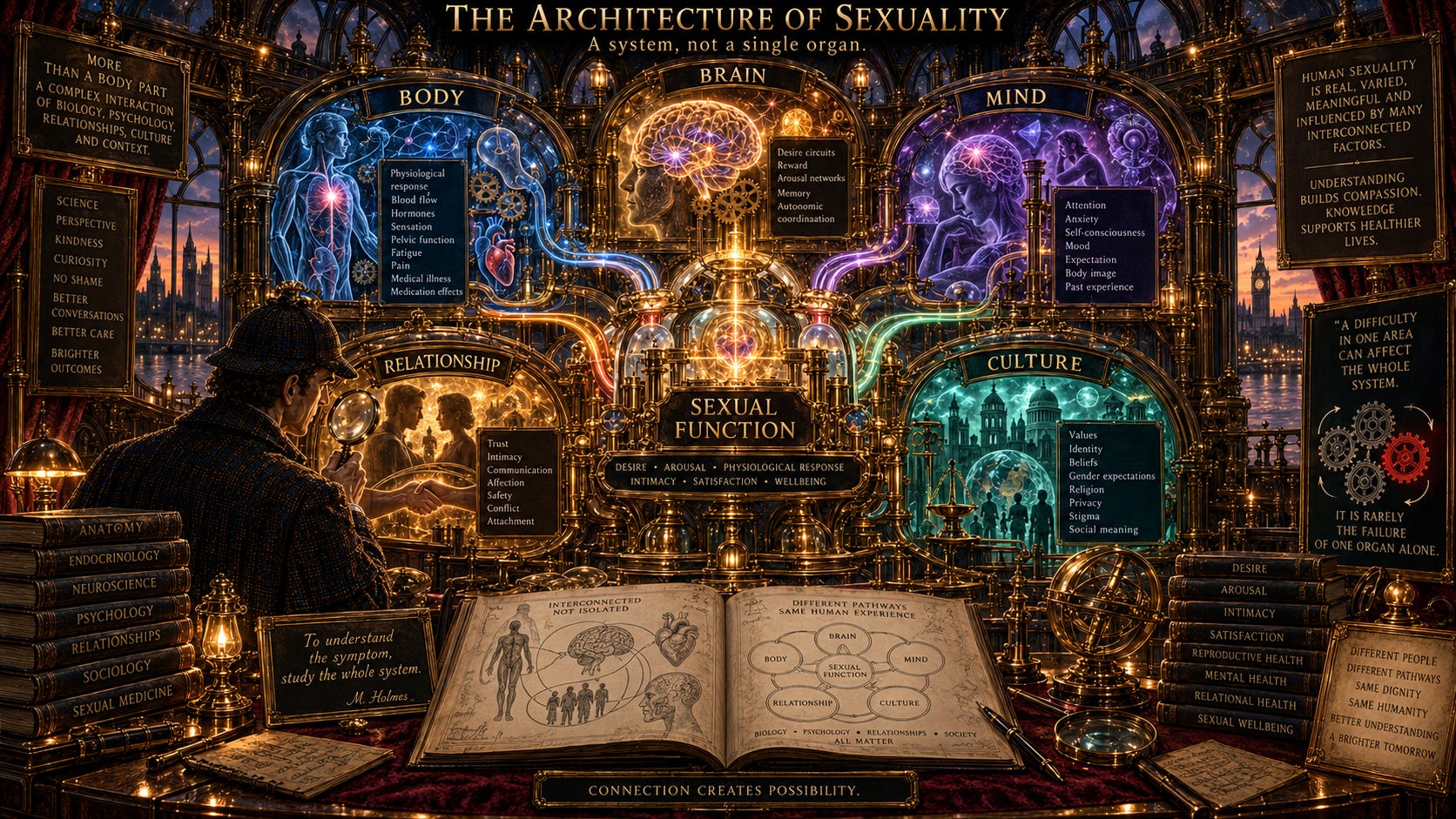
PSYCH 130: Normal Human Sexuality and Sexual Dysfunctions
Description
Medlock Holmes enters an immense Neo-Victorian institution called The Grand Observatory of Human Sexuality.
It is part anatomy theatre, part neuroscience laboratory, part relationship clinic and part cultural museum.
At its centre stands an enormous brass instrument labelled:
SEXUAL FUNCTION
Seven interlocking systems surround it:
BODY • BRAIN • HORMONES • DESIRE • RELATIONSHIP • LEARNING • CULTURE
Holmes immediately sees the central lesson:
sexual function cannot be understood by examining any one of these systems alone.
Human sexuality contributes to identity, self-esteem, intimacy and well-being. It is also extraordinarily diverse. What is considered normal varies across cultures, historical periods and individual lives. A particular fantasy, behaviour or preference is not itself evidence of pathology. Clinical significance depends much more on distress, impairment, coercion, loss of control, medical consequences and the individual’s broader context.
Holmes first enters the Physiology Chamber.
Parasympathetic pathways help generate penile erection, clitoral engorgement and vaginal lubrication. Nitric oxide relaxes cavernosal smooth muscle and facilitates penile blood flow. Sympathetic mechanisms play a major role in ejaculation. Spinal reflexes, brainstem inhibition, limbic emotional systems and cortical processing all contribute.
Neurochemistry further modifies the system. Dopamine generally facilitates sexual motivation, while serotonin can inhibit aspects of sexual response. Testosterone contributes to libido in both sexes, while prolactin, cortisol and several medications can suppress sexual functioning.
Yet physiology alone is insufficient.
In the next gallery, Holmes watches desire, arousal, orgasm and resolution unfold.
The traditional sexual response model describes progression from desire through excitement and orgasm to resolution. But the chapter emphasises that sexual response is not always linear, especially in women. Desire may precede arousal, occur alongside it or emerge after arousal has already begun. Subjective arousal and genital physiological responses may also diverge.
This becomes clinically important.
The question is not simply:
“Did the body respond?”
but:
“Did the person experience desire, pleasure, arousal and satisfaction?”
Holmes then enters the Life-Course Gallery.
Sexuality changes from childhood curiosity and adolescent experimentation to adult intimacy, middle-age adaptation and sexuality in later life.
Ageing modifies physiology but does not abolish sexuality.
Older men may require more stimulation, experience less rigid erections and have longer refractory periods.
Postmenopausal women may experience reduced lubrication and vaginal atrophy.
Medical illness and medications become increasingly important.
But the presence of an interested partner, previous sexual activity and overall health strongly influence whether sexuality continues.
The next corridor contains the disorders.
Male hypoactive sexual desire disorder.
Female sexual interest/arousal disorder.
Erectile disorder.
Female orgasmic disorder.
Delayed ejaculation.
Early ejaculation.
Genitopelvic pain/penetration disorder.
Substance- or medication-induced sexual dysfunction.
Holmes notices a recurring diagnostic pattern.
Most require not merely a symptom, but:
PERSISTENCE + CLINICALLY SIGNIFICANT DISTRESS + EXCLUSION OF BETTER EXPLANATIONS.
Many are further described as:
lifelong or acquired
and
generalised or situational.
This classification itself provides diagnostic clues.
Listen Now
Love PodBriefly?
If you like Podbriefly.com, please consider donating to support the ongoing development.
Support Us