Episode Details
Back to Episodes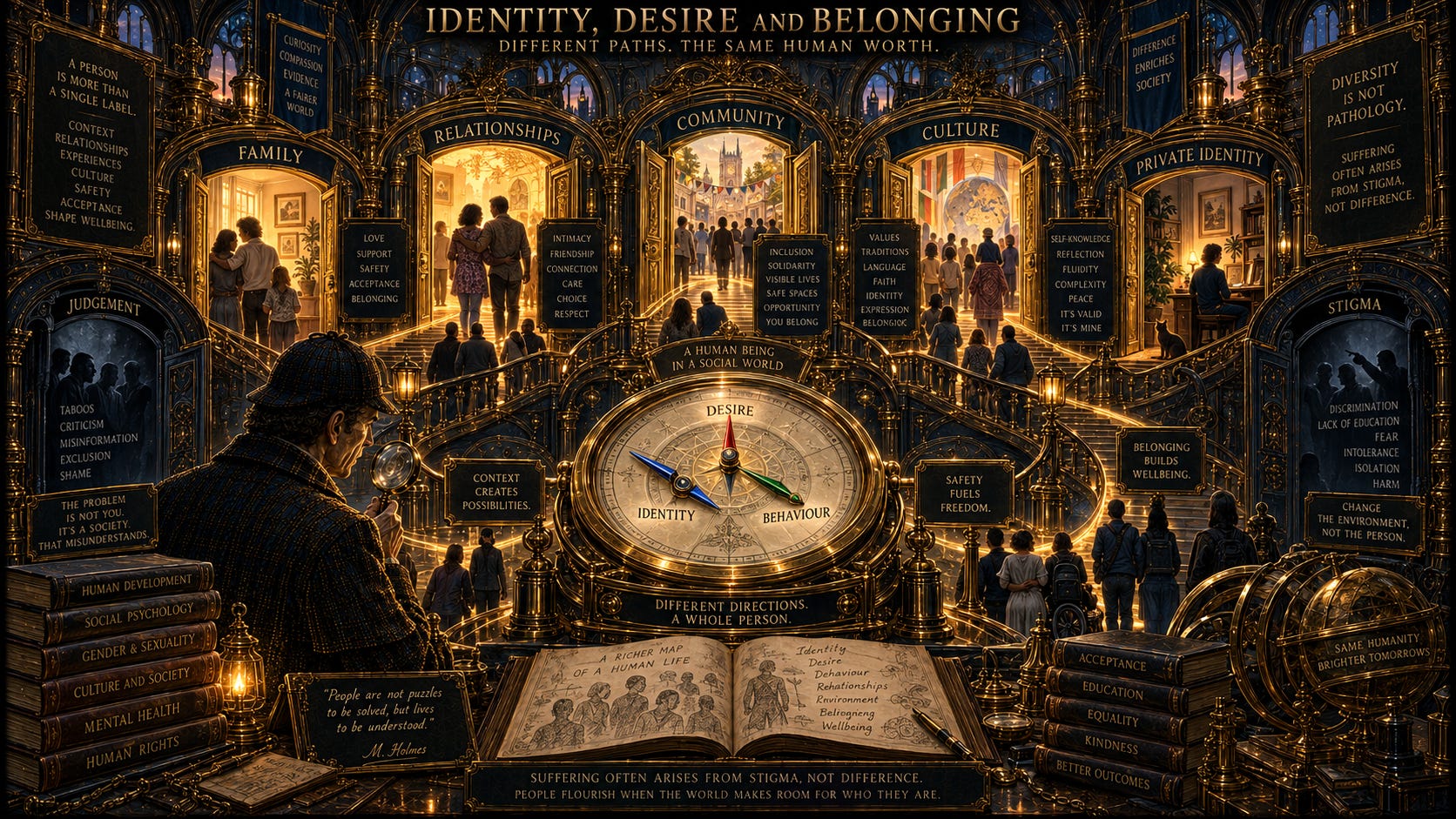
PSYCH 131: Homosexuality, Gay and Lesbian Identities, and Homosexual Behaviour
Description
Medlock Holmes enters an immense Neo-Victorian institution called The Hall of Sexual Identity and Social Meaning.
At its centre is a large brass compass with three separate needles:
DESIRE • BEHAVIOUR • IDENTITY
Holmes notices immediately that the needles do not always point in the same direction.
A person may experience same-sex attraction without acting on it. Another may have same-sex relationships without identifying as gay or bisexual. Another may identify strongly with an LGB community. Still another may acknowledge their orientation privately while presenting publicly as heterosexual.
The first lesson is therefore simple:
Sexual orientation is not the same thing as sexual behaviour or sexual identity.
The chapter traces a remarkable transformation in psychiatry. Same-sex attraction was once interpreted through frameworks of sin, degeneration, developmental failure and mental illness. Over time, research in sexology, psychology, cross-cultural studies and population science progressively challenged those assumptions. Homosexuality was removed from the DSM in 1973, later removed from the ICD framework, and is now regarded within mainstream psychiatry as a normal variation of human sexuality.
Holmes enters the Historical Tribunal.
One chamber contains early biological theories. Another contains psychoanalytic explanations. A third displays research from nonpatient populations demonstrating that homosexual individuals could not be distinguished from heterosexual individuals by psychological functioning alone.
The investigation eventually leads to a critical psychiatric principle:
A characteristic is not a disorder simply because society disapproves of it.
A disorder requires clinically meaningful disturbance or impairment attributable to the condition itself.
Holmes then enters the Continuum Gallery, inspired by the Kinsey model.
Sexual attraction is represented not as two sealed boxes labelled heterosexual and homosexual, but as a broad spectrum. Yet Holmes finds another warning on the wall:
A continuum of attraction does not fully describe identity.
Identity is shaped by culture, language, family, community and personal meaning.
The chapter then opens into the House of Coming Out.
Some rooms are fully illuminated.
Some remain hidden.
Some doors open only to friends.
Others to family.
Others never open at all.
Coming out is not one event. It involves both recognition within oneself and disclosure to others, and may happen differently across work, family, religious and social settings.
Holmes studies another map, corresponding to the identity diagram on page 51. It shows how individuals with the same underlying homosexual orientation may be:
* closeted
* homosexually self-aware
* gay, lesbian or bisexual identified
* nongay identified.
The orientation may remain relatively stable while the identity attached to it changes.
This becomes clinically important.
The psychiatrist’s task is not to decide what label the patient “really is”.
It is to understand:
How does this person experience their attractions?
What meaning do they give them?
What risks or benefits are associated with disclosure?
What conflicts exist with family, religion or culture?
The next chamber is labelled:
MINORITY STRESS
Here Holmes sees the real source of much of the excess psychiatric burden associated with sexual minority status.
Not homosexuality itself.
But:
* stigma
* discrimination
* rejection
* concealment
* h