Episode Details
Back to Episodes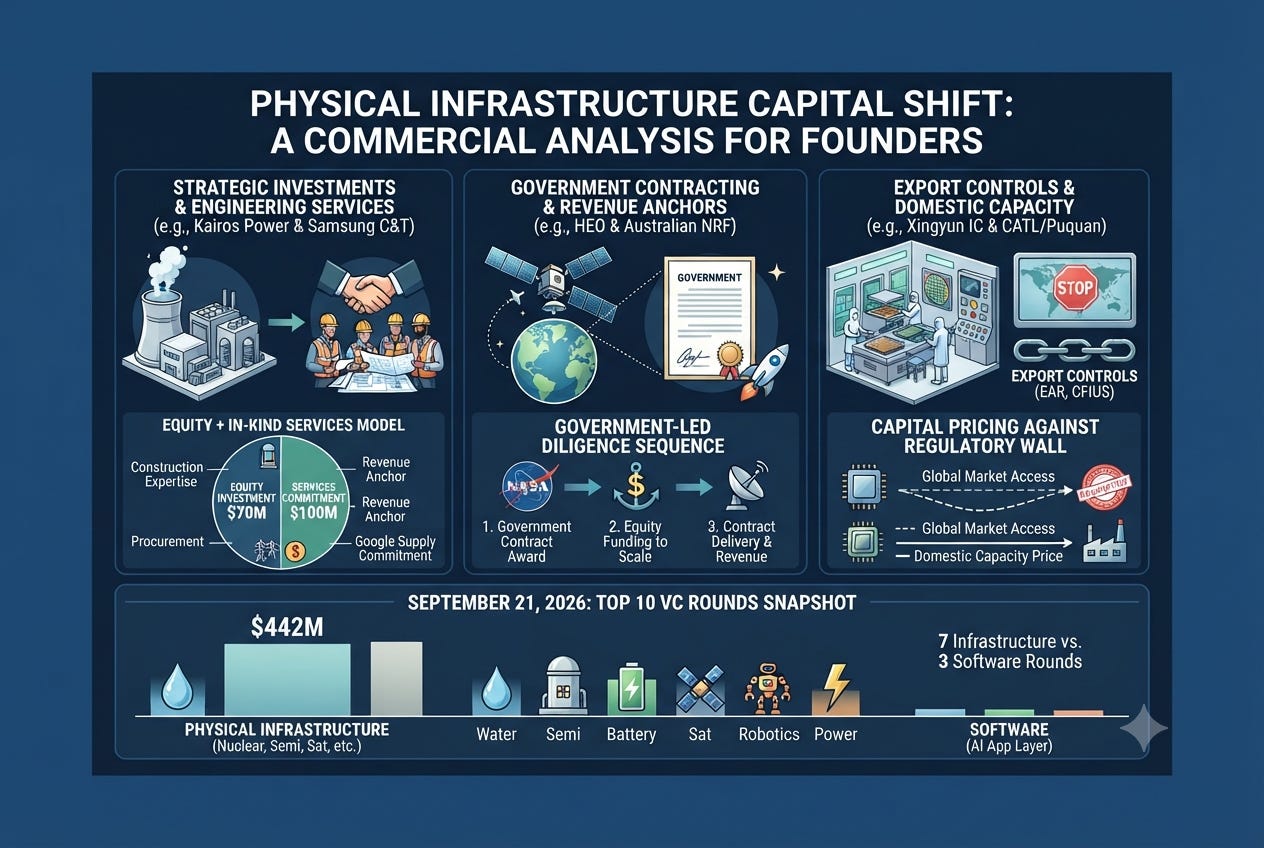
Physical Infrastructure Took Seven of Ten Largest Venture Rounds
Description
As of the week of September 21, 2026, seven of the ten largest venture rounds funded physical infrastructure such as Rainmaker and Kairos Power, not AI application software. Samsung C&T did not simply write Kairos Power an equity check: it put in $70 million in cash and separately committed up to $100 million in engineering services, drawing on a company that has built or helped build about a dozen nuclear reactors, toward two reactors rising in Oak Ridge, Tennessee. Most software founders will never see a term sheet structured that way, but the instinct behind it, capital paired with an operating capability the founder does not have, is now showing up in the questions generalist investors ask software companies too.
The other six infrastructure rounds tell the same story at different scales. Rainmaker closed $100 million for drone based cloud seeding aimed at water scarce regions competing with data centers for supply. Xingyun Integrated Circuit raised roughly $110 million, backed by CATL linked capital, to build domestic graphics processor capacity in China. Amber Electric closed a $56.2 million Series E, led by Morgan Stanley Investment Management’s 1GT, to expand residential battery automation from Australia into Europe. HEO closed a $25 million Series B for satellite imaging, with government backed capital arriving only after HEO had already secured a contract reported above $100 million. Zhongyi Embodied Intelligence raised roughly $15 million for humanoid robotics hardware, and Jierendi Electronic Technology raised roughly $13.8 million for power electronics manufacturing.
Only three rounds funded pure software, and none of the three looked like a chat interface bolted onto someone else’s model. Corridor raised $25 million from Bain Capital Ventures to build a licensed health benefits brokerage for small businesses. Kheops raised roughly $15 million to move French grocery retailers from manual assortment planning to a data driven purchasing workflow. Sprive raised $10 million for a mortgage overpayment application embedded in a regulated United Kingdom lending relationship. Each of the three owns a narrow, licensed, or contractual workflow a foundation model vendor cannot replicate by shipping a new feature.
That distinction is the whole commercial lesson for a founder closing a software only round this quarter. Artificial intelligence companies captured approximately 86 percent of the $412.7 billion deployed in United States venture capital during the first half of 2026, roughly $355.9 billion, a figure published on July 9, 2026, that sounds like software is thriving even though most of that total sat with two frontier model labs instead of spreading across application companies. The dollars chasing a general purpose interface are shrinking even as the dollars chasing artificial intelligence broadly are near a record.
Jasper is the completed example every investor in the room has already read. Jasper’s internal valuation fell from $1.5 billion in October 2022 to roughly $1.2 billion by 2024, a $300 million markdown, after OpenAI shipped ChatGPT in November 2022 and erased the writing assistant’s differentiation. Jasper’s revenue fell from about $120 million in 2023 to about $55 million in 2024 as the feature it sold became a checkbox inside the model itself. Google vice president Darren Mowry said in February 2026 that wrapping thin intellectual property around a foundation model exposes a company to margin compression and commoditization, and the arithmetic behind that warning is specific: a wrapper business pays token costs on every query, which compresses gross margin to roughly 40 percent, against 70 to 80 percent for software that does not carry that per query cost.
In three decades of reviewing venture financings for companies moving technology out of a laboratory and into a paying customer’s hands, the clause that stops a negotiation is rarely the valuation line. It is the