Episode Details
Back to Episodes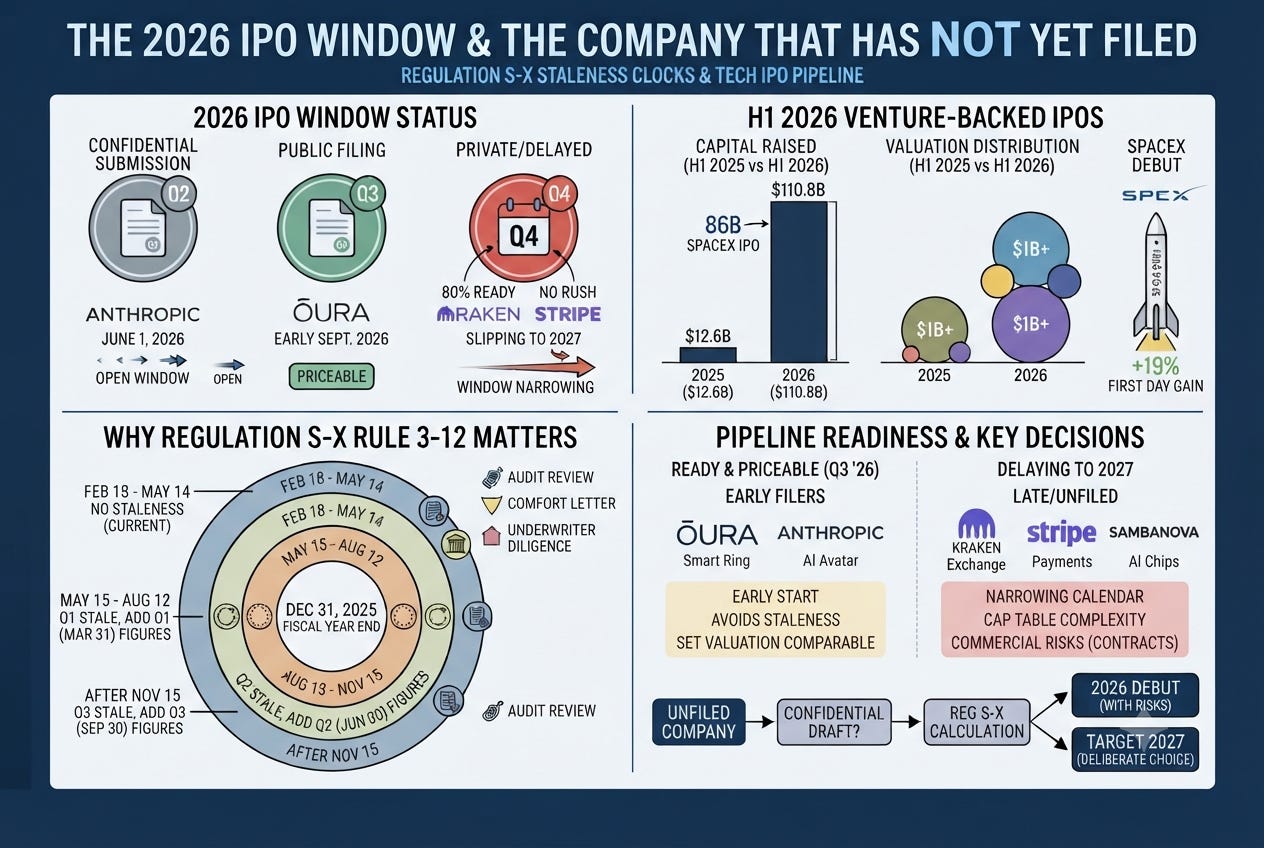
Anthropic’s June Filing Shows the 2026 IPO Window Is Closing
Description
A venture backed company that still has no confidential registration statement on file with the Securities and Exchange Commission is running out of runway to reach the public market before 2027, not because investors have lost their appetite for growth stories, but because the accounting calendar that governs Regulation S-X Rule 3-12 no longer leaves enough days between now and December to complete underwriting on financials that will still be current at pricing.
Founders preparing for an initial public offering spend months on investor narrative, roadshow logistics, and valuation comparables, and comparatively little time on a mechanical accounting deadline buried in Regulation S-X Rule 3-12: the rule that governs how old a set of audited financial statements is allowed to be on the day a registration statement goes effective. That rule, not the mood of the public market, is what actually decides whether a company that has not yet filed confidentially can still complete a 2026 debut.
Under the rule, a calendar year filer generally has one hundred thirty four days after its most recent fiscal year end before it must swap in a fresh set of interim financial statements reviewed or audited to a later date. A company with a December 31 fiscal year end that has not filed by mid August 2026 must already be presenting financials through June 30, 2026, and a company still working through legal and audit preparation as September closes is looking at financials through September 30, layering another quarter of review, comfort letters, and audit committee sign off onto a timeline that was already tight.
Anthropic ran that clock correctly. The company submitted its confidential draft registration statement to the Securities and Exchange Commission on June 1, 2026, days after closing a $65 billion Series H round that valued the company near $965 billion, and it did so early enough in its fiscal year that it did not have to chase a moving set of interim numbers while lawyers were still negotiating underwriting agreements. Reporting since has the company’s annualized revenue crossing $47 billion, up from roughly $9 billion at the end of 2025, and describes a possible fall debut that could raise up to $100 billion.
SpaceX priced its own initial public offering in June 2026, raised more than $86 billion, and closed its first trading day up nineteen percent at $161 a share on the Nasdaq. Venture backed companies raised $110.8 billion through United States initial public offerings in the first half of 2026, compared with $12.6 billion in the first half of 2025, and those two facts sit next to each other for a reason: one company’s listing built a meaningful share of the year’s entire capital pool.
That aggregate figure looks stronger than the pipeline behind it. By early September 2026, only Oura, the smart ring maker considering a listing above an $11 billion valuation, had a public registration statement that was actually priceable. Kraken’s chief executive has described the cryptocurrency exchange as roughly eighty percent ready for a listing but open to pushing it into 2027, and Stripe’s leadership continues to say the payments company, whose shares have traded in tender offers near a $140 billion valuation, is in no rush to file at all. SambaNova, holding an $11 billion valuation from its own $1 billion Series F, has its chief executive talking about next year, not this one.
For a founder deciding this quarter whether to prepare for a 2026 window or wait for 2027, the choice is not really about whether investors want the stock. The aggregate numbers say they do. The choice is about whether the company can complete Securities and Exchange Commission review, underwriting due diligence, and roadshow logistics before its own staleness clock forces a second, more expensive round of financial statement preparation into 2027 anyway, at which point the company might as well have chosen the 2027 calendar delib