Episode Details
Back to Episodes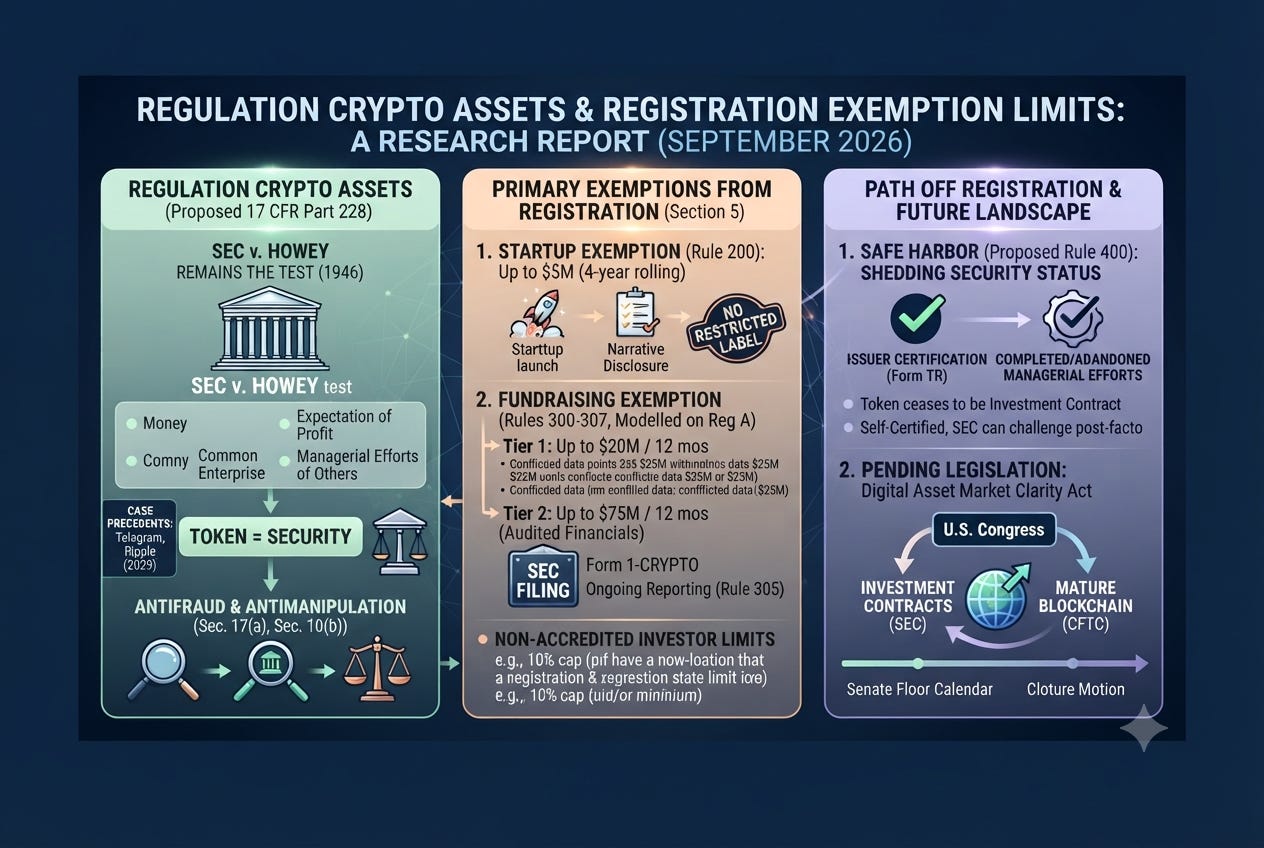
SEC Regulation Crypto Assets Exemptions
Description
A founder with a token launch scheduled for the fourth quarter of 2026 is reading the Securities and Exchange Commission’s Regulation Crypto Assets and hearing the wrong headline. The rule, published in the Federal Register on August 21, 2026, with comments due October 20, 2026, does let that founder sell up to 5 million dollars of tokens without filing a registration statement. It does not let the tokens stop being securities. Those are two different questions, and the gap between them is where a compliant looking raise turns into an enforcement target eighteen months later.
Start with what the proposal actually builds. It adds a new part to the Commission’s rules, 17 CFR Part 228, defining a category called the covered investment contract and then carving two conditional paths around Section 5 of the Securities Act of 1933, the provision that has required registration before any sale of a security since 1933. The Startup Exemption, proposed Rule 200, lets an issuer raise up to 5 million dollars over a rolling four year period with no accredited investor requirement, no restriction on public marketing, and no restricted securities label on the tokens once sold. In exchange, the issuer files a short notice, Form NOR, and keeps a public website disclosure current across ten categories the rule spells out: the contract terms, the offering, management and conflicts, network development plans, source code security, token economics, how holders control protocol decisions, the state of the network’s participants, and risk factors.
For a company that has outgrown 5 million dollars, the companion Fundraising Exemption, modeled on Regulation A, opens two tiers. Tier 1 permits a raise of either 20 million or 25 million dollars per year, a figure that two independent legal analyses of the same release describe differently, which is itself worth flagging before anyone sizes a raise against it. Tier 2 permits up to 75 million dollars per year but requires audited financial statements and ongoing periodic reports on Form 1-CRYPTO, plus a Form TR transition report if the issuer later claims the separate safe harbor discussed below. Both tiers cap purchases by investors who are not accredited at 10 percent of the greater of their income or net worth, the same ceiling Regulation Crowdfunding has used for years.
None of that changes what a token is. The proposal is explicit that a covered investment contract sold under either exemption remains subject to the antifraud provision of Section 17(a) of the Securities Act and to Section 10(b) and Rule 10b-5 of the Securities Exchange Act of 1934. Every one of those ten Rule 103 disclosures a founder posts to a website becomes a statement a plaintiff or the Commission can test for falsity later, the same way a prospectus statement gets tested today. Trading a registration statement for a website disclosure page does not trade away the liability that comes with making public statements about a securities offering.
The only mechanism in the proposal that actually ends security status is proposed Rule 400, a safe harbor under which a covered investment contract stops being an investment contract once the issuer has completed, or permanently abandoned, the managerial efforts it promised purchasers, and files a Form TR certifying that fact. Read that sentence again: the trigger is the issuer’s own certification, not a Commission order, not a no action letter, not a judgment. The Commission has reserved the authority to challenge that certification after the fact, which means an issuer that files a Form TR and keeps distributing tokens on the assumption the safe harbor now applies is making a bet the Commission can still call years later.
This is not a new legal test. It is the same four part test from SEC v. W.J. Howey Co., 328 U.S. 293, decided in 1946: an investment of money, in a common enterprise, with a reasonable expectation of profit from someone else’s managerial ef