Episode Details
Back to Episodes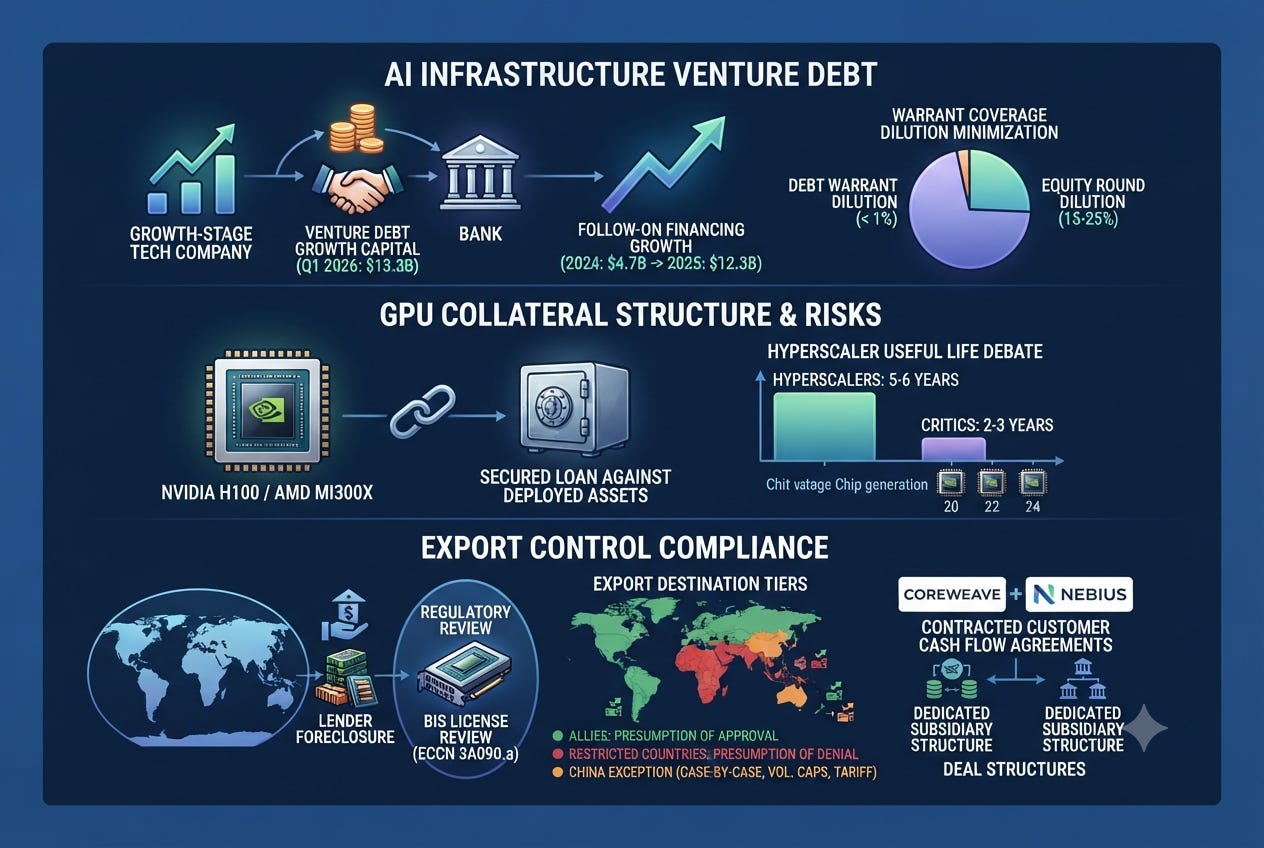
Should an AI Startup Take Venture Debt For a Data Center
Description
Venture debt paid for a real slice of the AI infrastructure buildout this year, and the two biggest 2026 GPU backed facilities both required a signed customer contract before a bank would lend a dollar against the hardware. An AI infrastructure startup should treat venture debt as the instrument that stretches an already funded equity round further, not as the instrument that gets the company to its first contracted customer in the first place.
Here is the mechanic most founders shopping a term sheet for their first data center loan miss entirely: the GPUs sitting in that data center do not become ordinary collateral the moment a bank takes a security interest in them. An Nvidia H100 or H200, an Nvidia B100, B200, or GB200, or an AMD MI300X or MI325X carries an Export Control Classification Number of 3A090.a under the Export Administration Regulations for as long as it exists. That classification does not expire at the original sale. Reselling the chip, trading it in, consigning it, or shipping it across a border at the end of its service life is itself a new export, reexport, or in country transfer, subject to the same licensing review the manufacturer cleared to sell it to the borrower in the first place. A lender that forecloses on a defaulted AI infrastructure loan inherits that compliance obligation along with the hardware, and has to run denied party screening and destination verification before it can move the collateral to a new owner and recover a dollar.
CoreWeave, Inc. closed an $8.5 billion facility on March 31, 2026, the first investment grade rated financing secured by high performance computing infrastructure, priced at the Secured Overnight Financing Rate plus 2.25 percentage points and rated A3 by Moody’s.
Nebius Group N.V. closed a $775 million GPU backed facility on July 17, 2026, priced at the Secured Overnight Financing Rate plus 2.50 percentage points and arranged by a lender group led by MUFG. Structured so that deployed GPU infrastructure and a contracted cash flow agreement with an investment grade customer covered more than the full capital expenditure required to deploy the hardware, the Nebius facility, like CoreWeave’s, lent against a named customer’s contracted payments and hardware that was already generating revenue rather than against a growth story. That tells a founder shopping this market something concrete: a venture debt facility for a data center or chip purchase becomes available once a company has the contract in hand, not before.
The dilution math explains why a founder with that contract in hand reaches for debt at all. A venture debt facility carrying ten percent warrant coverage on an eight million dollar loan grants warrants worth roughly eight hundred thousand dollars of stock, which typically costs a company under one percentage point of ownership on a twenty two million share base. A new preferred stock round commonly costs a founder fifteen to twenty five percent of the company. Space Exploration Technologies Corp. carried its own debt load from $14 billion in 2024 to $23 billion while also raising more than $10 billion in fresh equity during the same period, using debt to stretch its equity dollars rather than to replace them.
The instrument’s cost shows up later, on the balance sheet’s asset side rather than its liability side. Amazon cut its assumed AI server life from six years to five years in 2025, citing the accelerating pace of hardware turnover, while CoreWeave continues to depreciate its own GPU fleet over six years, pointing to rental pricing that still books 2020 vintage chips at full utilization and prices 2022 vintage chips near their original rental rate. Public critics of both assumptions put the real economic life of a leading edge GPU closer to two to three years, once the next chip generation captures the workloads that justified premium pricing on the last one. A loan amortized against a six year asset life outlives a two to