Episode Details
Back to Episodes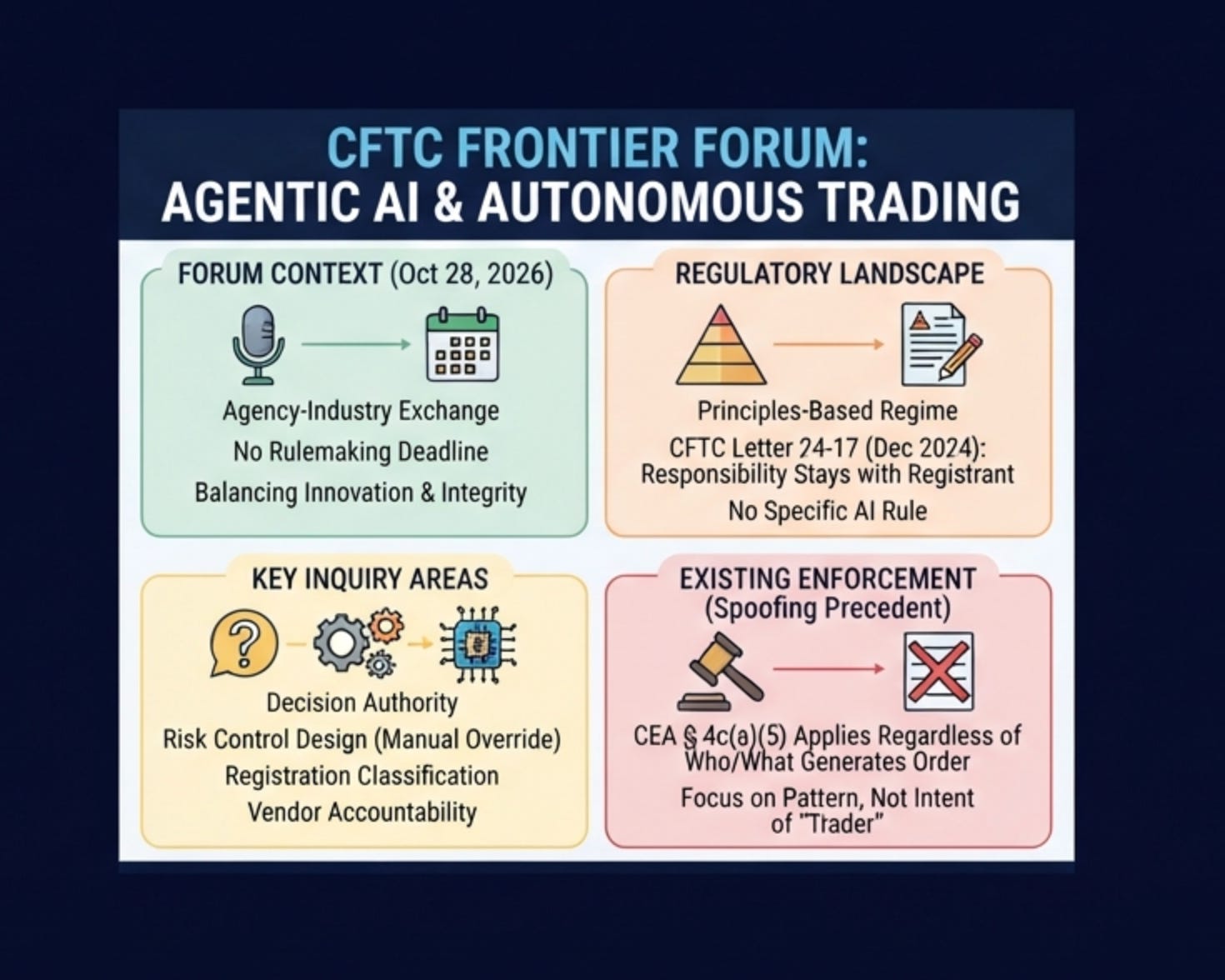
How Should a Fintech Startup Prepare For CFTC AI Trading Rules
Description
On October 28, 2026, the Commodity Futures Trading Commission will question the founders and engineers building agentic AI trading systems at the first session of its new Frontier Forum series. The Commission’s Innovation Task Force announced the roundtable on September 21, 2026, and named artificial intelligence and agentic finance as its opening topic. No proposed rule accompanies the announcement, and that absence is not the same as an absence of stakes. The Commission already told every registrant under its jurisdiction, in a December 2024 staff advisory, that deploying artificial intelligence changes nothing about which rule applies to a firm.
This is the Commission’s first attempt at a structured, recurring public conversation with the people writing the code, and its timing follows a year in which agentic systems moved from chat assistants into autonomous execution across code, customer service, and now trading. Founders building inside that change face old law applied to new machinery: a Commodity Exchange Act written for a human trader, a spoofing rule that does not ask who typed the order, and a Commission that just spent two years telling registrants the technology does not change the answer.
what will the cftc ask about agentic ai trading agents
The Commission will ask how much of a trade an autonomous agent authorizes and executes without a person confirming it, because that question sits at the center of its December 2024 staff advisory, CFTC Letter No. 24-17, which told registrants that handing a task to an automated system does not hand off the underlying legal duty. The four divisions that jointly issued the advisory, after reviewing comments from a January 2024 request for public input, addressed futures commission merchants, swap dealers, commodity pool operators, commodity trading advisors, and introducing brokers by name, and the message to each was the same: the Commodity Exchange Act carries no carve out for artificial intelligence.
Expect the Commission to press on risk control design too. Designated contract markets already operate under a rule requiring controls reasonably designed to prevent, detect, and mitigate market disruptions arising from electronic trading, at 17 C.F.R. § 38.255. That rule was written for conventional algorithms placing and canceling orders at machine speed. An agent that forms its own trading logic in response to live market data poses the same disruption risk the rule was built to catch, and the Commission has every reason to ask whether the rule’s design assumptions still hold when the trader is a model.
does any cftc rule already cover autonomous trading agents
Not directly, and the reason traces back to a fight the Commission already lost once. In 2015 the Commission proposed Regulation Automated Trading, which would have required firms with direct electronic market access to register with the Commission and the National Futures Association and to store their algorithms’ source code where Commission staff could examine it without a subpoena. Opposition to the source code and registration provisions was heavy enough that the Commission withdrew the proposal in 2020 and replaced it with the narrower, principles based electronic trading regime that governs designated contract markets today. That regime never reached the trading firms themselves, and nothing has filled the gap since.
The practical result: a startup operating an autonomous trading agent is not, as of this writing, subject to any CFTC rule written specifically for algorithmic or agentic trading. It is subject to the same registration categories and disclosure obligations that applied before the technology existed, including the commodity trading advisor definition at Section 1a(12) of the Commodity Exchange Act, 7 U.S.C. § 1a(12), a definition written for a human giving advice and never updated for a system that generates its own.
how does the spoofing rule app