Episode Details
Back to Episodes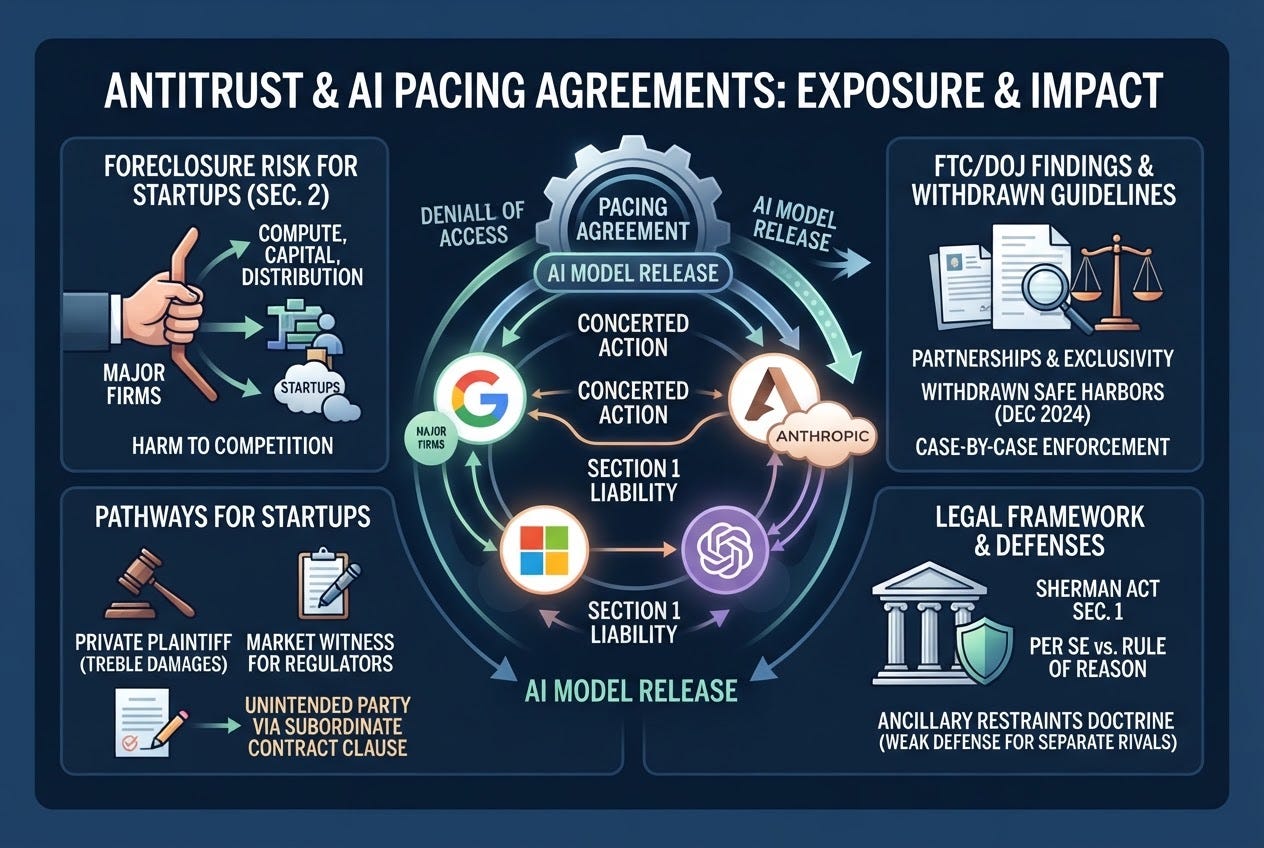
Would an AI Labs Agreement To Slow Model Releases Break Antitrust Law
Description
A federal court dissolved the American Airlines and JetBlue capacity alliance in 2023, a precedent that would likely doom a formal pacing pact among Anthropic, OpenAI, Google, and Microsoft. Sherman Act Section 1, 15 U.S.C. Section 1, condemns concerted restraints among competitors, and a pact that slows the release of frontier models restrains output the same way the airlines’ capacity coordination restrained flights. The four companies already meet inside the Frontier Model Forum, the safety research body they launched in July 2023, but that charter stops at information sharing and never touches release timing. A smaller AI startup that never joined a pacing pact would not face Sherman Act liability for it, since Section 1 reaches only the parties to the restraint, but the startup would face a different problem entirely: foreclosure from the compute and capital the same four companies already control.
Start with why anyone would propose this. Frontier model releases carry real safety stakes, and a coordinated pause has an obvious appeal to executives who would rather not be the company that shipped the capability nobody could contain. The instinct is not new. The Frontier Model Forum exists precisely because these four companies decided that sharing safety research beats racing in silence, and nothing about that decision creates antitrust exposure. Information sharing about evaluation methods and red teaming practices does not restrain any company’s output. A commitment to release models on a synchronized schedule does, and that difference is where the legal analysis actually turns.
United States v. American Airlines Group Inc., decided in the District of Massachusetts on May 19, 2023 and affirmed by the First Circuit in November 2024, is the closest factual match available. American Airlines and JetBlue coordinated flight capacity and scheduling in the Northeast, arguing the alliance let two mid sized carriers compete more effectively against a dominant rival. The court called it a naked restraint of trade and ordered it dissolved within thirty days. The airlines were not accused of fixing prices. They were accused of coordinating output, and that alone was enough. A pacing agreement among AI labs would coordinate a different kind of output, the release of capability rather than flights, but National Collegiate Athletic Association v. Board of Regents of the University of Oklahoma, 468 U.S. 85 (1984), already confirmed that Section 1 reaches output restrictions on their own terms, without requiring proof that any price changed as a result.
Could a safety rationale save the deal. Texaco Inc. v. Dagher, 547 U.S. 1 (2006), upheld a single pricing policy adopted by two oil companies, but only because the two companies had already merged their refining and marketing operations into one integrated joint venture first. The pricing term was ancillary to a real integration of assets, not a side agreement layered onto otherwise independent companies. Four AI labs proposing to pace their releases while remaining separate, arm’s length competitors in every other respect look far more like FTC v. Indiana Federation of Dentists, 476 U.S. 447 (1986), where a group of dentists’ agreement not to compete on one specific dimension of their service was condemned without any independent proof of market power. Pacing restrains one specific dimension too: the speed at which each company brings its next model to market.
None of this reaches the smaller startup that never sat at the table, and that is the detail most commentary on this question gets backward. Sherman Act Section 1 liability attaches to the parties to a restraint, not to the competitors it locks out. What the excluded startup actually faces is a foreclosure problem, and the Federal Trade Commission has already built much of the record for that claim. The agency’s staff report on cloud provider and AI developer partnerships, released January 17, 2025 after