Episode Details
Back to Episodes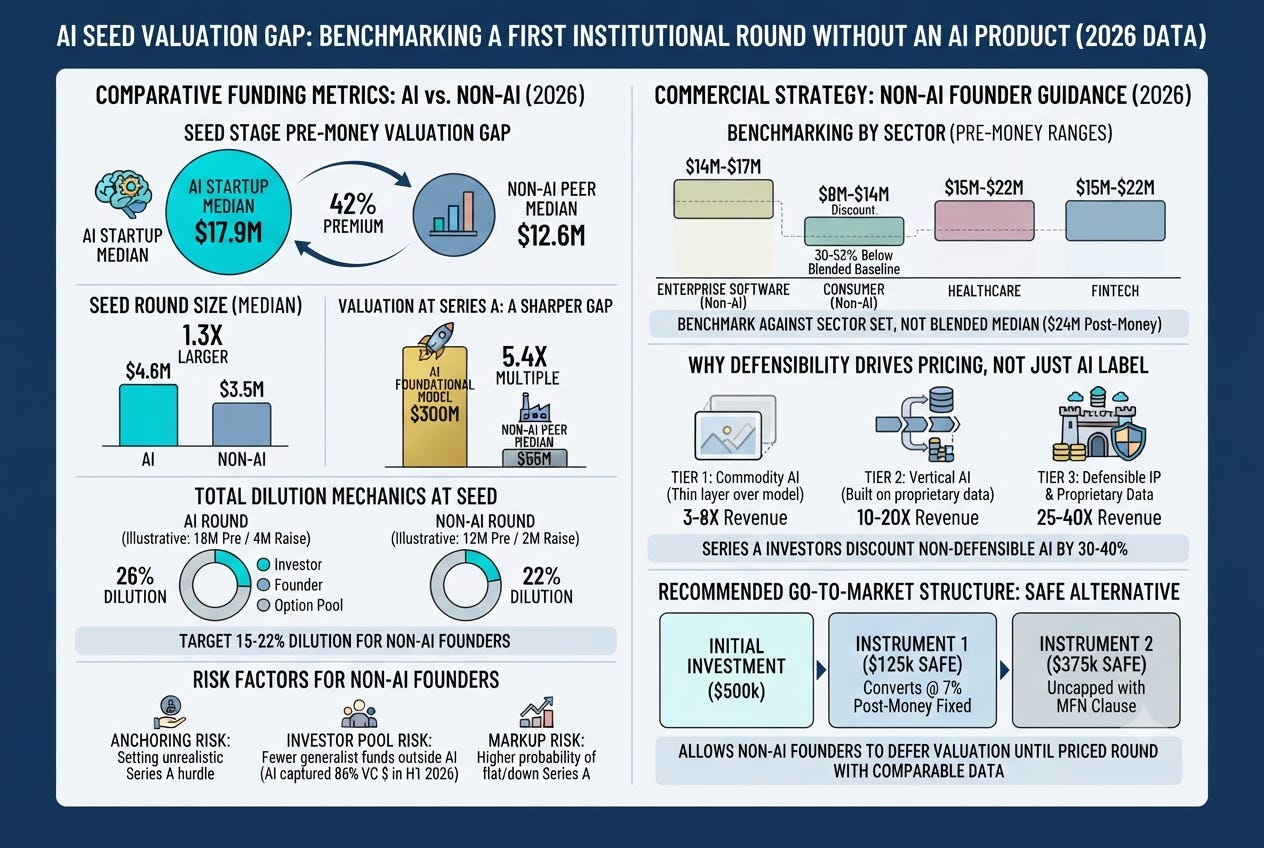
AI Startup Seed Valuation Premium vs Non AI Startups
Description
Seed stage investors in 2026 price artificial intelligence startups at a median premium of roughly 42 percent over non-AI peers, a gap of $17.9 million against $12.6 million in pre-money valuation, and that gap widens to 5.4 times by Series A. A founder without an artificial intelligence focused product who prices a seed round against the blended market headline, rather than against the sector specific comparable set, sets a Series A hurdle the company’s own growth rate cannot clear.
In thirty years of counseling technology companies through early financings, the founders most likely to mistime their own cap table are the ones who anchor a seed ask to a headline number from an entirely different company’s round, rather than to a comparable set anyone in the room can actually verify. That is the mechanic most non-AI founders miss in 2026: the seed market is not one market with one price. It is a market where a small number of artificial intelligence companies are bidding against each other for capital at prices no comparable business, artificial intelligence or not, will ever be asked to justify at a priced round.
The gap is real and it is large. Independent trackers converge on a seed stage premium of roughly 40 to 44 percent for artificial intelligence companies in 2026: a median pre-money valuation near $17.9 million against a non-AI median near $12.6 million, with artificial intelligence rounds also running about 1.3 times larger in dollar terms. The premium does not hold steady. At Series A, an artificial intelligence foundational model company raised at a median $300 million valuation against $55 million for a non-AI company at the same stage, a multiple of roughly 5.4 times rather than the 1.4 times the seed premium alone would predict. In July 2025, Mira Murati’s Thinking Machines Lab closed a $2 billion seed round at a $12 billion valuation, a figure that exists only because a handful of frontier model companies compete against each other for capital, not against the broader seed market a non-AI founder actually competes in.
What the headline number hides is that the premium tracks defensibility, not the artificial intelligence label by itself. Investors now price artificial intelligence exposure in three tiers: a commodity application built as a thin layer over a third party model trades at 3 to 8 times revenue, a vertical application built on proprietary data trades at 10 to 20 times revenue, and a company with defensible intellectual property and proprietary data trades at 25 to 40 times revenue. By Series A, an artificial intelligence company that cannot show defensible data or intellectual property already absorbs a 30 to 40 percent valuation penalty against peers that can, roughly the same size as the seed premium the label commands in the first place. That penalty is the market telling a non-AI founder exactly what it is actually pricing: not a word on a pitch deck, but a defensible technical or data position a company can show and defend in diligence.
The practical benchmarking task starts with sector, because sector is the single largest input into a non-AI seed price and it is the input founders skip past fastest. A non-AI enterprise software company should price against the $14 million to $17 million pre-money band that enterprise software carried in 2026, not against the $24 million post-money figure that artificial intelligence rounds pull the blended market median toward. A consumer company should price against an $8 million to $14 million band, a discount of 30 to 53 percent against the blended baseline that reflects genuine structural headwinds in consumer venture funding, not a defect in the business. A healthcare or fintech company should price against a $15 million to $22 million band regardless of any artificial intelligence exposure, since regulatory complexity and recurring revenue already price close to the top of the non-AI range on their own.
Dilution discipline