Episode Details
Back to Episodes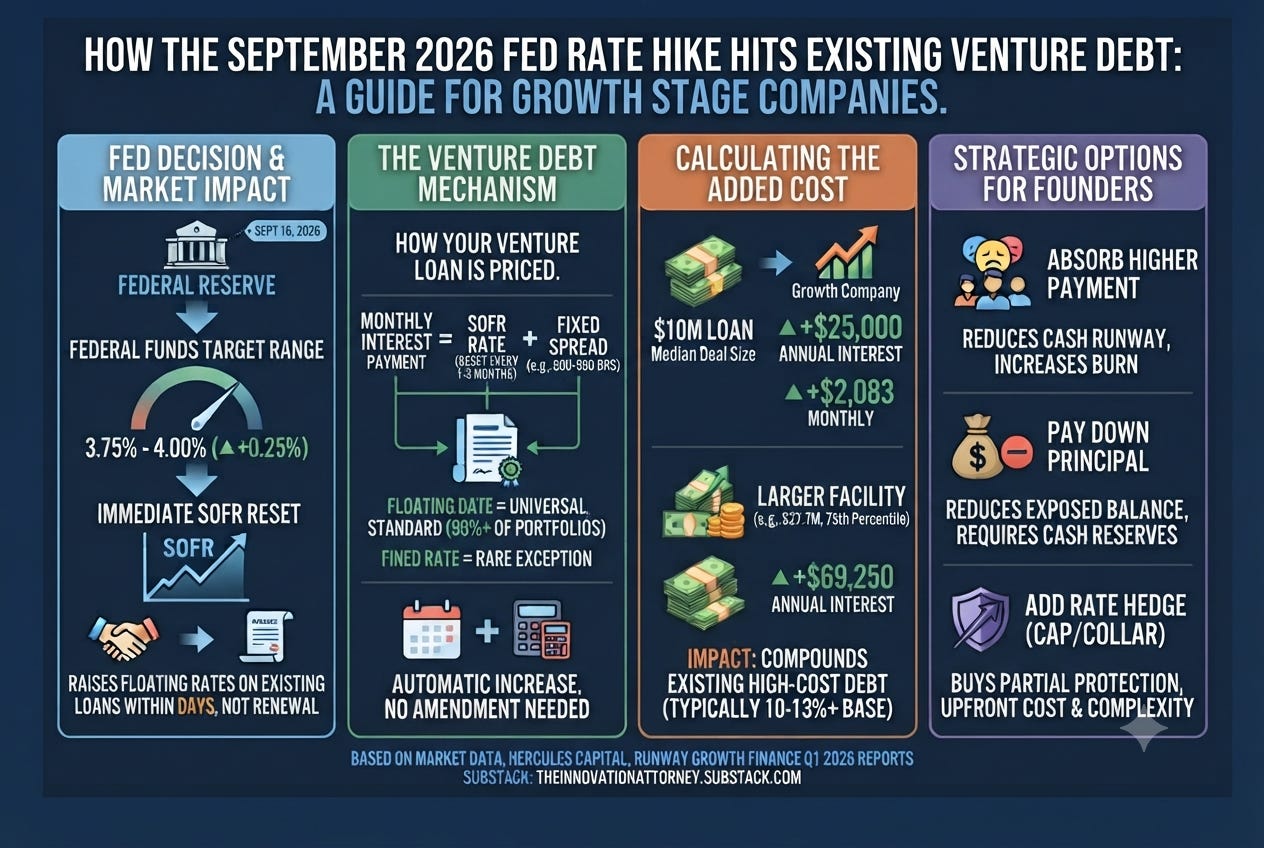
Does The Fed Rate Hike Raise Venture Debt Interest
Description
The Federal Reserve’s September 16, 2026 vote to raise the federal funds target range a quarter point to 3.75 to 4.00 percent already increased the interest bill on most outstanding venture debt in the United States, and it did so without a single lender picking up the phone.
A founder who signed a venture debt term sheet eighteen months ago is used to thinking about interest rate risk the way a homeowner thinks about a thirty year mortgage: locked in at closing, revisited only if the company refinances. That instinct is wrong for venture debt, and it is wrong in a way that costs real money the moment the Federal Open Market Committee moves. The credit agreement did not need to be reopened for the September 16 increase to reach a borrower’s books. It reached them automatically, on the next scheduled interest reset, because the loan was never fixed rate to begin with.
The mechanics are worth walking through once, because most founders sign the credit agreement and never look at the interest calculation again. The Federal Open Market Committee set a target range, not a single rate, and voted 12 to 0 on September 16, 2026 to move that range to 3.75 to 4.00 percent, effective the next day. The Federal Reserve Board’s implementation note raised the rate paid on bank reserves to 3.90 percent, which is the lever that pulls the Secured Overnight Financing Rate, the actual benchmark written into most venture loan documents, up into the new range within a day or two of the vote.
SOFR, not the federal funds rate itself, is the benchmark written into most venture loan documents, and it moved into the Federal Reserve’s new 3.75 to 4.00 percent range within a day of the September 16, 2026 vote.
Run the arithmetic on a real facility and the number stops being abstract. Hercules Capital, the largest publicly traded venture lender, disclosed that 98.0 percent of its debt investment portfolio carried a floating rate with a SOFR or SONIA floor as of March 31, 2026, which is about as close to a universal structure as a lending market gets. A quarter point increase on a 10 million dollar facility adds roughly 25,000 dollars in annual interest, or about 2,083 dollars a month. Runway Growth Finance Corp’s review of the venture debt market put 2025 originations at 68.8 billion dollars, with a median deal size of 5.5 million dollars and a 75th percentile of 27.7 million dollars, so scale the arithmetic up: a company at the 75th percentile is absorbing close to 5,771 additional dollars a month, arriving on whatever invoice cycle its credit agreement happens to run.
Timing is where most founders get the mechanics backward. The increase does not wait for the loan’s maturity date, an amendment, or a refinancing conversation. It lands on the next interest period defined in the credit agreement, commonly monthly, which means the window between the Federal Reserve’s vote and a higher invoice runs closer to 30 to 90 days than to whatever date is printed on the loan’s cover page as the maturity. A company on a mid month reset saw the change on its October statement. A company whose reset falls later in the cycle will see it on November’s.
A venture loan’s interest rate resets on its own scheduled interest period, typically monthly, not on the loan’s maturity date, so a Federal Reserve increase reaches a borrower’s payment within 30 to 90 days.
Refinancing into a fixed rate is the phrase that comes up first in every founder conversation about this problem, and it is also the option that barely exists as a standard offering in growth stage lending. The market guides describing venture debt terms treat SOFR plus a spread as the structure, not a choice among several, and the specialty lenders that write most of these loans have their own reasons to keep it that way. Hercules Capital disclosed that 80.4 percent of its own outstanding borrowings carried fixed interest rates while 98.0 percent of the loans in its portfolio