Episode Details
Back to Episodes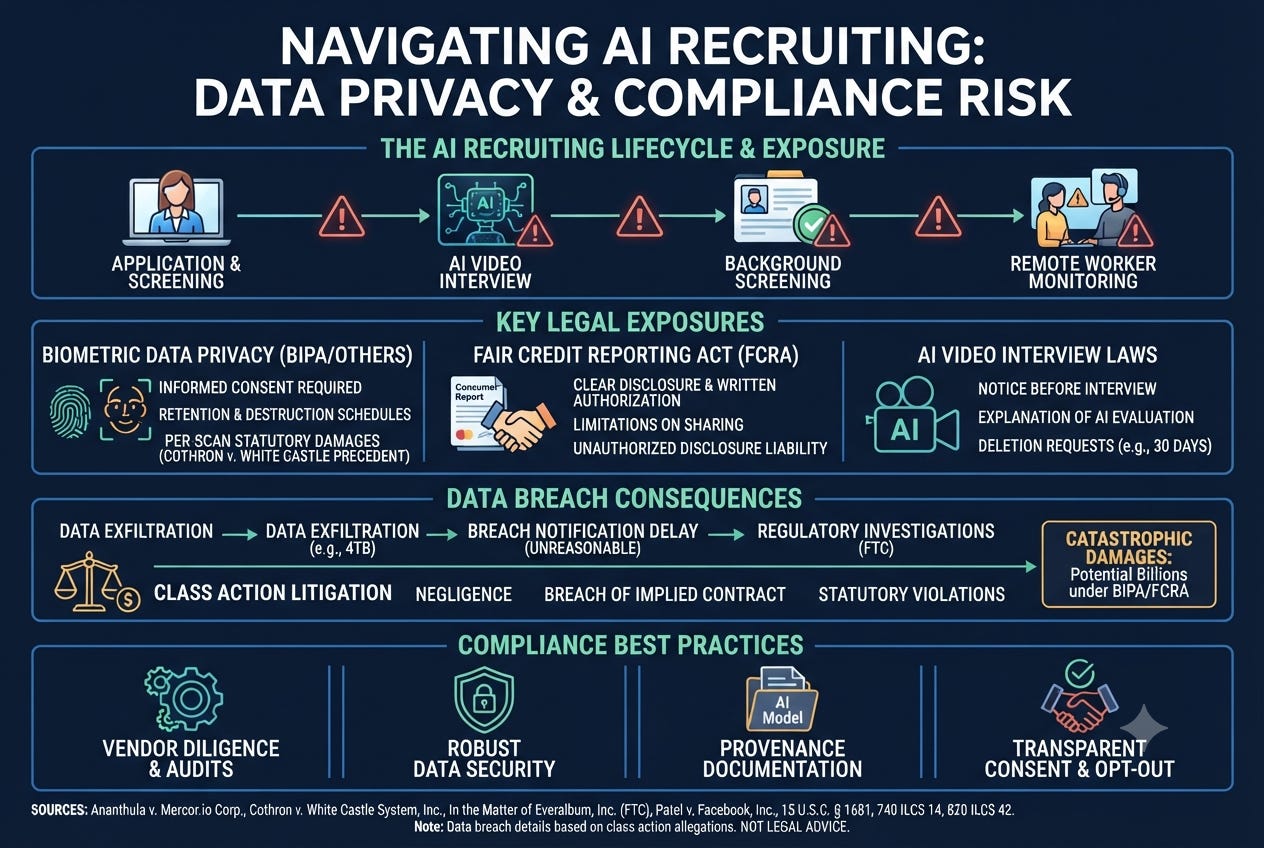
What Happens If My AI Startup Trains Models On Candidate Interview Data
Description
Seven class action complaints filed against Mercor.io Corporation since April 2026, including Ananthula v. Mercor.io Corporation, No. 3:26-cv-03362 in the Northern District of California, allege that the ten billion dollar AI recruiting startup exposed facial biometric data, interview recordings, and Social Security numbers for more than 40,000 contractors after a March 24, 2026 supply chain breach. The complaints reach further than a standard data breach filing. They accuse Mercor of using candidate interview footage to train its own AI models without separate consent for that purpose, a claim that turns a security incident into a question about who owns the value created from a job interview.
I have spent thirty years drafting the data rights provisions in software and AI licensing agreements, and the clause that gets the least attention in a term sheet negotiation is almost always the one that defines what a company may do with data collected for one purpose once that purpose has been served. Mercor’s applicants consented, at most, to being evaluated for a job. What the complaints allege Mercor actually did was something closer to conscription: turning each candidate’s face and voice into training material for a commercial product sold to other companies, including Meta, which paused its relationship with Mercor and opened its own investigation within days of the breach becoming public.
The breach itself began outside Mercor’s own code. Security researchers traced the intrusion to a compromised version of the open source LiteLLM package, distributed after attackers poisoned Aqua Security’s Trivy vulnerability scanner and pushed malicious code to the Python Package Index, an attack that CloudSEK’s investigation found had reached more than 2,500 organizations. A group calling itself TeamPCP claimed the exfiltration of roughly four terabytes of Mercor data, three terabytes of it video and identity verification files. Mercor did not notify affected individuals until June 25, three months after the intrusion. None of that is unusual for a 2026 era breach. What makes Mercor’s exposure distinct is what was inside the four terabytes: not passwords, but faces.
Illinois wrote the statute that turns a face into a liability line item. The Biometric Information Privacy Act requires written, informed consent before any private entity collects a scan of face geometry, and it sets statutory damages of 1,000 dollars for a negligent violation and 5,000 dollars for a reckless or intentional one. For a decade, companies treated that ceiling as manageable, a few thousand dollars times a few thousand plaintiffs. The Illinois Supreme Court ended that assumption in Cothron v. White Castle System, Inc., ruling that a new BIPA claim accrues every time a biometric scan occurs rather than once per person. Applied to White Castle’s employee fingerprint scanners, the ruling put the company’s exposure as high as 17 billion dollars. Applied to Mercor, where an automated system generated a facial profile image from every interview and likely reprocessed footage across multiple evaluation rounds, the per scan theory turns a class of Illinois applicants numbering in the low thousands into a claim that scales with every processing event, not every person.
Illinois did not stop at fingerprints and faces generally. It passed a second statute aimed specifically at what Mercor built: the Artificial Intelligence Video Interview Act, which requires an employer to tell an applicant before the interview that AI will analyze the video, explain in general terms how the evaluation works, and get written consent, and which bars using AI on any applicant who has not consented. Hall Attorneys’ complaint alleges Mercor’s platform automatically generated profile images from applicants’ interview footage and ran that footage through AI evaluation systems, the exact conduct the Video Interview Act was written to require consent for. The statute carri