Episode Details
Back to Episodes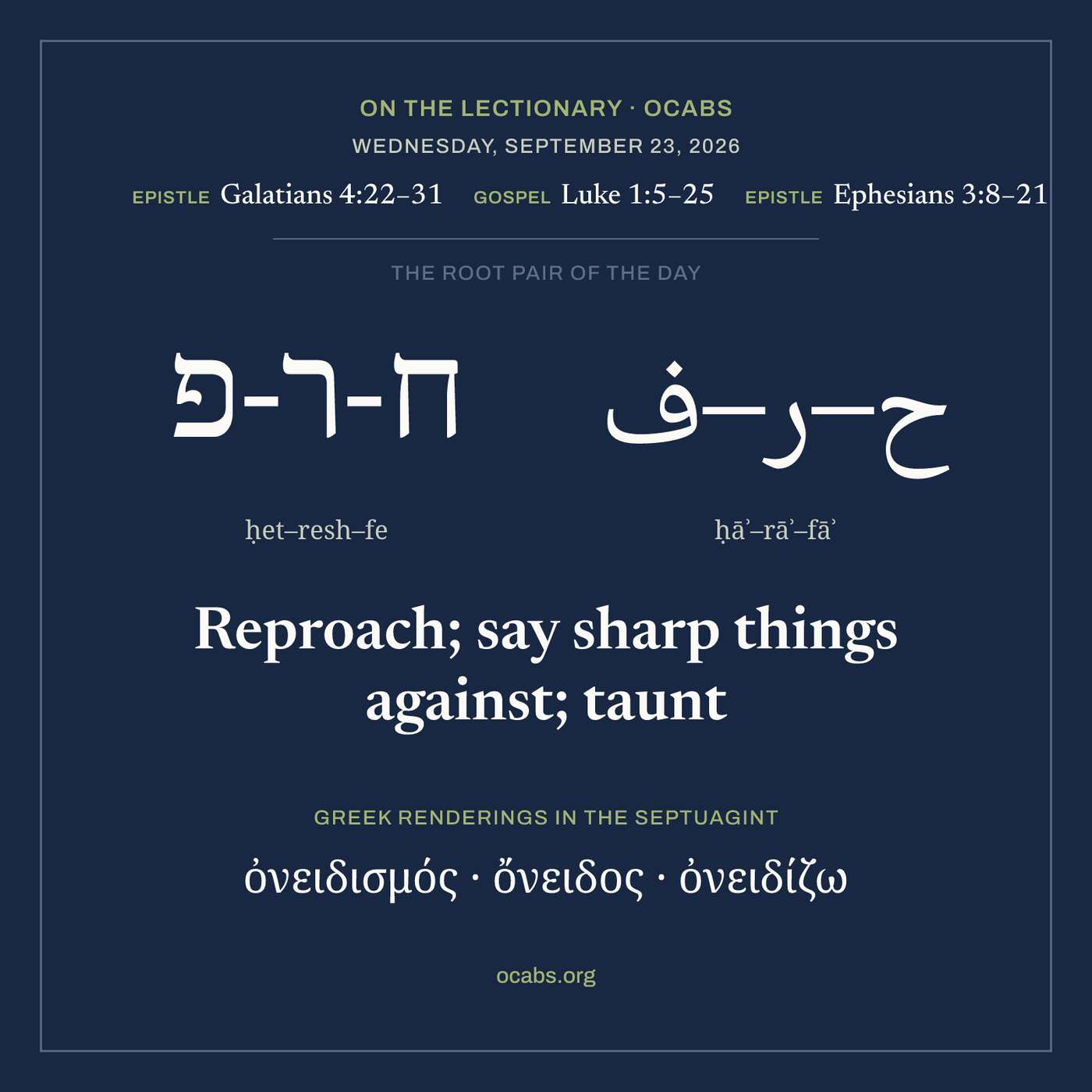
Galatians 4:22-31 · Luke 1:5-25 · Ephesians 3:8-21 · Luke 4:1-15 — Wednesday, September 23, 2026
Description
A daily note from the team at OCABS.ORG, drawing on the published works of Fr. Paul Nadim Tarazi, with citations to his books and lectures.
Readings: Galatians 4:22-31; Luke 1:5-25; Ephesians 3:8-21; Luke 4:1-15.
Fr. Paul observes that in this passage Paul folds two Genesis stories, about Hagar and Sarah, into one statement, and what matters is not the mothers' names but the status of their sons as slave or free [1]. Even so, the deeper weight falls on the next verse's terms, "according to the flesh" and "through promise," language that runs throughout the whole letter, more than on the slave/free vocabulary confined to this passage [7]. Paul is refuting an opponents' claim that the Gentile Galatians, like Ishmael, cannot inherit the promise [4]. By writing "our mother" rather than "your mother" in speaking of the Jerusalem above, he insists that Jewish and Gentile believers alike are children of Sarah [5]. The whole argument is built from Isaiah's word about the barren woman and new Jerusalem, set against Sinai and Hagar [8], and it closes with scripture's own command that the slave and her son be cast out, since there is only one heir [6].
In Ephesians, Paul calls himself the very least of all the saints, given grace to preach the unsearchable riches of Christ and to make known the mystery hidden for ages in God [19]. Fr. Paul explains that through the church this "manifold wisdom of God" reaches the rulers and powers, that is, "the leaders of Rome and those of Jerusalem" [23]. The prayer that Christ dwell in the heart, with believers "rooted and grounded" in love, is no private feeling: Christ resides among us only so far as trust in his teaching is translated into love for others [24]. This same blessing extended to the Gentiles as fellow heirs, already argued from scripture in Galatians, reaches its fuller statement here in Ephesians [22].
The passages available on Luke's account of Zacharias and the angel's announcement address other verses in Luke rather than this scene itself, so nothing further can be drawn from them here [15,16].
The root pair of the day · ח-ר-פ ḥet–resh–fe, חֶרְפָּה ḥerfah · ح–ر–ف ḥāʾ–rāʾ–fāʾ, يُحَرِّفُ yuḥarrifu · reproach; say sharp things against; taunt. Elizabeth's words, "to take away my reproach among men" (Luke 1:25), give the pair ḥerfah and yuḥarrifu its clearest anchor, matched by Greek oneidismos and oneidizo. The same root names Rachel's reproach removed at Joseph's birth (Genesis 30:23) and the reproach Christ bears outside the camp (Hebrews 13:13). Elizabeth's barrenness ends as reproach turns to gladness. cf. The Consolation of Consonants
Sources: Tarazi, Galatians: A Commentary, p. 239; Tarazi, Galatians: A Commentary, p. 240; Tarazi, Galatians: A Commentary, p. 250; Tarazi, Galatians: A Commentary, p. 254; Tarazi, Galatians: A Commentary, p. 241; Tarazi, Galatians: A Commentary, p. 245; Tarazi, I Thessalonians: A Commentary, p. 149; Tarazi, I Thessalonians: A Commentary, p. 181; Tarazi, Philippians: A Commentary, p. 125; Tarazi, Ephesians and 2 Thessalonians: A Commentary, p. 51; Tarazi, Ephesians and 2 Thessalonians: A Commentary, p. 77; Tarazi, Ephesians and 2 Thessalonians: A Commentary, p. 79.
Opening music: Taksim Arbi, Bichi Slama, oud (Tunis, Archives de la Parole, 1930s), public domain. Source: gallica.bnf.fr / BnF.