Episode Details
Back to Episodes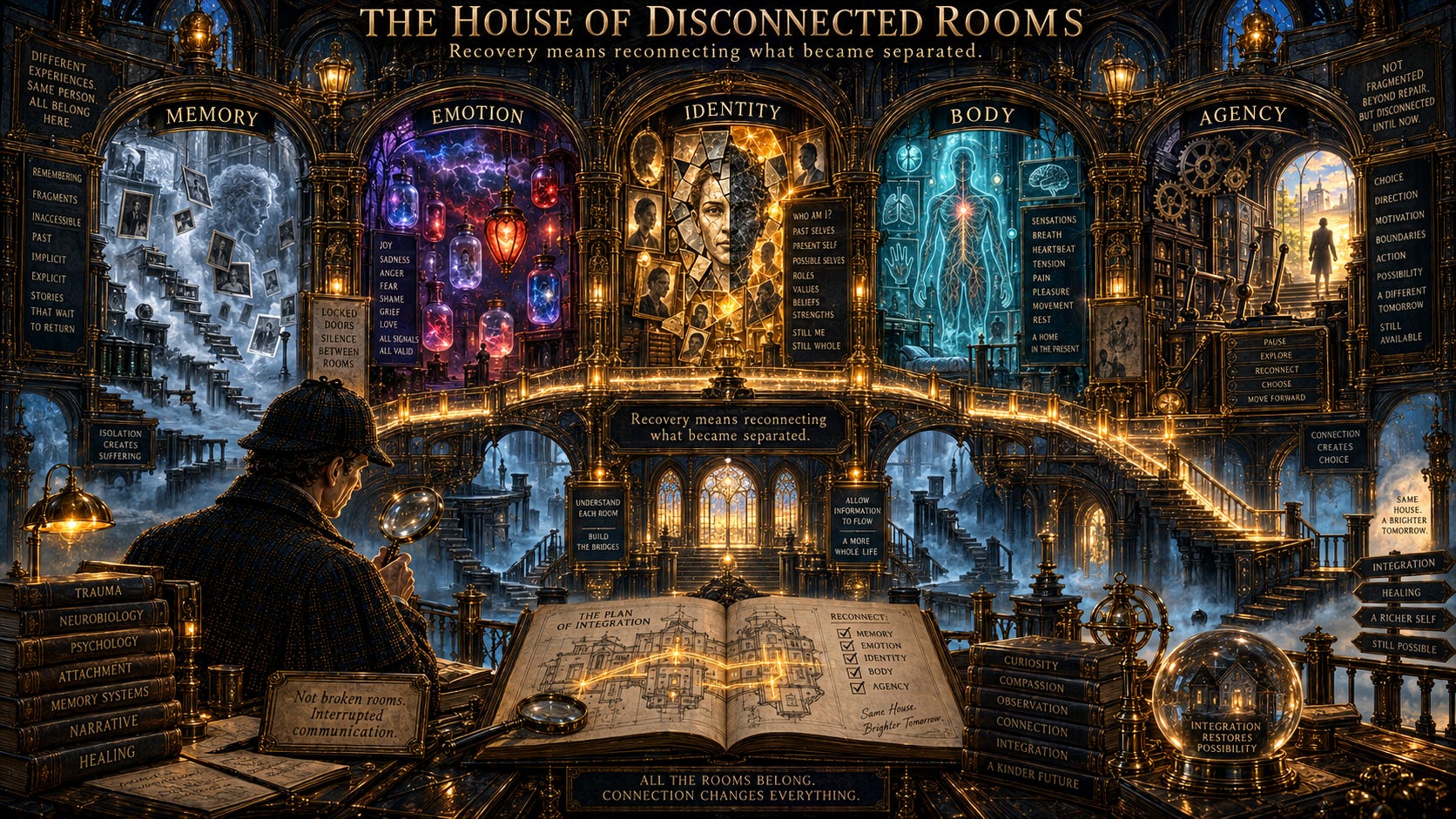
PSYCH 129: Dissociative Disorders
Description
Medlock Holmes enters an extraordinary Neo-Victorian building called The House of Disconnected Rooms.
From outside, it appears to be one house. Inside, however, corridors terminate unexpectedly, doors open into rooms that seem unaware of one another, clocks show different times, mirrors reflect unfamiliar faces, and sections of the archive are inaccessible from the main library.
Nothing has disappeared completely.
The connections have been disrupted.
This becomes Holmes’s central metaphor for dissociation: a disruption in the normal integration of functions that usually operate together - identity, memory, consciousness, emotion, perception, bodily representation, behaviour and motor control.
The disorders emerging from this disruption include dissociative identity disorder, dissociative amnesia and depersonalisation/derealisation disorder, alongside other specified and unspecified presentations. Diagnostic systems differ somewhat at the boundaries, particularly in their classification of functional neurological symptoms and trance or possession states.
Holmes first enters the Archive of Missing Memory.
Ordinary forgetting leaves faded pages.
Dissociative amnesia can leave entire sections inaccessible - particularly autobiographical information associated with overwhelming experiences. Sometimes the missing period is circumscribed; in severe cases, access to large portions of personal history and even identity may be disrupted. A person may travel away from their usual environment during a dissociative fugue, appearing outwardly organised while disconnected from important autobiographical knowledge.
The next chamber is stranger.
A person looks into a mirror and says:
“I know this is me, but I do not feel like me.”
This is depersonalisation.
Through another window the world appears artificial, distant, dreamlike or strangely unfamiliar.
This is derealisation.
Yet an essential diagnostic clue remains illuminated:
REALITY TESTING IS INTACT.
The person experiences unreality but generally recognises that the experience is subjective. That distinction helps separate depersonalisation/derealisation from psychotic disorders.
Holmes then reaches the most complex part of the house: the Gallery of Identity.
Here, experience is organised into partially separated self-states, with discontinuities in memory, agency, behaviour, perception and sense of self.
This is the territory of dissociative identity disorder.
The popular stereotype imagines several completely separate people occupying one body. Clinical reality is considerably more nuanced. Identity disruption can involve overlapping self-states, variable degrees of awareness between them, intrusive thoughts or emotions experienced as not one’s own, unexplained actions, voices experienced internally, memory gaps, shifts in skills or preferences, and a disturbing sense of losing control over one’s own behaviour.
Holmes therefore replaces the theatrical question -
“How many personalities are there?”
-with the clinically useful one:
“Where has integration broken down?”
The history of dissociation is itself a detective story. Nineteenth-century medicine moved between explanations involving hypnosis, hysteria, suggestion, neurological disconnection and trauma. The famous demonstrations at the Salpêtrière became simultaneously scientific investigations and public performances. The chapter’s historical image of a clinical demonstration captures this complicated intersection between medicine, suggestion, spectacle and genuine suffering.
One of the central historical disputes remains relevant today:
Does