Episode Details
Back to Episodes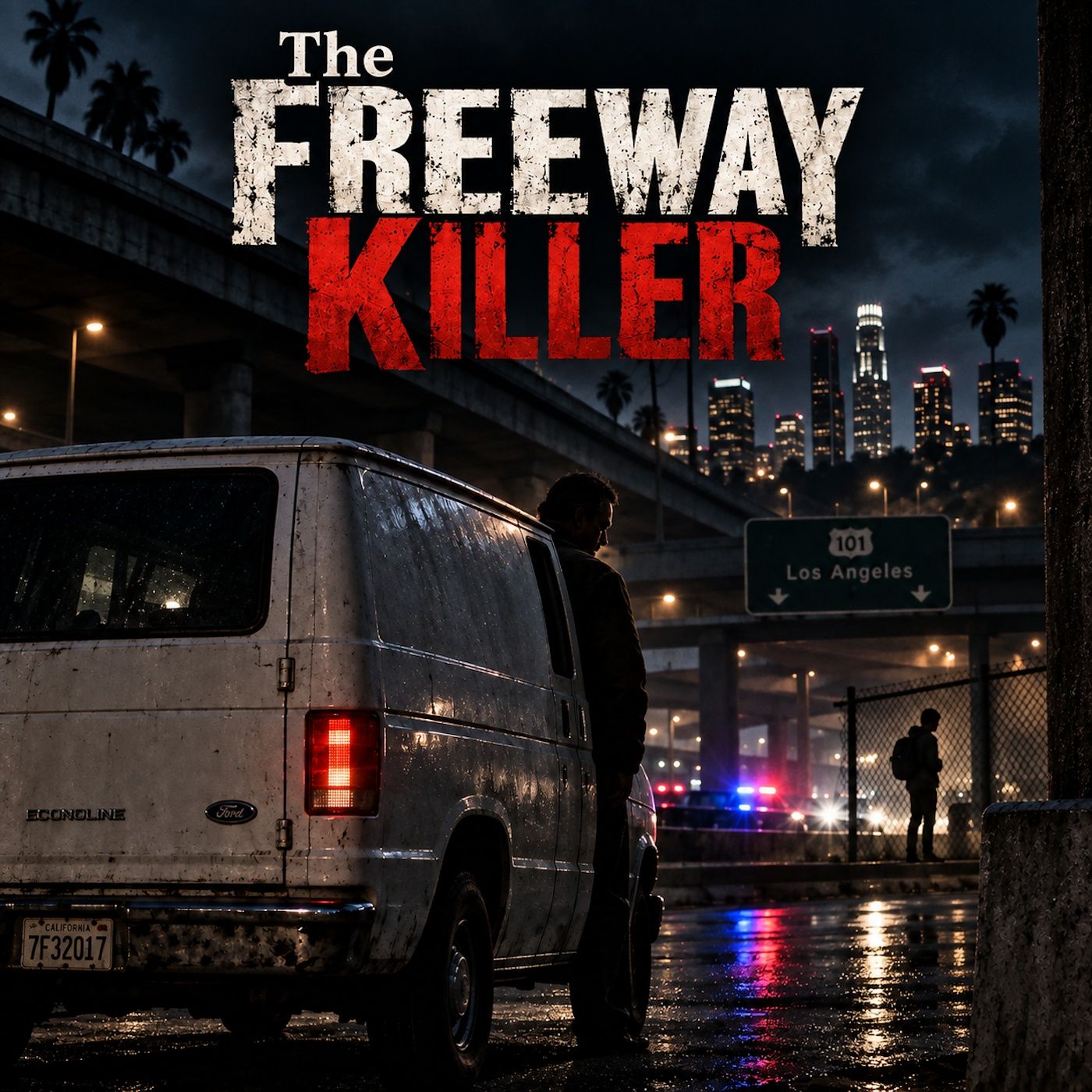
The Freeway Killer
Published 16 hours ago
Description
This episode discusses sexual violence against children and teenagers, torture, and murder and is not suitable for younger audiences. Listener discretion is strongly advised.
On the night of June 11, 1980, plainclothes officers who had been following a Ford Econoline van through Hollywood watched its driver approach a series of young men along Santa Monica Boulevard.
Five refused to get inside. The sixth was a 15-year-old runaway.When the van eventually stopped in a vacant lot and officers heard screams coming from inside, they moved in. Behind the door they found 33-year-old truck driver William Bonin assaulting a bound teenager.
The arrest ended one of the most brutal murder sprees in Southern California history.
In this episode of Disturbing History, Brian examines the complete story of the man the press dubbed the Freeway Killer, using court opinions, federal appeals records, corrections documents, contemporary reporting, and testimony from the people who survived him.
The story begins decades before the murders, with Bonin's deeply troubled childhood, institutionalization, military service in Vietnam, and a disturbing pattern of sexual violence that began almost immediately after his 1968 discharge.Authorities had multiple opportunities to see what he was becoming.
After attacking several teenage boys, Bonin was committed to Atascadero State Hospital, where records documented sexual sadism, antisocial behavior, and his own warning that future victims might not be left alive. Released in 1974, he attacked again the following year. After another conviction, he was paroled in October 1978.
Within months, boys and young men began disappearing.From 13-year-old Thomas Lundgren in May 1979 to 18-year-old Steven Wells in June 1980, Bonin would later describe the murders of 21 victims. Bodies were abandoned beside freeways, dumped along roads, and left in isolated areas across Southern California.
The episode reconstructs the murder spree in chronological order while examining the evidence that eventually connected Bonin to the crimes, including distinctive carpet fibers from his van, witness testimony, physical evidence, confessions, and the investigation led by LAPD homicide detective John St. John.
It also examines the four younger men drawn into Bonin's orbit—Vernon Butts, Gregory Miley, William Pugh, and James Munro—and the very different roles they played in the murders and in the case that eventually brought Bonin down.
Then came two murder trials, controversial defense decisions, disputes over confessions and plea negotiations, death sentences, and nearly fourteen years of appeals.On February 23, 1996, William Bonin became the first person executed by lethal injection in California.But one part of the story remains unfinished. Among the victims Bonin admitted killing was a young man whose body was discovered beside Route 99 south of Bakersfield in November 1979.
More than four decades later, his identity remains unknown.
Email Brian
Join Our FREE Newsletter
Get Brian's Books
Leave Us A Voicemail
Visit Our Website
Have a forgotten historical mystery, disturbing event, unsolved crime, or hidden conspiracy you think deserves investigation?
Send your suggestions to brian@paranormalworldproductions.com.
On the night of June 11, 1980, plainclothes officers who had been following a Ford Econoline van through Hollywood watched its driver approach a series of young men along Santa Monica Boulevard.
Five refused to get inside. The sixth was a 15-year-old runaway.When the van eventually stopped in a vacant lot and officers heard screams coming from inside, they moved in. Behind the door they found 33-year-old truck driver William Bonin assaulting a bound teenager.
The arrest ended one of the most brutal murder sprees in Southern California history.
In this episode of Disturbing History, Brian examines the complete story of the man the press dubbed the Freeway Killer, using court opinions, federal appeals records, corrections documents, contemporary reporting, and testimony from the people who survived him.
The story begins decades before the murders, with Bonin's deeply troubled childhood, institutionalization, military service in Vietnam, and a disturbing pattern of sexual violence that began almost immediately after his 1968 discharge.Authorities had multiple opportunities to see what he was becoming.
After attacking several teenage boys, Bonin was committed to Atascadero State Hospital, where records documented sexual sadism, antisocial behavior, and his own warning that future victims might not be left alive. Released in 1974, he attacked again the following year. After another conviction, he was paroled in October 1978.
Within months, boys and young men began disappearing.From 13-year-old Thomas Lundgren in May 1979 to 18-year-old Steven Wells in June 1980, Bonin would later describe the murders of 21 victims. Bodies were abandoned beside freeways, dumped along roads, and left in isolated areas across Southern California.
The episode reconstructs the murder spree in chronological order while examining the evidence that eventually connected Bonin to the crimes, including distinctive carpet fibers from his van, witness testimony, physical evidence, confessions, and the investigation led by LAPD homicide detective John St. John.
It also examines the four younger men drawn into Bonin's orbit—Vernon Butts, Gregory Miley, William Pugh, and James Munro—and the very different roles they played in the murders and in the case that eventually brought Bonin down.
Then came two murder trials, controversial defense decisions, disputes over confessions and plea negotiations, death sentences, and nearly fourteen years of appeals.On February 23, 1996, William Bonin became the first person executed by lethal injection in California.But one part of the story remains unfinished. Among the victims Bonin admitted killing was a young man whose body was discovered beside Route 99 south of Bakersfield in November 1979.
More than four decades later, his identity remains unknown.
Email Brian
Join Our FREE Newsletter
Get Brian's Books
Leave Us A Voicemail
Visit Our Website
Have a forgotten historical mystery, disturbing event, unsolved crime, or hidden conspiracy you think deserves investigation?
Send your suggestions to brian@paranormalworldproductions.com.
Listen Now
Love PodBriefly?
If you like Podbriefly.com, please consider donating to support the ongoing development.
Support Us