Episode Details
Back to Episodes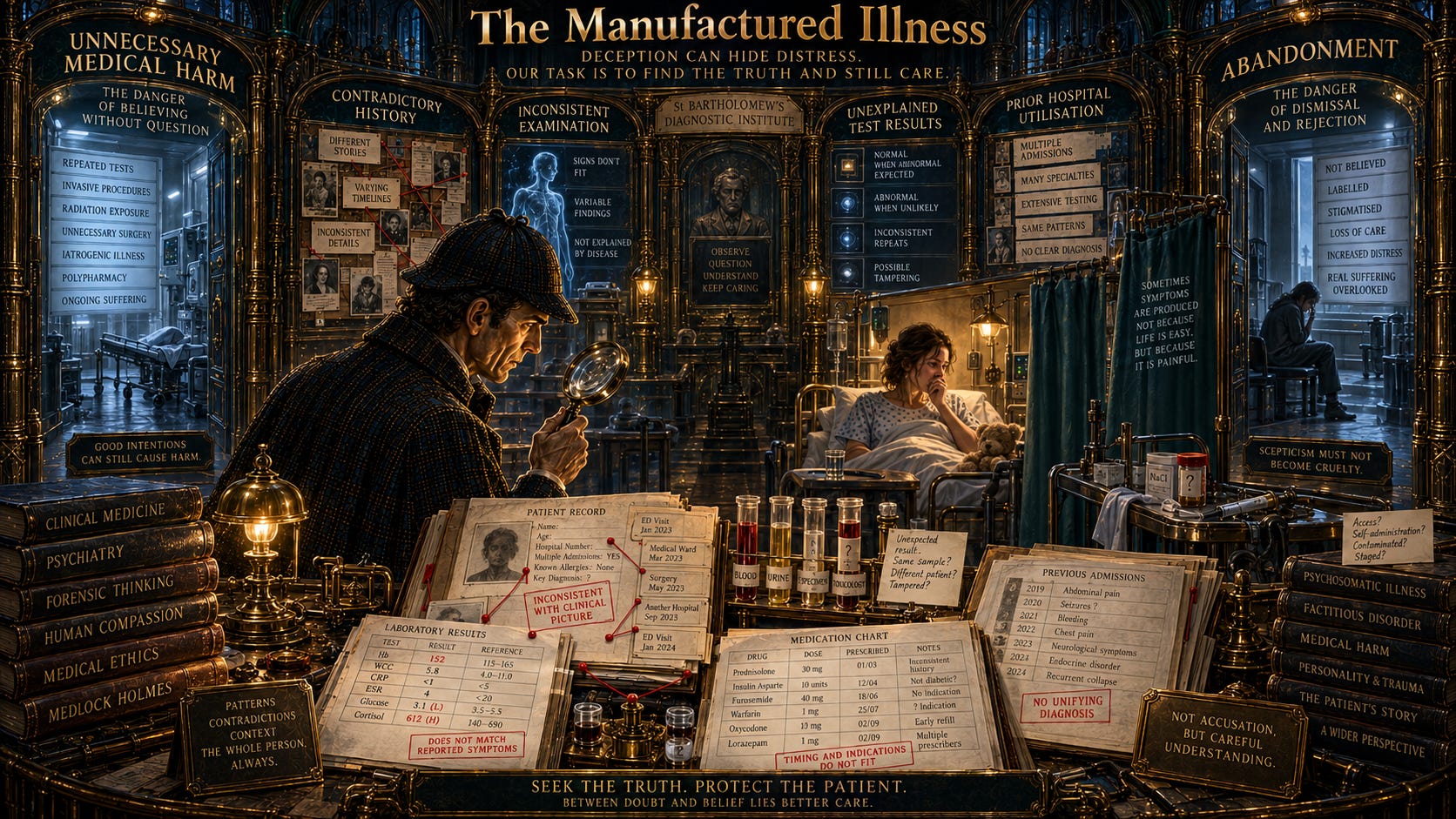
PSYCH 128: Factitious Disorder
Description
At first, the cases look extraordinary.
A patient presents with recurrent sepsis caused by unusual organisms. Another has persistent wounds that never heal. Another reports repeated seizures that vanish under observation. One produces dramatic laboratory abnormalities. Another travels from hospital to hospital under changing identities. In a paediatric ward, a child appears inexplicably ill whenever one caregiver is present.
Holmes immediately recognises the central diagnostic requirement:
There must be evidence of deception.
Factitious disorder involves falsifying, inducing, exaggerating, or aggravating illness while presenting oneself-or another person-as sick, without an obvious external reward. That absence of clear material incentive separates it conceptually from malingering.
The distinction sounds simple.
In practice, it is not.
Motives can change over time. Factitious behaviour and malingering can coexist. A patient who initially seeks the sick role may later discover disability payments or controlled medications. Another may begin by seeking narcotics but continue deceptive illness behaviour even after the external reward disappears.
Holmes therefore learns not to reduce the entire investigation to a single question of motive.
The more immediate questions are:
Is deception occurring?
Is anyone being harmed?
What genuine illness might also be present?
How can further harm be prevented?
The chapter emphasises that factitious disorder is not a diagnosis of exclusion. Waiting until every conceivable disease has been ruled out can itself expose patients to dangerous tests and procedures. Suspicion should arise when the clinical course repeatedly defies expected medical patterns.
The table on page 20 provides a practical map of clues:
multiple hospitals, inconsistent histories, atypical disease course, extraordinary numbers of unsuccessful investigations, symptoms greatly exceeding objective pathology, eager acceptance of invasive procedures, refusal of collateral information, medical training, pseudologia fantastica, unexplained deterioration before discharge, and evidence that laboratory findings have been manipulated.
Holmes enters the Laboratory of Manufactured Signs.
The creativity is remarkable.
Fever can be induced or falsified.
Hypoglycaemia can be produced with insulin or oral hypoglycaemics.
Bleeding can be fabricated.
Laxatives can create diarrhoea.
Diuretics can produce electrolyte abnormalities.
Foreign substances can contaminate wounds.
Medications can generate arrhythmias, hypertension, endocrine abnormalities, or neurological syndromes.
The long systems-based table in the chapter makes an important point: factitious disorder can mimic almost any branch of medicine.
But the clinician’s task is not to become suspicious of every unusual patient.
It is to search for incompatibility between the claimed disease and the objective pattern, then gather positive evidence of fabrication.
Past records become essential.
So does collateral information.
Specimens may need to be obtained under observation.
Laboratory values may reveal signatures incompatible with natural disease.
The course may improve when the patient is separated from opportunities to manipulate symptoms.
Holmes then enters a second wing:
Munchausen Syndrome.
This is not synonymous with all factitious disorder.
It represents a severe, chronic form characterised by:
peregrination - travelling widely from institution to institution,
and
pseudologia fantastica - elaborate, self-aggrandising autobiograph