Episode Details
Back to Episodes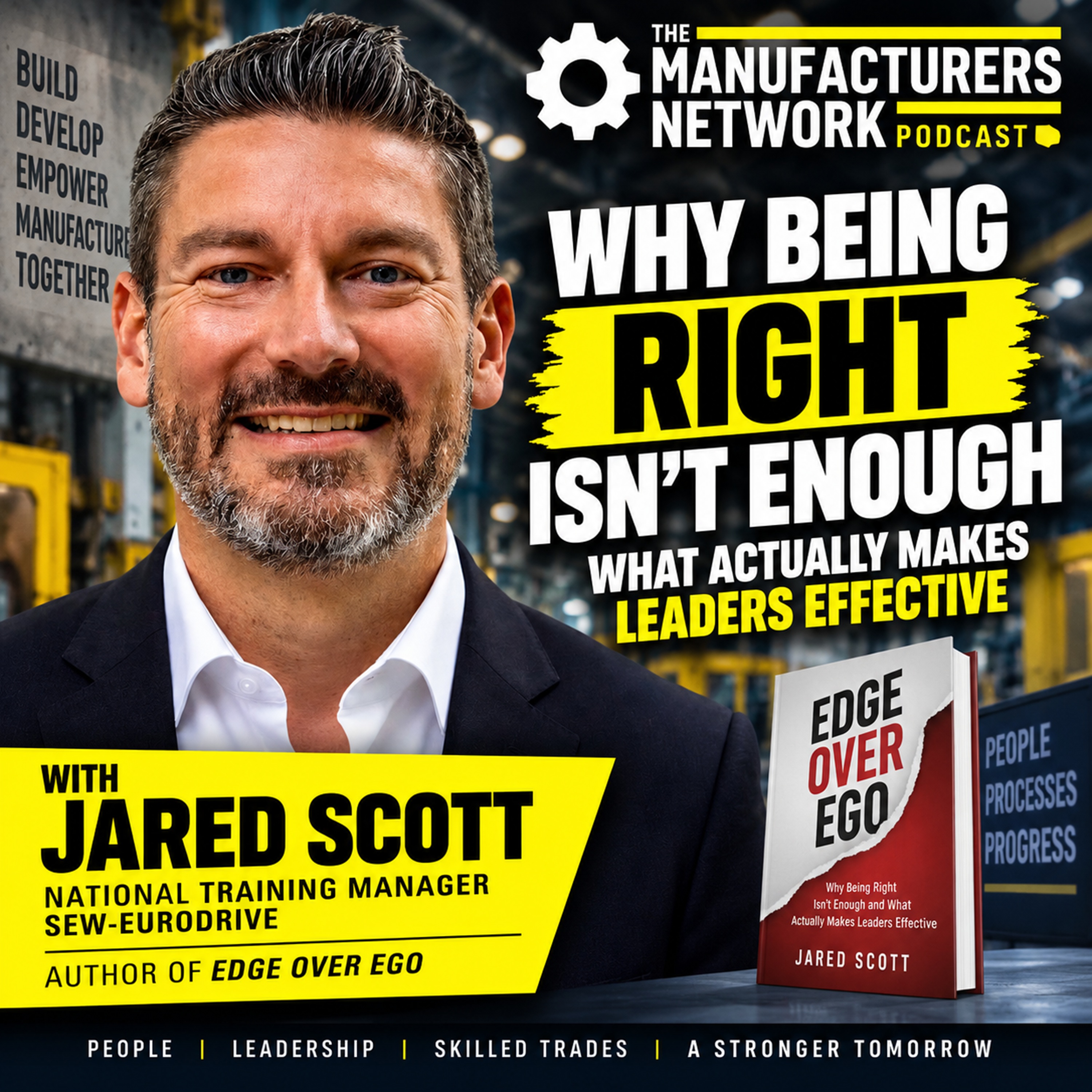
Manufacturing Leadership: Why Being Right Isn’t Enough with Jared Scott
Description
What happens when a manufacturing leader’s experience becomes the very thing keeping the operation from improving?
In this episode of The Manufacturers Network Podcast, Lisa Ryan talks with Jared Scott, National Training Manager at SEW-EURODRIVE and author of Edge Over Ego: Why Being Right Isn’t Enough and What Actually Makes Leaders Effective, about manufacturing leadership, workforce development, technical training, AI, and the generational shift happening across the industry.
Jared has worked in manufacturing since 1995, starting with hands-on industrial maintenance before moving into workforce training and leadership development. He has watched manufacturing change dramatically, but one challenge remains: experienced leaders can become so accustomed to how things are done that they stop noticing what could be better.
That’s where ego gets expensive.
Jared shares a story from early in his career when he found a simple way to grease tapered bearings more efficiently using a basketball needle. Instead of considering the idea, the experienced employee training him rejected it because Jared hadn’t “paid his dues.”
It’s a great example of how manufacturers can lose good ideas, efficiency improvements, and employee engagement because experience becomes a reason to stop listening.
Lisa and Jared discuss a question every manufacturing leader should consider when a new employee challenges an established process:
What if they’re right?
As manufacturers face skilled labor shortages, retiring experienced workers, AI adoption, automation, and rapidly changing technology, leaders can’t afford to confuse experience with infallibility.
Jared describes the “boiled frog” problem in manufacturing. When you’ve worked inside the same operation for years, problems can become so familiar that you stop seeing them.
The pothole everyone drives over. The inefficient process everyone works around. The machine problem everyone tolerates. The procedure nobody questions because “that’s how we’ve always done it.”
New employees may notice those problems immediately because they haven’t learned to ignore them yet.
Manufacturing leaders don’t have to implement every suggestion. They do need to create an environment where employees can question a process, offer an idea, or point out a problem without being dismissed because of tenure or job title.
Human Judgment, AI and Manufacturing
Lisa and Jared also explore what happens as artificial intelligence and automation become more prevalent in manufacturing.
AI can increase capability, but manufacturers still need people who understand equipment, processes, troubleshooting, and what actually happens on the shop floor.
At the same time, experienced workers are retiring with decades of practical manufacturing knowledge. Younger employees may enter with less experience but different technical skills, fresh perspectives, and access to new tools.
The leadership challenge is connecting those capabilities instead of allowing generations to dismiss each other.
Why Manufacturing Training Fails
Jared’s work in manufacturing training has taught him that theory alone doesn’t prepare someone to troubleshoot equipment, machine a component, wire a motor, or solve a real production problem.
Effective manufacturing training requires practical application and instructors who understand the work.
Employees also want to know why a new process is better, how it helps them do their jobs, and whether their experience and feedback matter. Jared shares how employee feedback has led his team to change training because workers discovered a better way to perform the work.
Ego, Listening and Better Decisions
One of Jared’s simplest leadership practices is also one of the hardest: Don’t respond immediately when you feel challenged.
Listen Now
Love PodBriefly?
If you like Podbriefly.com, please consider donating to support the ongoing development.
Support Us