Episode Details
Back to Episodes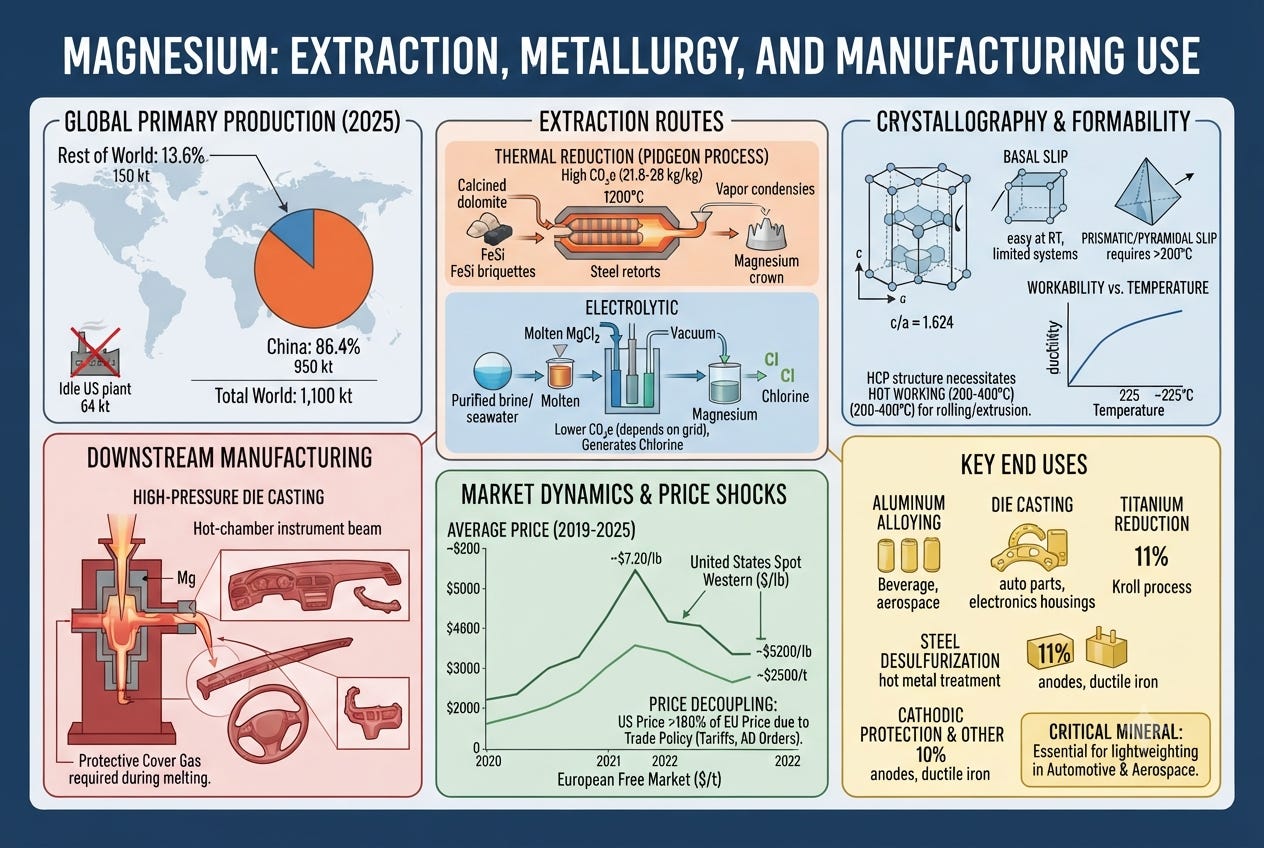
Magnesium: Extraction, Metallurgy, and Manufacturing Use
Description
China produced 950,000 of the 1,100,000 metric tons of primary magnesium made worldwide in 2025, while the United States produced none after its sole smelter filed for bankruptcy. American primary magnesium output has been zero since limited operations at the Rowley, Utah electrolytic plant ended in 2022, following critical equipment failures in 2021 and a force majeure declaration on supply contracts dated September 29, 2021. The operator filed for Chapter 11 protection in September 2025, and on January 28, 2026 the State of Utah acquired the assets for $30 million, taking 4,500 acres on the southwest shore of the Great Salt Lake and water rights to just over 144,000 acre feet. Domestic demand is now met by 82,000 tons of imports, 110,000 tons of secondary metal recovered from scrap, and inventory.
Two findings drive the analysis that follows. First, the dominant production route is thermal rather than electrolytic. The Pidgeon process, a batch silicothermic reduction of calcined dolomite carried out in steel retorts at roughly 1,200 degrees Celsius under vacuum, accounts for the large majority of Chinese output and carries a reported carbon intensity of 21.8 to 28 kilograms of carbon dioxide equivalent per kilogram of metal, against 0.56 to 0.59 kilograms per kilogram for European secondary metal. Second, price formation in the United States has decoupled from the rest of the world. The 2025 annual average United States spot Western price of $3.20 per pound works out to roughly $7,055 per metric ton, while the European free market average was $2,500 per metric ton, a spread of about 182 percent created by an 8 percent most favored nation duty on unwrought metal layered on antidumping orders that have covered Chinese pure magnesium since 1995 and Chinese magnesium metal since 2005.
For anyone allocating capital to lightweight structures, titanium production, or steel finishing, the operative question is not whether magnesium is useful. It is whether a manufacturer can obtain it at a predictable price from a source that does not sit inside a single national grid.
Definition, Scope, and Technical Context
Magnesium is the lightest structural metal in commercial use, with a density of 1.738 grams per cubic centimeter at 20 degrees Celsius, about 36 percent below aluminum and roughly 78 percent below carbon steel. It melts at 650 degrees Celsius and boils at 1,091 degrees Celsius, a narrow liquid range by metallurgical standards and one that shapes both how the metal is won from ore and how it is cast. This analysis covers primary extraction, alloying, forming, and industrial end use of magnesium metal. It excludes magnesium compounds such as magnesia refractories, magnesium hydroxide, and pharmaceutical salts, which follow separate production chemistry and separate markets.
The metal is classified as a light nonferrous structural metal and, for purposes of federal minerals policy, as a critical mineral. Magnesium appears on the final 2025 List of Critical Minerals published under section 7002 of Public Law 116 260 as amended by Public Law 118 233, codified at 30 U.S.C. 1606, effective November 7, 2025, one of sixty minerals on that list.
Two production families exist and they share almost no equipment. Thermal reduction takes a calcined carbonate ore and strips oxygen from magnesium oxide using silicon, producing magnesium as a vapor that is condensed as crystalline metal. Electrolysis takes anhydrous magnesium chloride, derived from brine or seawater, and splits it into liquid metal and chlorine gas in a molten salt cell. The choice between them is not a matter of preference. It determines the plant’s feedstock, its energy source, its byproduct stream, its capital intensity, and its emissions profile, and those differences explain most of the geography of the industry.
The scope also covers downstream forming, because magnesium is unusual in that the crystal structure that makes it li