Episode Details
Back to Episodes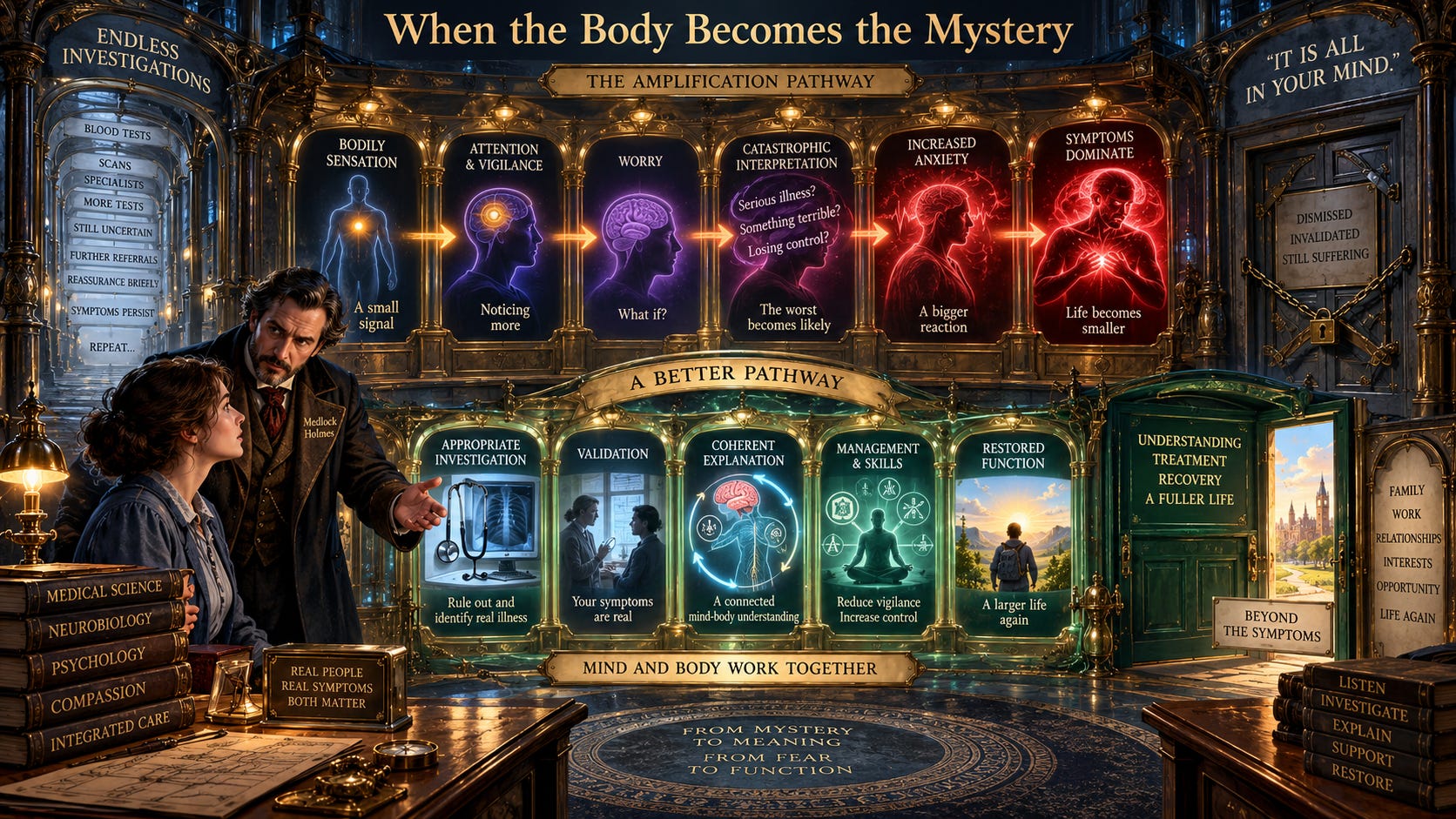
PSYCH 127: Somatic Symptom and Related Disorders
Description
Medlock Holmes enters an immense Neo-Victorian medical complex called The House of Bodily Signals.
Every corridor is crowded.
One patient reports abdominal pain. Another dizziness. Another weakness. Another chest discomfort. Another is convinced that a subtle bodily sensation means serious disease. One patient has undergone scan after scan without reassurance. Another has genuine physical illness but has become consumed by fear and monitoring. In a neighbouring neurological ward, someone presents with limb weakness that does not conform to recognised neurological anatomy.
Holmes notices immediately that the central mystery is not:
“Are the symptoms real?”
The symptoms are real experiences.
The more useful question is:
“How does the person interpret, respond to, and organise life around those symptoms?”
This is the conceptual shift at the heart of modern somatic symptom and related disorders.
Earlier diagnostic systems relied heavily on whether symptoms were medically unexplained. DSM-5 moved away from that distinction because medicine cannot always establish whether a symptom is medically explained, partially explained or idiopathic, and because patients with genuine medical disease can still become disproportionately preoccupied with bodily symptoms.
Somatic symptom disorder therefore focuses upon the combination of:
distressing somatic symptoms
plus
excessive thoughts, feelings or behaviours related to those symptoms.
The diagnostic table on page 11 makes this explicit. One or more somatic symptoms must cause distress or disruption, while the patient also shows disproportionate concern about seriousness, persistently high health anxiety, or excessive time and energy devoted to the symptoms. The overall symptomatic state is persistent, usually for more than six months.
Holmes sees why this distinction matters.
A patient can have chronic pain caused by osteoarthritis and still develop somatic symptom disorder if the response to that pain becomes excessive, consuming and disabling.
Conversely, a person can have many medically unexplained symptoms without meeting criteria if they are not excessively preoccupied or impaired.
The disorder is therefore not diagnosed by proving that nothing is physically wrong.
It is diagnosed by understanding the relationship between bodily symptoms and the patient’s cognitive, emotional and behavioural response.
The chapter then separates several neighbouring conditions.
In illness anxiety disorder, somatic symptoms are absent or relatively mild, but the fear of serious illness dominates the person’s life.
In functional neurological symptom disorder, symptoms such as weakness, tremor, seizures, gait disturbance or sensory loss are incompatible with recognised neurological disease.
In psychological factors affecting another medical condition, psychological or behavioural factors demonstrably worsen an established medical illness.
In factitious disorder, symptoms are intentionally falsified or induced without an obvious external reward.
And in malingering, which is not itself a psychiatric disorder, symptoms are intentionally produced for an external incentive such as money, avoiding work or obtaining drugs.
Holmes realises that these categories sit at one of medicine’s most difficult boundaries.
The distinction between physical and psychological is not a clean line.
Pain, autonomic symptoms, fatigue, dizziness, gastrointestinal disturbance, weakness and bodily vigilance are all influenced by:
* biology
* attention
* expectation
* emotion
* learning
* culture
* previous exp