Episode Details
Back to Episodes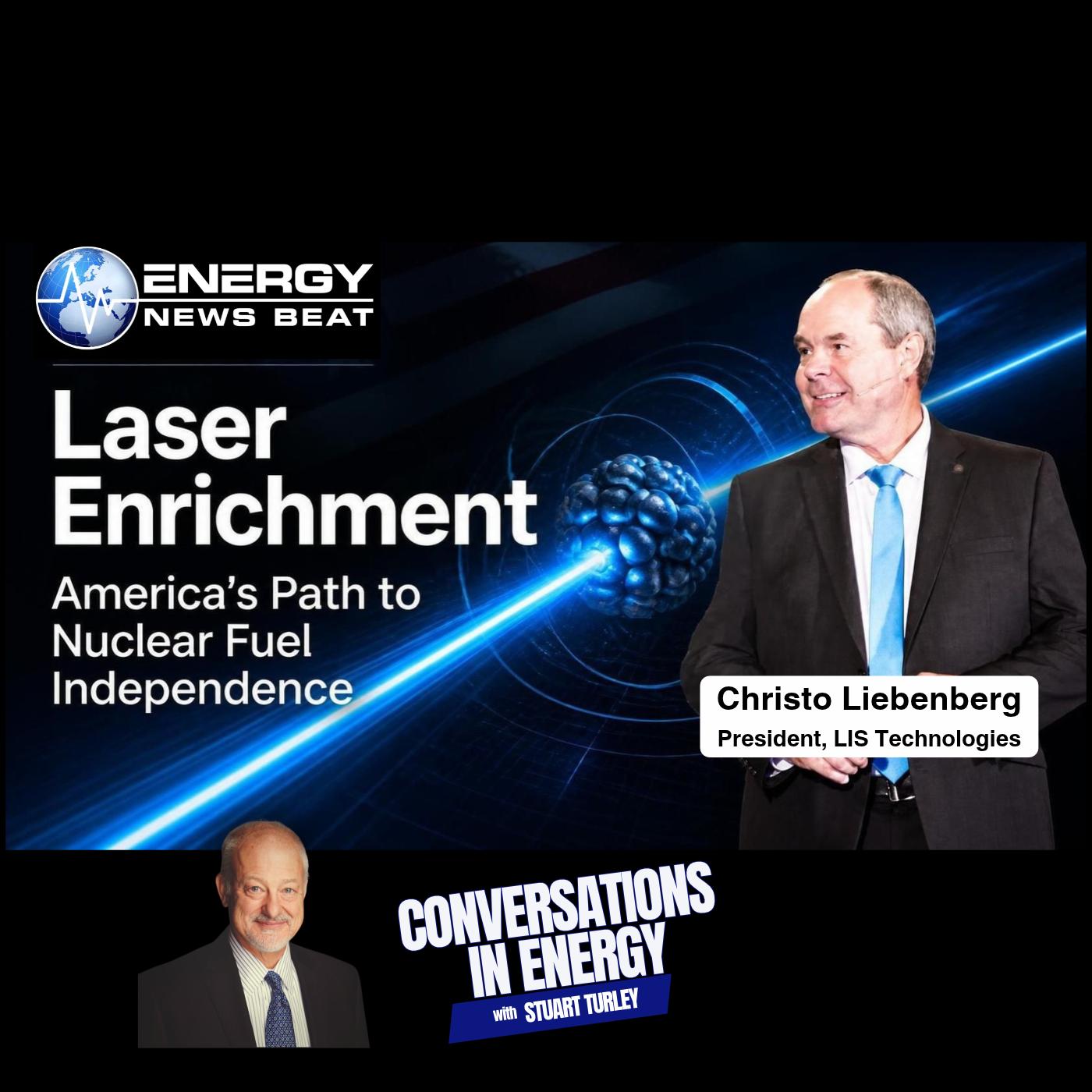
Laser Enrichment: America's Path to Nuclear Fuel Independence
Description
In this episode of the Energy News Beat Podcast, host Stu Turley sits down with Christo Liebenberg, President, Co-Founder, and Chief Technical Advisor of LIS Technologies, to explore one of the most promising solutions to America's nuclear fuel crisis. As global demand for nuclear power accelerates—driven by AI data centers, electrification, and climate imperatives—the U.S. faces a critical challenge: it currently produces only one-third of its own uranium enrichment needs, relying on imports from Russia and Western Europe.
LIS Technologies is reviving a decades-old technology that could transform this landscape. Using advanced laser isotope separation, the company aims to enrich uranium more efficiently, recycle spent nuclear fuel, and establish U.S. energy independence. With a working prototype weeks away from operation, a 206-acre facility in Oak Ridge, Tennessee, and a strategic partnership with Nano Nuclear, Liebenberg discusses the ambitious roadmap to commercialization, the regulatory pathway forward, and why laser enrichment has long been considered the "holy grail" of enrichment technologies. This conversation explores not just a technological breakthrough, but a pivotal moment for American nuclear energy and national security.
LIS Technologies Website: https://laseristech.com/
Christo Liebenberg's LinkedIn: https://www.linkedin.com/in/christo-liebenberg-838b4343/
1. Laser Isotope Separation (LIS) TechnologyThe core focus is LIS Technologies' development of laser-based uranium enrichment. This technology uses lasers to selectively target uranium-235 isotopes, enriching uranium in a single stage—far more efficient than traditional centrifuge methods that require dozens of stages. The technology was originally demonstrated in the late 1980s-early 1990s and is now being revived and commercialized.
2. Nuclear Fuel Independence & National SecurityA major theme is breaking U.S. dependence on Russian and Western European nuclear fuel. Currently, the U.S. only produces one-third of its enrichment needs domestically and imports two-thirds from abroad. LIS Technologies aims to make the U.S. self-sufficient in nuclear fuel production, positioning it as both an energy security and national security issue.
3. Growing Demand for Nuclear PowerThe podcast emphasizes accelerating demand driven by:
- AI data centers (Amazon, Microsoft, Google, Apple, Meta all gravitating toward nuclear)
- Electrification and climate change concerns
- Small modular reactors (SMRs) and micro-reactors for diverse applications
- Maritime applications (ships, tankers powered by nuclear instead of bunker fuel)
A key application: only 3% of nuclear fuel is burned in reactors, leaving 97% as spent fuel. Laser enrichment can selectively remove contaminant isotopes (uranium-232, 234, 236) and recover usable uranium-235, effectively recycling spent fuel.
5. Commercialization Timeline & InfrastructureLIS Technologies' roadmap includes:
- Phase 1: Re-demonstrate 1993 baseline results (weeks away from loading uranium hexafluoride)
- Phase 2: Scale hardware
- Phase 3: Build a pilot plant by 2030 (500,000 SWU/year) and full commercial facility by 2032 (5 million SWU/year)
- They've purchased a 206-acre island in Oak Ridge, Tennessee for the commercial facility
To quadruple U.S. nuclear power by 2050 (from 100 to 400 gigawatts), the U.S. would need roughly 380-600 new reactors. This requires a 12-fold increase in enrichment capacity and rebuilding the entire nuclear fuel cycle (mining, milling, conversion, enrichment, deconversion, fuel fabrication).
7. Strategic Partnerships & Vertical IntegrationLIS Technologies is partnering with Nano N