Episode Details
Back to Episodes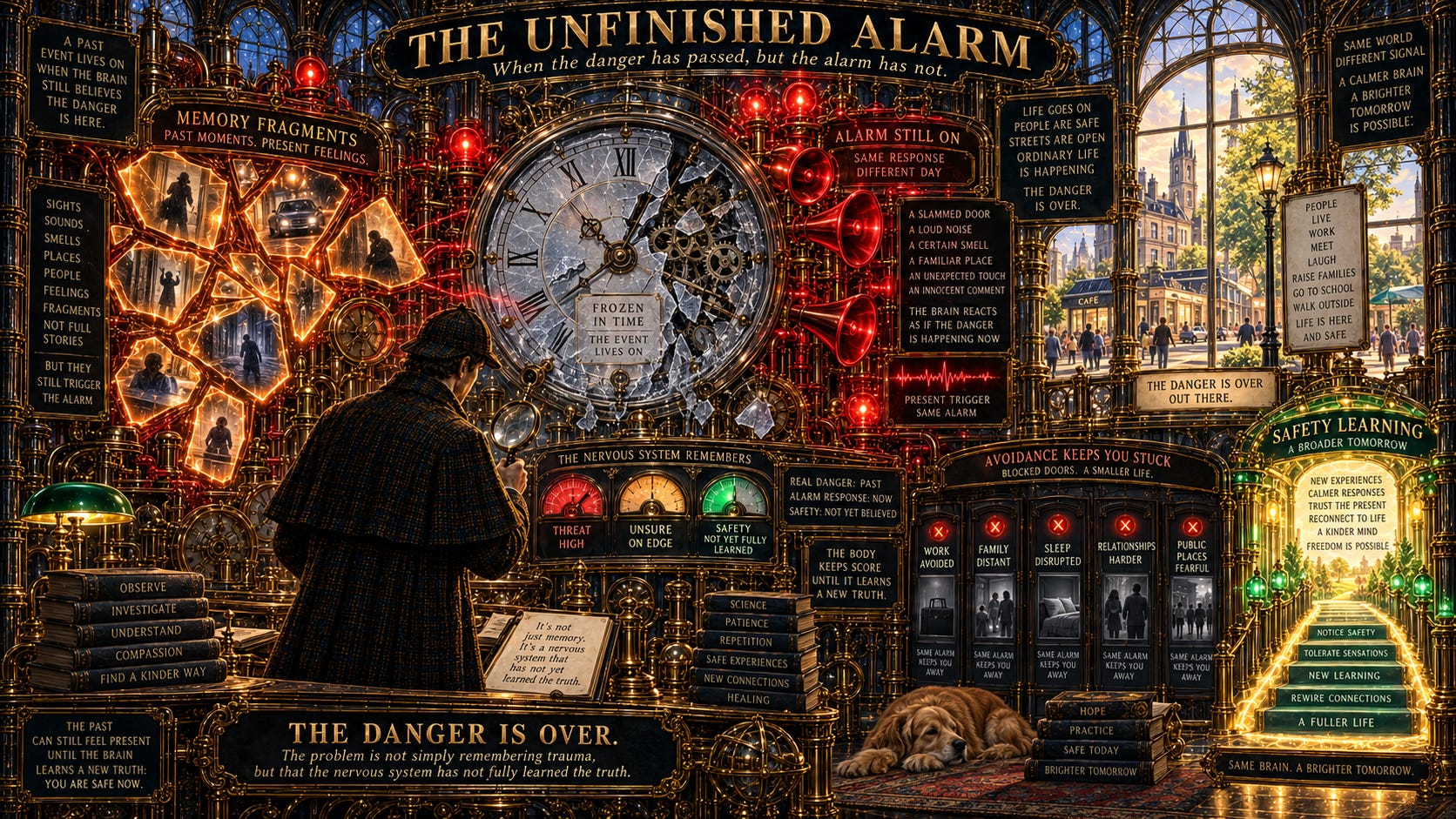
PSYCH 126: Post-Traumatic Stress Disorder
Description
Medlock Holmes enters an immense Neo-Victorian institution called The Citadel of the Unfinished Alarm.
At the centre is a vast clock frozen at the moment of trauma.
Outside the citadel, the danger has passed.
Inside, however, bells continue to ring.
A veteran ducks at the sound of a car backfiring. A survivor avoids a street that resembles the place of an assault. Another wakes from the same nightmare night after night. A fourth scans every room for exits.
Holmes immediately recognises the defining paradox of post-traumatic stress disorder:
The event belongs to the past, but the nervous system continues to respond as though danger remains present.
PTSD is classified as a trauma- and stressor-related disorder. Diagnosis requires exposure to actual or threatened death, serious injury or sexual violence, followed by characteristic symptoms lasting longer than one month and causing meaningful distress or impairment.
Those symptoms fall into four major clusters:
Intrusion. Avoidance. Negative alterations in cognition and mood. Alterations in arousal and reactivity.
Intrusive memories are not ordinary recollections. They possess a disturbing “here and now” quality. Flashbacks, nightmares and physiological reactions to reminders can make the past feel emotionally immediate.
Avoidance then emerges as an understandable attempt to control this intrusion. The person avoids places, people, conversations, memories, feelings and bodily sensations associated with trauma.
But avoidance comes at a cost.
It prevents the nervous system from learning:
“This reminder is not the original danger.”
Fear spreads. One battlefield cue becomes avoidance of uniforms, crowds, loud noises and unfamiliar places. Life becomes increasingly organised around preventing surprises.
The third cluster alters the person’s world beyond the trauma itself.
I cannot trust anyone.
The world is completely dangerous.
I should have prevented it.
Something in me is permanently damaged.
Interests fade. Positive emotion becomes difficult. Relationships become distant. Guilt, shame and emotional numbing can replace the person’s previous assumptions about self and world.
Meanwhile, the alarm system remains sensitised.
Hypervigilance.
Exaggerated startle.
Poor sleep.
Irritability.
Concentration difficulty.
Reckless behaviour.
The syndrome therefore becomes more than fear of a memory. It is a disturbance of threat detection, contextual processing, emotion regulation, attention, learning and recovery.
The brain-circuit diagram on page 25 captures this particularly well. Four interacting systems are highlighted: emotion regulation and executive function, threat and salience detection, contextual processing, and fear learning. Rather than one damaged “trauma centre”, PTSD involves altered communication among the prefrontal cortex, anterior cingulate, insula, amygdala, hippocampus, thalamus and related structures.
Holmes reaches the amygdala first.
It rapidly tags potential threat.
The insula monitors salient internal and external signals.
The dorsal anterior cingulate helps orient attention towards danger.
But prefrontal regulatory systems that should inhibit unnecessary alarm may function less efficiently.
The hippocampus supplies another critical function:
context.
A loud noise in combat meant one thing.
A loud noise at home years later means another.
PTSD can impair the ability to use context to update the meaning of the signal.
This is why the chapter presents PTSD as, in part, a disorder of recovery.
Listen Now
Love PodBriefly?
If you like Podbriefly.com, please consider donating to support the ongoing development.
Support Us