Episode Details
Back to Episodes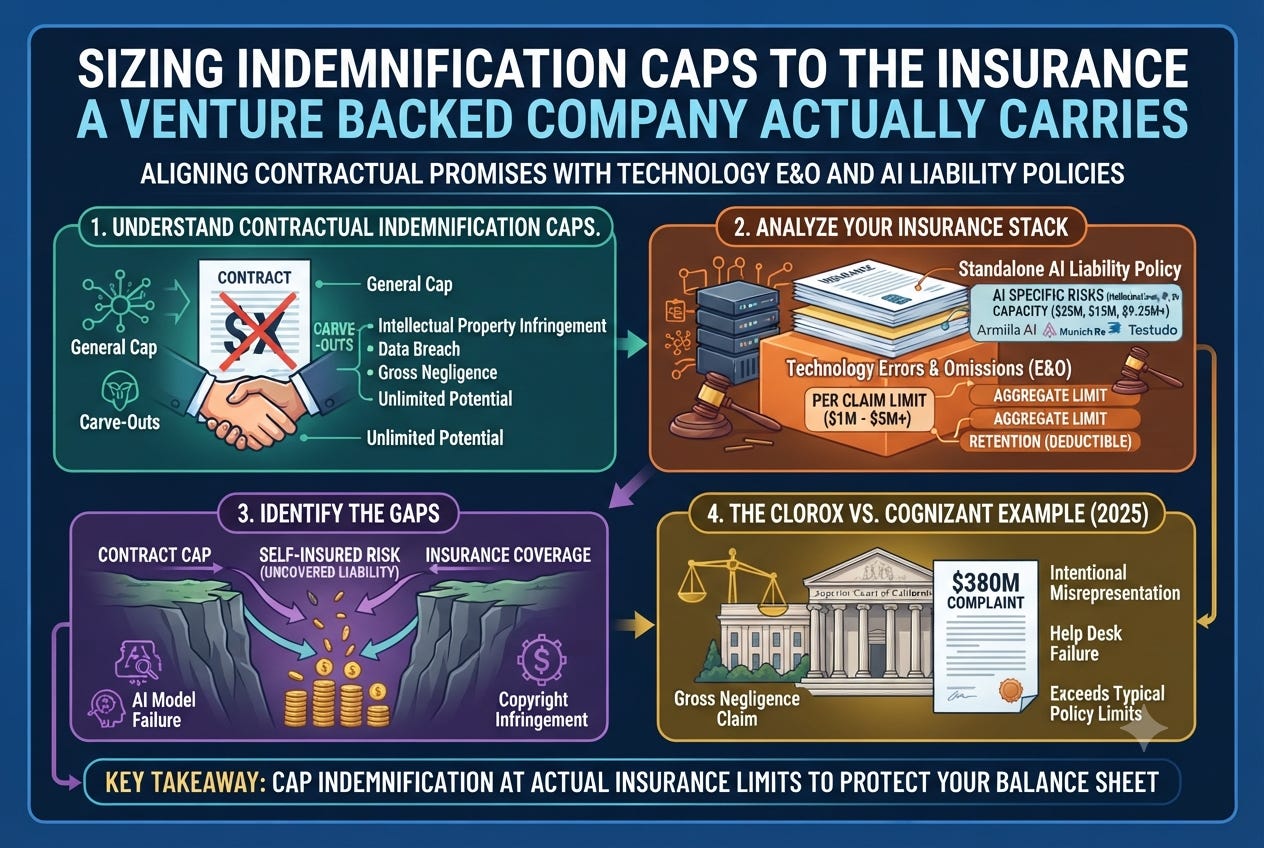
How to Size Indemnification Caps Against Insurance Limits
Description
A venture backed company should never let a contract’s indemnification cap exceed what its Technology Errors and Omissions policy and any standalone artificial intelligence liability policy will actually pay. Clorox Company’s $380 million complaint against Cognizant Technology Solutions U.S. Corporation, filed July 23, 2025, in the Superior Court of California, Alameda County, shows what happens once a cap and its carve outs are tested against real damages rather than against the multiple of fees the drafters had in mind. The complaint pleads gross negligence and intentional misrepresentation, the two categories of claim a well drafted carve out puts outside any general liability cap, precisely because the plaintiff wants access to the defendant’s full exposure rather than to a number set months earlier at the negotiating table.
Every commercial and software agreement negotiated in Silicon Valley over the past three decades has carried some version of the same structure: a general cap, usually a multiple of the fees paid under the agreement, and a list of carve outs the parties agree the general cap will not touch. What has changed is what sits behind that structure. A Technology Errors and Omissions policy written five years ago was priced against ordinary software defects and professional negligence. The same policy today, renewed without a hard look at its endorsement schedule, may carry a sublimit or an outright exclusion for claims arising from a generative or agentic feature the company added to its product somewhere in between renewals.
How do Technology Errors and Omissions limits actually work
A Technology Errors and Omissions policy pays against a per claim limit and a separate aggregate limit, and the aggregate, not the per claim number printed on the certificate, is usually the figure that matters once more than one claim lands in the same policy year. Before either limit applies, the policyholder pays a retention out of its own funds, commonly running from $10,000 to $250,000 for a growth stage company, and a common starting point for that company’s primary layer is a $1 million per claim limit, with excess layers added on top as enterprise customers demand higher numbers. The part of the policy that does the most damage to an unprepared company is the sublimit: a policy advertised at $5 million per claim can carry a $250,000 sublimit for a named category of loss, sitting on the same declarations page as the headline number, unflagged and easy to miss unless the broker is asked directly for the full endorsement schedule.
What does the standalone artificial intelligence liability market actually offer
The market for artificial intelligence specific liability insurance is still small enough to name every real underwriter in a single paragraph. Armilla AI, a Toronto based managing general agent, placed the first standalone artificial intelligence liability policy at Lloyd’s of London in April 2025, underwritten through Chaucer Group syndicates, with limits up to $25 million per insured organization and a requirement that the artificial intelligence system pass an independent certification before the policy binds. Munich Re’s aiSure product, a model performance warranty running since 2018, is now distributed through Mosaic at limits up to $15 million. Testudo, a Lloyd’s Lab backed underwriter, launched in January 2026 offering limits up to $9.25 million per insured. None of those numbers, stacked together with a typical Technology Errors and Omissions program, reaches anywhere near the $380 million Clorox is seeking from Cognizant, and that arithmetic is the entire point: a company cannot contract its way to protection its insurance market has not yet been built to sell.
How should a company reconcile its cap against that stack
Reconciliation is arithmetic before it is negotiation. Pull the current declarations page, the full sublimit schedule, and every endorsement attache