Episode Details
Back to Episodes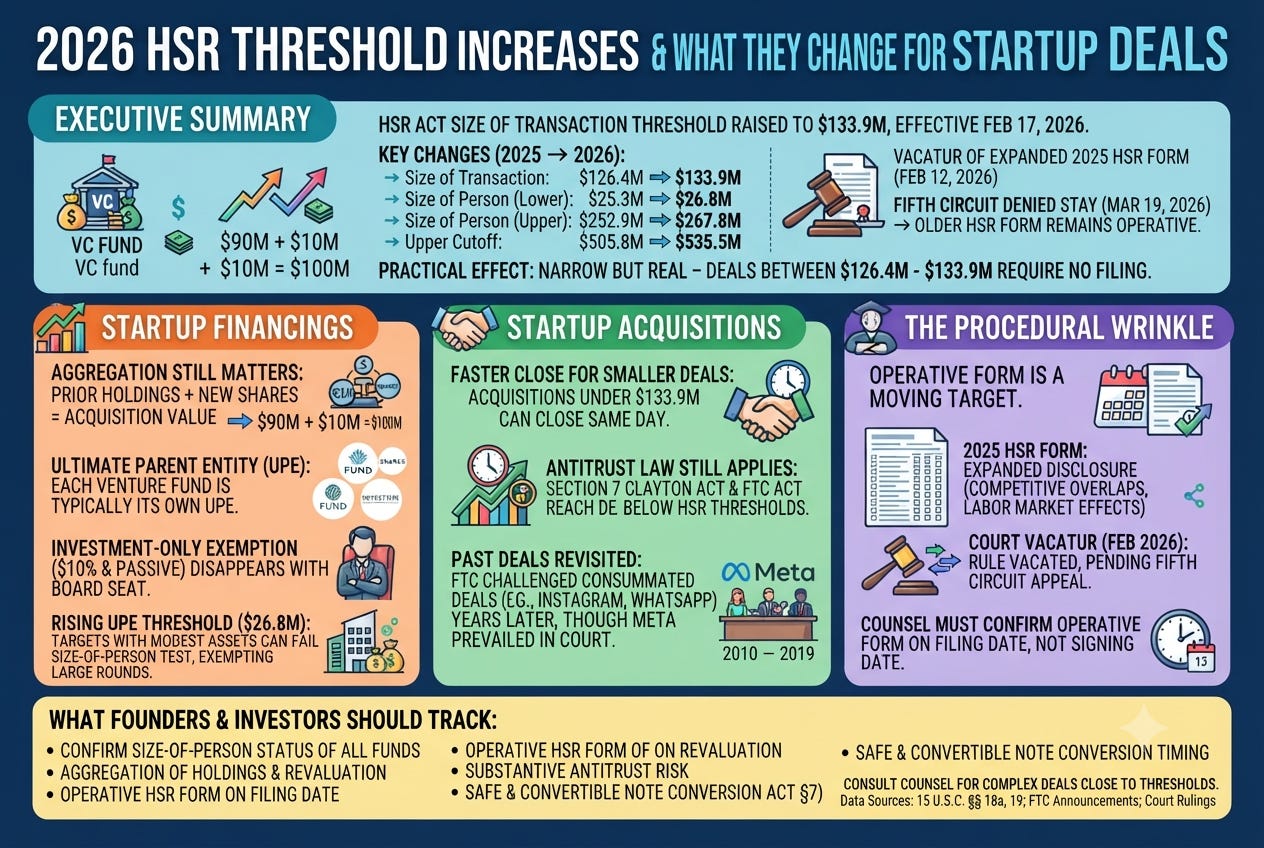
New Hart Scott Rodino Thresholds
Description
A term sheet that priced a company’s Series D round at $130 million would have forced the lead investor into a Hart Scott Rodino filing and a thirty day wait in 2025. Close that same round in 2026, after the Federal Trade Commission raised the Hart Scott Rodino Act size of transaction threshold from $126.4 million to $133.9 million on February 17, 2026, and the filing obligation disappears entirely. Nothing about the company changed. Nothing about the round’s terms changed. Only the government’s yardstick moved, under a statutory formula at 15 U.S.C. Section 18a(a)(2) that resets every dollar figure in the statute once a year according to the change in gross national product.
That formula has now run for seven consecutive years without interruption, and the cumulative effect is larger than any single year’s headline suggests. The size of transaction threshold has climbed from just above $90 million a decade ago to $133.9 million today. The size of person thresholds, which govern whether a deal priced between the transaction floor and roughly $535.5 million still needs a filing based on the assets of the parties involved, rose this year to $26.8 million and $267.8 million. The Clayton Act’s separate rule on interlocking corporate directorates, codified at 15 U.S.C. Section 19, rose in step to $54,402,000. Every one of those numbers governs a decision a founder or a fund manager has to make before signing, not after.
The mechanics matter more than the headline. A financing round is, in the eyes of the statute, an acquisition of voting securities by whichever investors receive them, and the Federal Trade Commission does not look only at the new money going in. It looks at everything the investor will hold once the round closes, revalued at fair market value and aggregated with whatever that investor already owned. A fund that held $90 million of a company’s preferred stock and writes a $10 million check in a new round is treated as acquiring $100 million, not $10 million, for threshold purposes. Founders who assume a small follow on check keeps a filing off the table have often done the math on the wrong number.
Venture funds also catch a break that strategic acquirers do not always get. Each fund is ordinarily treated as its own ultimate parent entity under the regulations, even when several funds share a general partner, because most fund structures never give one entity majority control over another’s profits or assets. A platform that raises money across four or five separate vehicles can therefore field several funds that each independently clear or fail the size of person test, so long as acquisitions made by funds that do share a true parent are aggregated with each other, not analyzed in isolation. The investment only exemption in 15 U.S.C. Section 18a(c)(9) adds a second escape hatch, excusing a stake of ten percent or less of a company’s voting securities from any filing at all, provided the investor holds it purely for investment and takes no board seat. The moment a lead investor negotiates the right to designate a director, that exemption is gone, regardless of how small the resulting stake is.
Acquisitions of startups face the same threshold, and the same limits on what the threshold actually buys a buyer. Raising the line to $133.9 million lets a technology company absorb a smaller engineering team or a narrow product line the same day it signs the agreement, with no filing and no thirty day wait. It does not put that acquisition beyond the reach of Section 7 of the Clayton Act, which carries no statute of limitations on a claim for injunctive relief. The Federal Trade Commission proved exactly how large that gap can get in a staff report issued September 15, 2021, which examined 616 acquisitions by Alphabet, Amazon, Apple, Facebook, and Microsoft over the prior decade and found that only 94 of them had ever crossed the Hart Scott Rodino threshold in effect at the time. The same report ca