Episode Details
Back to Episodes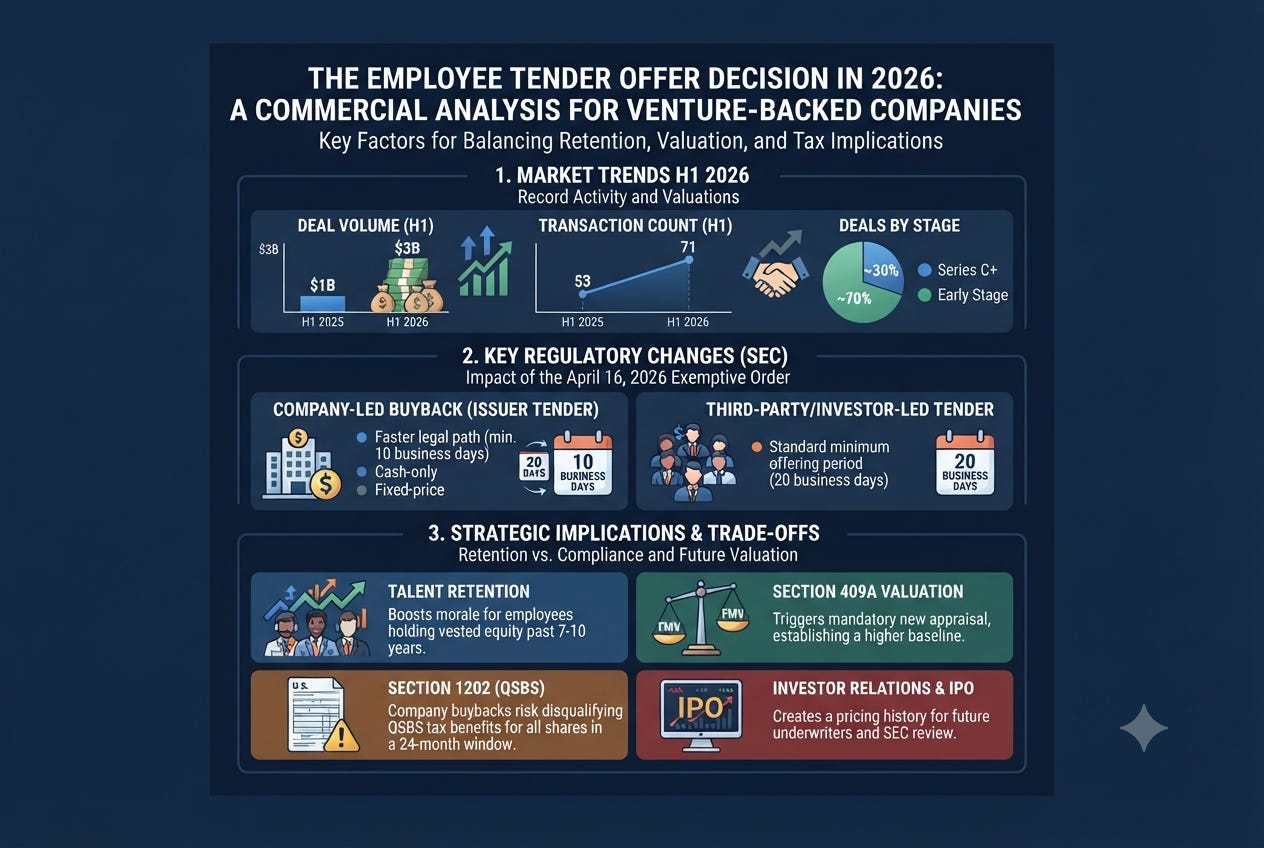
Employee Tender Offers Hit a Four Year High in 2026
Description
Employee tender offer volume reached a four year high in the first half of 2026, when seventy one deals worth three billion dollars closed under new federal rules that shortened the standard offer period. The decision facing a venture backed company this year is not whether tender offers have become common. They have. The decision is which structure to use, because the wrong one can strip a tax exclusion from every option granted in the surrounding two years.
Most founders planning a tender offer focus on the number: what valuation, what percentage of vested shares, what the retention story sounds like to the team. Few founders ask who is actually buying the stock, and that question decides whether the company just created a hidden tax problem for its own capitalization table. When the company itself repurchases shares from employees using cash on hand, the purchase counts against a test buried in the tax code that most term sheets never mention.
Under Internal Revenue Code Section 1202(c)(3)(B), a company that repurchases more than five percent of its aggregate stock value within the twenty four months surrounding a share issuance disqualifies every share issued in that window from the tax exclusion. Not the shares tendered. Every share issued to anyone, founder, employee, or investor, during that stretch loses the exclusion that made qualified small business stock worth holding in the first place. A company valued at sixty million dollars in January that spends four million two hundred thousand dollars on a buyback five months later has crossed the five percent line and disqualified every share it issues through the following January.
That single rule is why market practice in 2026 has tilted toward investor led tenders at Series C and later, where an outside fund, not the company, buys vested shares directly from employees. The company is not the purchaser in that structure, so the redemption test never applies. One venture backed artificial intelligence company completed exactly this kind of tender in March 2026 at a four and a half billion dollar valuation, up from one and a half billion dollars in June 2025, opening the sale to more than three hundred employees weeks after closing a two hundred fifty million dollar Series D round. The financing set the price. The outside investors bought the stock. The company never touched its own cap table.
The timing rules cut the opposite way. The Securities and Exchange Commission’s Division of Corporation Finance issued an exemptive order on April 16, 2026 that lets an issuer led tender run for as few as ten business days instead of the standard twenty, but only when the issuer or a wholly owned subsidiary is the actual buyer. An investor led deal gets no such relief. So the fastest legal path to closing a tender is the company funded buyback, the same structure that carries the Section 1202 exposure, while the structure that avoids the tax trap still runs the full twenty business day clock. A board choosing between speed and tax safety is choosing between two real costs, not between a good option and a bad one.
A tender offer changes more than who owns the stock afterward. It is a material event under Treasury Regulation section 1.409A-1(b)(5)(iv)(B), which ends the twelve month safe harbor life of the company’s existing common stock appraisal and forces a new one. Appraisers treat a completed tender as the strongest evidence available of what the common stock is actually worth, because real buyers paid a real price for it. A company that had set common stock at six dollars against a ten dollar preferred price, using a forty percent discount for lack of marketability, will typically see that discount narrow toward twenty percent once the tender clears at eight dollars a share. Existing option holders keep their original strike price. Every option granted after the new appraisal takes effect does not, which is why boards sequence the appraisal to la