Episode Details
Back to Episodes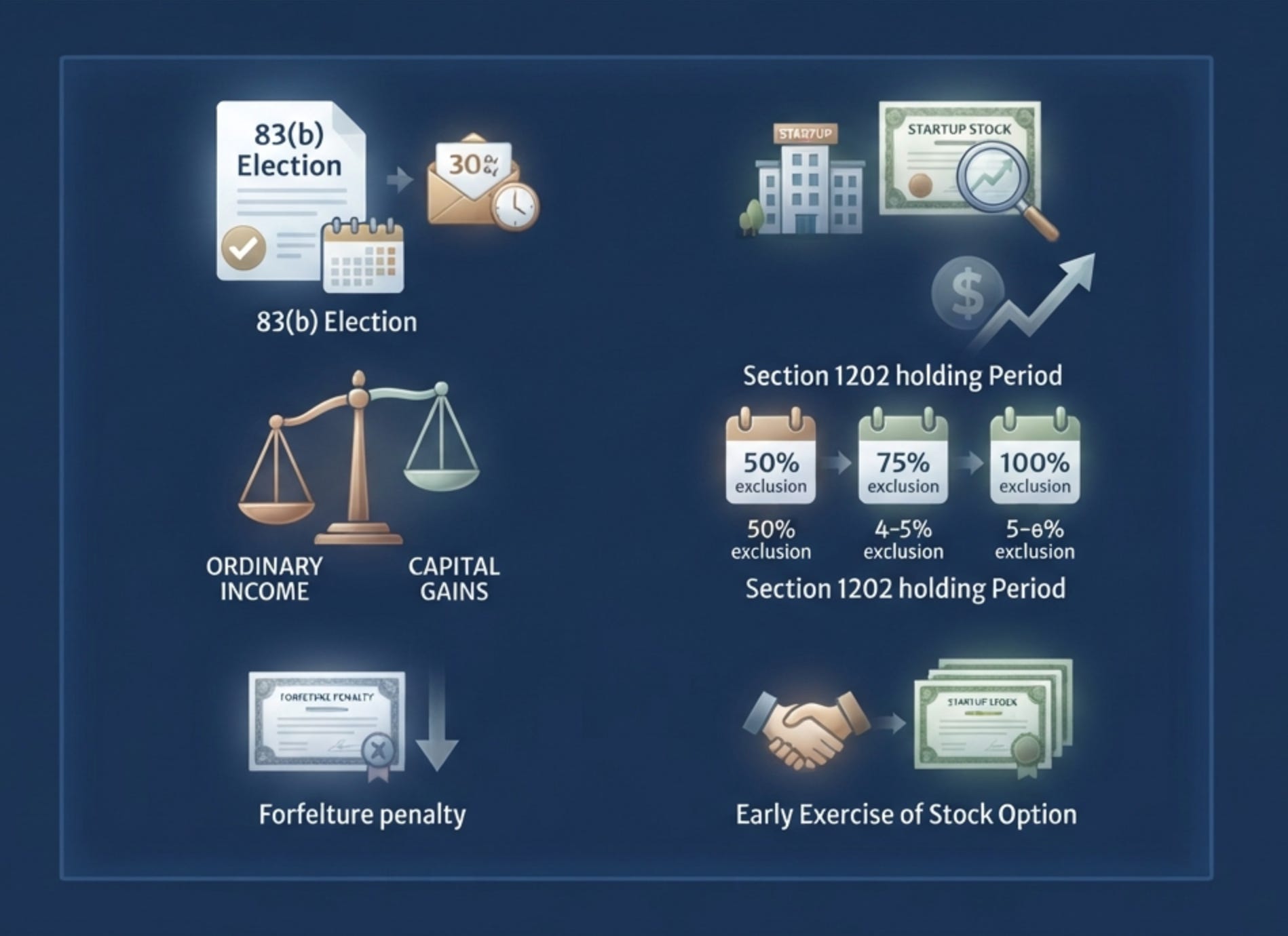
Does An 83b Election Affect QSBS Tax Exclusion Eligibility
Description
A founder who wants the Section 1202 gain exclusion on restricted stock must file a Section 83(b) election within thirty days of the transfer date, because 26 CFR Section 1.83-4 ties the start of the Section 1202 holding period to that election, not to the date the stock vests. File on time and the clock starts the day the company issues the shares. Miss the window and the clock restarts, tranche by tranche, on every vesting date, and there is close to no reliable way to fix a missed filing after the fact.
I have watched a founder learn this the hard way at the closing table, three years into a company he built from a spare bedroom, when the buyer’s counsel asked for copies of every 83(b) election on the cap table and one cofounder had none. The missing election did not sink the deal, but it cost that cofounder several years of Section 1202 exclusion on stock that had already appreciated well past what he paid for it, because his holding period had never started on the grant date at all. It started later, piecemeal, on each date a slice of his shares vested, and by the time of the sale several of those slices had not cleared the statutory holding period.
Section 83 of the Internal Revenue Code has taxed property transferred for services since 1969. Under Section 83(a), a founder who receives stock subject to a vesting schedule owes ordinary income tax at each vesting date on the difference between the stock’s value that day and whatever the founder paid for it. Section 83(b)(2) lets the founder elect out of that staggered treatment and instead recognize income once, at grant, based on the value on the grant date. For a founder who buys stock at formation, when the company is worth close to nothing, that value is often zero or close to it, so the election produces little or no tax due immediately, and it converts every dollar of future appreciation into capital gain rather than ordinary income realized years apart at each vesting date.
The Ninth Circuit decided whether this election rule even applies to founder stock in Alves v. Commissioner, 79 T.C. 864 (1982), affirmed, 734 F.2d 478 (9th Cir. 1984), holding that stock purchased for its full current value but subject to a repurchase right is still property received in connection with services under Section 83. That case is why every competent startup lawyer tells a new founder to file the election even when the founder paid cash for the shares at formation. The stakes of that advice changed on July 4, 2025, when the One Big Beautiful Bill Act rewrote Section 1202 for stock issued after that date. The per issuer exclusion cap rose from $10,000,000 to $15,000,000. The gross asset ceiling a company must meet at issuance rose from $50,000,000 to $75,000,000. Most importantly for the timing question, Congress replaced the old five year cliff, under which a founder excluded nothing before year five and everything after, with a tiered schedule: fifty percent exclusion after three years, seventy five percent after four years, and the full exclusion only after five years.
That tiered structure raises the value of getting the start date right. A founder who files a Section 83(b) election on a July 2025 grant reaches a fifty percent exclusion in the summer of 2028, three years after a single, known grant date. A founder on the identical cap table, granted the same day but without the election, and vesting monthly over four years, does not even reach the three year mark on his last vesting tranche until roughly seven years after the company issued the stock, because Treasury Regulation Section 1.83-4 starts each unvested block’s own holding period on its own vesting date rather than on the single date the founder actually received the grant. Two founders, same company, same start date, and one of them is years behind the other in reaching the exclusion because of a form that was due thirty days after the grant and never filed.
The deadline itself is