Episode Details
Back to Episodes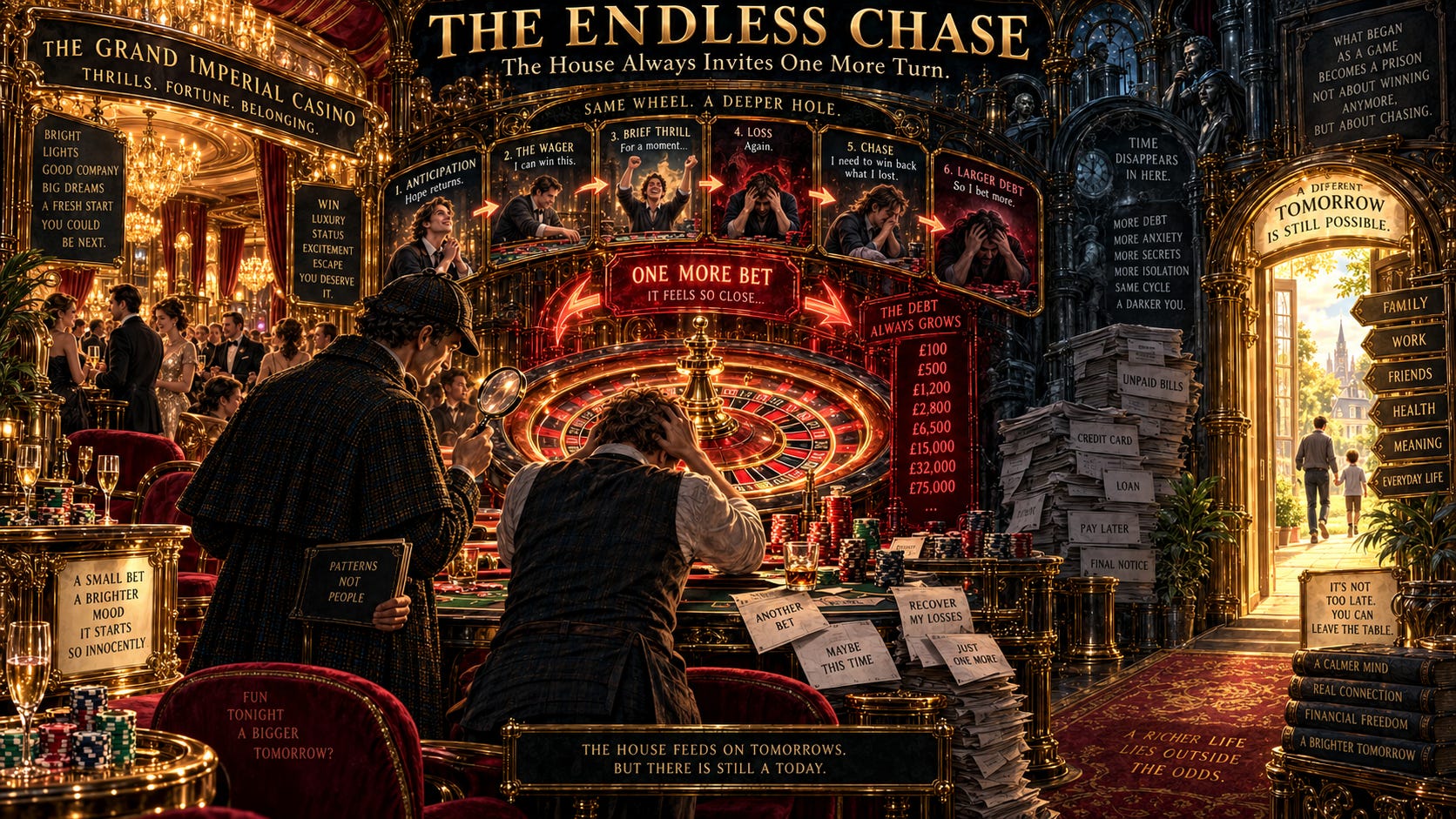
PSYCH 125: Gambling Disorder
Description
Medlock Holmes enters an immense Neo-Victorian casino called The House of the Endless Chase.
At first, the place appears glamorous.
Roulette wheels turn beneath chandeliers. Cards slide across green felt. Slot machines sing. Sports odds flicker across brass boards. Online betting screens glow in distant alcoves.
But Holmes notices something that ordinary gamblers do not.
Almost every corridor leads back to the tables.
A sign above the entrance reads:
“The first wager is about winning. The disorder is about continuing.”
Gambling has existed across human history - dice, cards, lotteries, races, casinos, sports and now internet wagering. For most people it remains recreational. But for a vulnerable minority, gambling shifts from an activity into an addiction.
That conceptual shift is important. Gambling disorder was historically grouped with impulse-control disorders. DSM-5 moved it into the category of non-substance-related addictive disorders, reflecting evidence that its behavioural patterns, reward circuitry, craving, impaired control and relapse resemble substance addictions.
Holmes enters the first chamber and sees nine great levers controlling the disorder.
The gambler needs increasingly large wagers for excitement.
Attempts to cut down produce restlessness and irritability.
Repeated promises to stop fail.
Thoughts become consumed by gambling.
Dysphoria triggers further play.
Losses are chased.
Lies conceal the extent of involvement.
Relationships and occupations are jeopardised.
Money is sought from others to rescue the financial consequences.
Four or more of these features over a twelve-month period establish the diagnosis in the framework described by the source.
Yet Holmes quickly realises that one feature dominates the whole casino:
CHASING LOSSES.
A person loses £100 and returns to recover it.
Then £500.
Then £5,000.
The original goal was profit.
Now the goal becomes escape from loss.
But every attempt to escape creates a deeper loss.
The gambler begins moving money between credit cards, family accounts, loans, savings and borrowed funds. What was once financial planning becomes the machinery that sustains the chase.
The casino contains no clocks.
That is appropriate.
The pathological gambler increasingly lives in an eternal present.
Future consequences - debt, divorce, unemployment, prosecution - become psychologically distant compared with the immediate possibility of the next wager.
Holmes now understands the word repeatedly used in the chapter:
Action.
The gambler is not merely seeking money.
The wager itself generates arousal.
Anticipation.
Risk.
Possibility.
The moment before the outcome becomes intensely rewarding.
Winning allows continued gambling.
Losing creates pressure to recover.
Either outcome can feed the next bet.
This helps explain why severe gambling disorder can eventually continue even when gambling itself brings little genuine pleasure.
Holmes then enters the Cognitive Distortion Hall.
A player remembers spectacular wins while forgetting hundreds of losses.
Another believes five consecutive losses mean a win must now be due.
Another interprets a near miss as evidence that success is getting closer.
Another exaggerates personal skill in an activity dominated by chance.
Another sees patterns where none exist.
The casino exploits these cognitive vulnerabilities expertly.
Lights.
Sounds.
Near misses.
Free drinks.
Rewards for prolonged play.
“Comps.”
Constant availability.
Online access.
Every feature encourages