Episode Details
Back to Episodes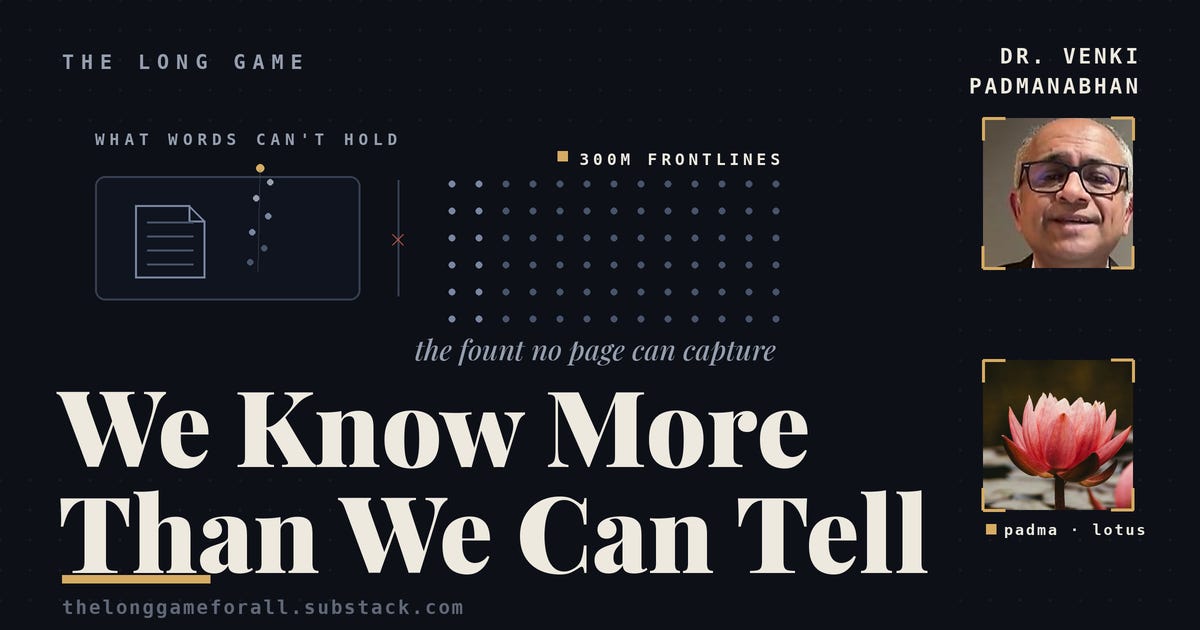
What the Document Can’t Hold: The Limits of Standardized Work and the Fount of Tacit Knowledge
Description
For ten weeks I’ve been making the case that frontline intelligence is systematically suppressed — by Taylor’s design, across industries, with devastating economic consequences. I’ve held up the Toyota Production System as the clearest proof that the opposite approach works. Toyota asks for frontline intelligence. Toyota deploys it. Toyota gets a million suggestions a year, world-class quality, and decades of compounding improvement.
This week I’m going to do something that will surprise readers who’ve been following along. I’m going to challenge Toyota’s system — not from the outside, not from theory, but from twenty years of practicing it.
Because even the best system in the world contains a hidden assumption that limits what it can capture. And that assumption matters enormously for what comes next — for AI, for the future of work, and for the question at the center of this entire series: where does frontline intelligence actually live?
The Two Translations
Standardized work, in the Toyota system, is the documented current best-known method for performing a task. It is a floor, not a ceiling — the baseline from which improvement is measured. I’ve spent twenty years teaching it, defending it, and building production systems around it. It is vastly superior to Taylor’s instruction card because it belongs to the worker, not to management, and it exists to be improved, not merely followed.
And yet.
Here is what happens when you standardize work. A skilled worker performs a task. That task involves knowledge — some of it explicit (the sequence, the tools, the specifications) and some of it tacit (the feel of the material, the sound of the machine, the micro-adjustments that the worker’s hands make without conscious instruction from the worker’s brain).
Standardization requires translating that performance into a written document. The worker’s embodied knowledge — knowledge that lives in muscles, in timing, in sensory perception — must be converted into words on a page. Diagrams. Step numbers. Key points. This is Translation One: from tacit knowledge to written text.
Then a new worker must learn the task. They read the document — or, more commonly, a certified trainer walks them through it using the document as a guide. The written text must now be converted back into physical performance. The new worker must translate words and diagrams back into hand movements, timing, sensory attention, and judgment. This is Translation Two: from written text back to embodied action.
Here is my challenge, after twenty years: both translations lose information.
Translation One loses everything that language cannot capture. The experienced operator who can feel when a torque application is approaching the edge of specification — that sensation has no adequate written representation. The machinist who hears the difference between a tool cutting correctly and a tool about to fail — you can write “listen for unusual sounds,” but that instruction contains approximately zero percent of the actual knowledge the machinist possesses. The welder who sees the puddle behavior that indicates penetration quality — the visual pattern is real, the knowledge is precise, but the words to describe it are approximations at best.
Translation Two loses everything that reading cannot transmit. A document can tell you the sequence. It cannot give you the rhythm. It can describe a hand position. It cannot teach you the pressure. It can specify a quality check. It cannot develop the eye that sees the defect before the measurement confirms it.
Every time we standardize work, we pass knowledge through these two lossy translations. What comes out the other side is useful — it preserves the explicit structure of the task — but it has been stripped of the tacit dimension that often contains the most economically valua