Episode Details
Back to Episodes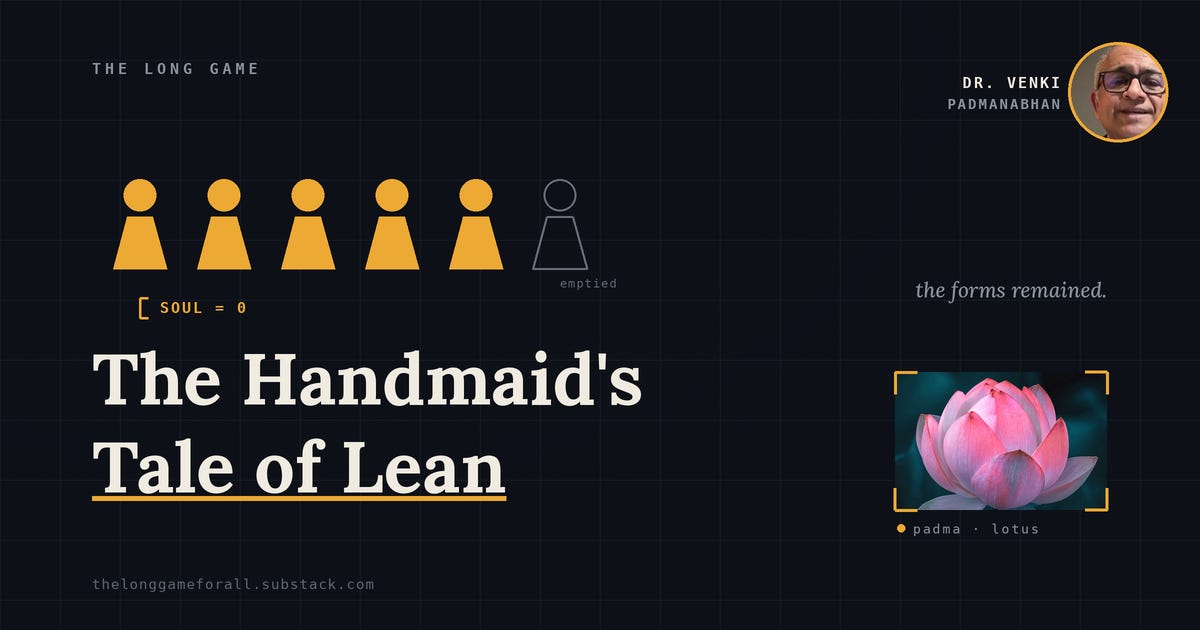
The Walden Pond Testimony: What I Saw When Nobody Came Down to Talk
Description
For eleven weeks I’ve been presenting other people’s evidence. Research papers, historical texts, industry data, case studies from Toyota, the Ritz-Carlton, Costco, Magnet hospitals.
This week the evidence is mine.
I need to tell you what I saw, because it’s the reason this series exists. Not the research — I found the research later. The seeing came first. And what I saw changed everything I thought I knew about manufacturing, about workers, and about the system I had spent my career operating inside.
Here is the argument in one line: intelligence suppression is not a theory or a statistic. It is something done to real people, every shift, and I watched it being done. That’s the argument. The rest of this essay is what it looked like.
The Handshake That Wasn’t Returned
I didn’t go to Lansing Delta Township seeking revelation. I thought I was returning to familiar ground. I had spent years at Lansing Grand River — another GM plant across town — proving that when you recognize and invest in human intelligence, you build not just a better workplace but a more profitable one. LGR had won JD Power Gold. It was the proof of concept for everything I believed.
I thought I understood manufacturing. I was about to learn how much I didn’t.
The warning signs appeared within hours. At the plant manager’s meeting, I reached out for a handshake — the firm, look-you-in-the-eye handshake that had been the foundation of everything we built at LGR. The handshake wasn’t courtesy. It was recognition. It said: I see you. You matter.
Not one person met it with the same energy. No eye contact. No connection. These weren’t bad people. They were people who had stopped expecting human connection at work.
Then I went to the floor for my first production meeting. In fifteen minutes I heard the phrase “at my level” five or six times. “At my level, I don’t have to deal with this stuff.” The language of separation. At LGR that phrase would have been anathema. Here, levels weren’t acknowledged — they were wielded like weapons. And every other sentence carried a threat: “If you don’t get this done, you’re going to get fired.” The whole environment radiated adversity — supervisors against workers, union against management, everyone protecting territory.
I walked to the start of the trim shop and began introducing myself, shaking hands, asking about the work. They looked at me with genuine surprise. Several long-serving workers said the same thing: “The last time anyone from leadership came down to talk to us was the first plant manager, years ago. Nobody comes down anymore.”
I had been there less than a day, and I already knew something was profoundly wrong.
The Handmaid’s Tale of Lean
A pattern became clear. The plant wasn’t ignoring Lean — it was performing it. Everywhere I looked were the artifacts: visual management boards, 5S audits, standardized work, problem-solving cascades. The forms were all there. The soul was gone.
The phrase that kept running through my mind was the Handmaid’s Tale of Lean. Just as Atwood’s dystopia used the language of faith and community to enforce oppression, this plant used the rituals of Lean to enforce compliance. Every ceremony remained, emptied of meaning. They had become tools of control, not empowerment.
I knew what real Lean looked like, because I had lived it at LGR. This was Lean’s evil twin — all the demands of the system, none of the investment in people.
The history explained it. When Delta Township opened, many LGR leaders came over and brought the philosophy with them. The early years were good. Then came 2008, the bankruptcy, and the exodus. New leaders arrived — competent, well-meaning — who had never experienced what we built. Yet they were told to run a “Lean” plant. So they seized the visible artifacts and demanded adherence. Combine the demand for Lean artifacts with zero investment in people, and you g