Episode Details
Back to Episodes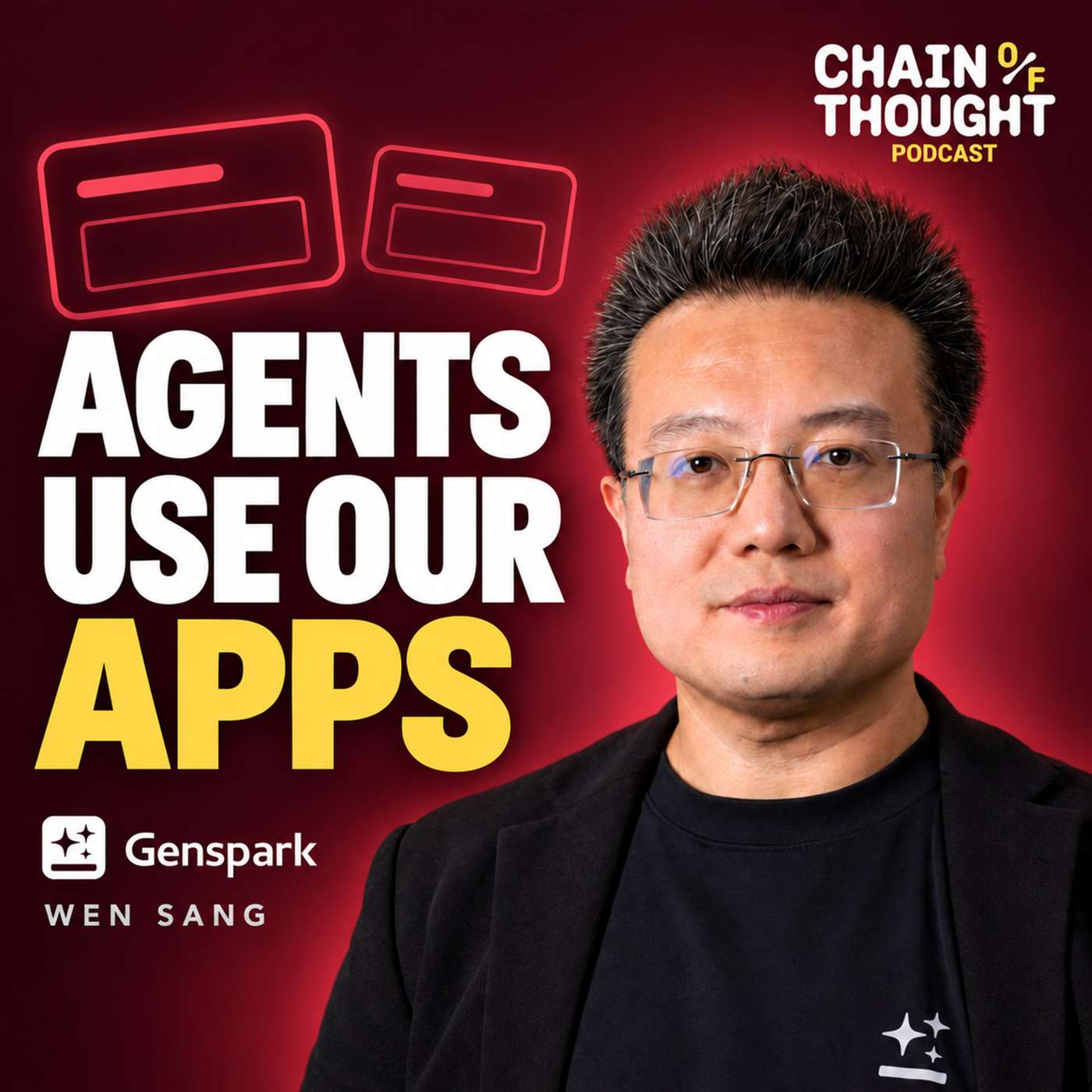
Genspark's Bet: AI Agents Become the Users of Software | Wen Sang
Description
Genspark went from launch to $250 million in ARR in about a year. Along the way it shipped a card-thin meeting recorder, open sourced an office suite that Wen Sang says one engineer prototyped in a week, and started running product triage with agents instead of product managers.
Full transcript and chapters: https://chainofthought.show/podcast/73-gensparks-bet-ai-agents-become-the-users-of-software/
Wen's bet is that agents, not people, become the next users of software.
Wen Sang is co-founder and COO of Genspark. In this episode he walks through the company's three-layer architecture (models, tools and premium data as the execution layer, a memory layer he calls the second brain, and a collaboration layer called Gen Team), why a meeting note should be the start of work rather than the end of it, the engineering behind the SecondBrain Note, and where he thinks knowledge work goes once agents absorb the busy work.
Disclosure: Genspark provided the SecondBrain Note recorder discussed in this episode at no cost. Genspark is not a sponsor of this episode.
We cover:
- Why Genspark builds the self-driving car around the frontier labs' engines, and what that means for people who cannot code
- How Genspark's mixture-of-agents architecture routes work across 70+ models, 150+ in-house tools and paid data sets
- Evals that grade whether the sales proposal answered the RFP, not whether the model can solve a differential equation
- What a meeting turns into a week later when an agent needs it: proposals, pricing models, research, follow-ups
- The SecondBrain Note's microphone array, battery decisions, and consent in a two-party state
- Why GenOffice went open source, and the one-week prototype story behind it
- How Genspark runs product feedback triage with agents and no dedicated PMs
Chapters:
(0:00) Cold open
(0:32) Geniuses with goldfish memories
(3:47) Engines and vehicles: Genspark builds the self-driving car
(6:25) Mixture of agents: models, in-house tools and premium data
(10:03) Grade the work output, not the intelligence
(11:22) A meeting note is where the work starts
(13:25) The second brain: Genspark's memory layer
(14:45) A thousand recorders, one question for the revenue team
(16:33) Execution, memory and collaboration layers
(19:19) Ten days in Bora Bora without a laptop
(20:07) Gen Team, Slack, and meeting customers where they are
(21:57) Agents become the users of software
(24:17) Keeping memories current when the deal changes
(26:41) Engineering the SecondBrain Note
(30:18) The note as an API for the room
(31:19) What deserves hardware and what stays software
(33:33) Learning hardware supply chains at a two-year-old company
(35:05) Why GenOffice went open source
(38:01) What knowledge workers do once the busy work is gone
(40:07) Building on Genspark with the CLI
(42:01) Consent, two-party states and the surveillance line
(43:45) Genspark Claw
(47:09) Cheaper hardware, deeper integration, and model welfare
(51:13) Eighty people and a lot of agents
(53:03) What 2027 looks like
(59:26) Where to find Wen, and product triage without PMs
Connect with Wen Sang:
- LinkedIn: https://www.linkedin.com/in/wen-sang/
- Twitter/X: https://x.com/sang_wen
- Genspark: https://www.genspark.ai
- GenOffice on GitHub: https://github.com/genspark-ai/genoffice
Connect with Chain of Thought host Conor Bronsdon:
- Newsletter:
Listen Now
Love PodBriefly?
If you like Podbriefly.com, please consider donating to support the ongoing development.
Support Us