Episode Details
Back to Episodes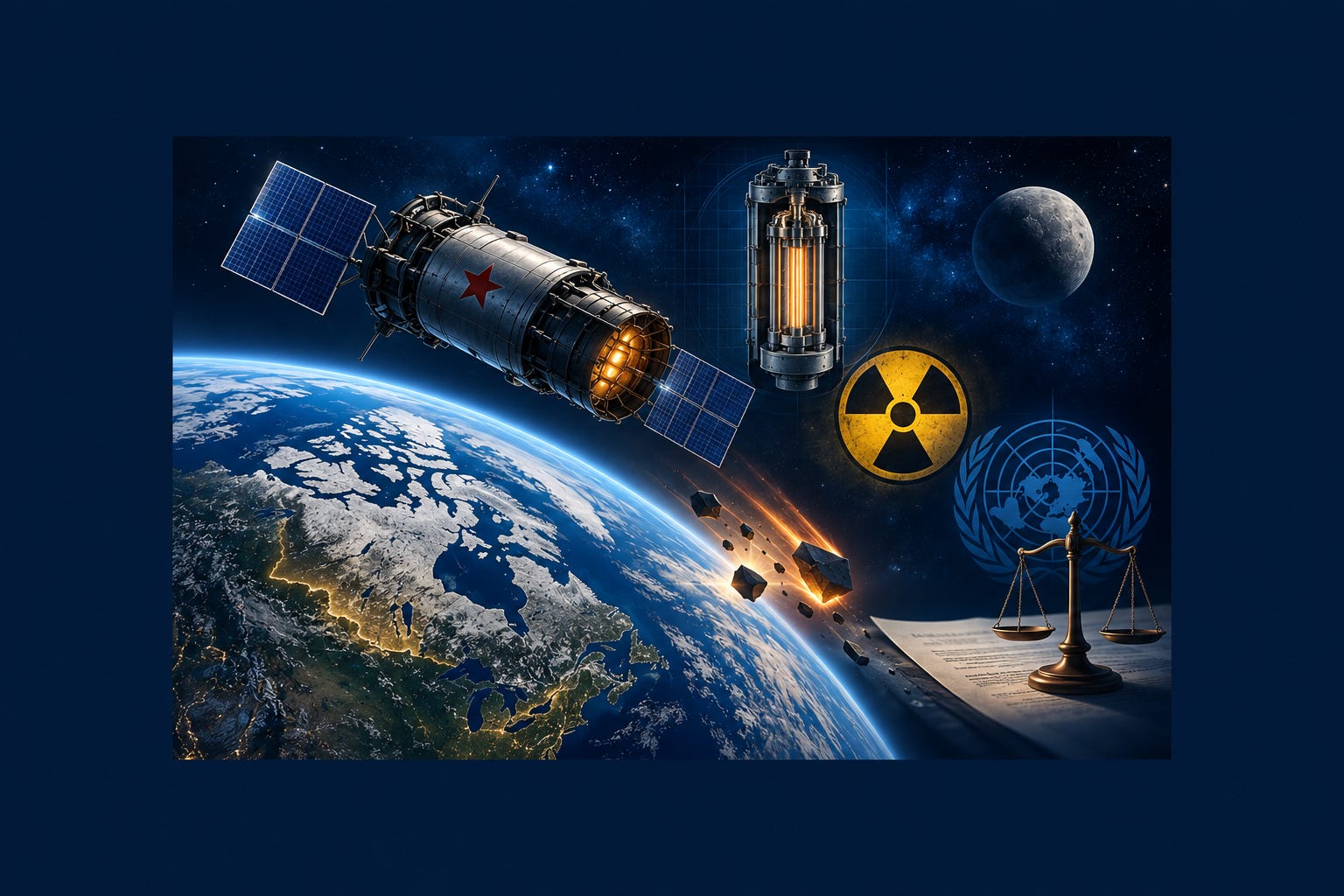
From the Country that Brought You Chernobyl
Description
The Buk Reactor Behind Kosmos 954 Still Shapes Space Nuclear Law
why did the soviet union put a nuclear reactor in orbit
A Soviet nuclear reactor called Buk fell out of orbit and scattered radioactive debris across northern Canada on January 24, 1978, after the satellite carrying it, Kosmos 954, lost control. Soviet engineers had built Buk to power a satellite radar system that tracked American and NATO warships from an orbit too low and too power hungry for the solar panels of the 1970s to sustain, and by December 1977 Moscow had already told Washington privately that it had lost the ability to steer the reactor to a safe disposal orbit. The satellite came down over the Northwest Territories anyway, and for several days nobody outside a small circle of Soviet, American, and Canadian officials could say how much of the wreckage was still radioactive or where the next piece might land.
Kosmos 954 had been flying since September, one of a fleet of satellites the Soviet navy used to track American aircraft carriers by radar, day and night, in fair weather and storm. What made it different from every other spy satellite in orbit was tucked inside its belly: a working nuclear reactor, fueled with uranium enriched well past ninety percent, small enough to fit inside a cylinder smaller than a beer keg.
The reactor existed because radar is a power hungry instrument and low orbit is a power starved place. To resolve a moving carrier group precisely enough to cue an anti ship missile, the US A satellites had to fly barely 270 kilometers up, low enough that atmospheric drag would pull an unpowered satellite down within weeks, and low enough that the solar arrays of that decade could not keep the radar’s electronics running through every eclipse the orbit produced. The Buk reactor solved that problem by brute force. Its core packed about fifty kilograms of highly enriched uranium into that small cylinder, ran hot enough to push roughly 100 kilowatts of heat through a bank of thermoelectric converters bolted to its skin, and delivered a modest three kilowatts of electricity in return. A terrestrial power engineer would call that conversion rate a failure. In orbit, where every kilogram costs a fortune to launch, it was the whole point: no fuel to haul up later, no sunlight required, no moving parts to wear out over a mission that might run three months.
The plan for what happened after the mission mattered just as much as the reactor itself. Once a satellite finished its surveillance run, its own thrusters were supposed to fire twice and push the spent core into a storage orbit nearly 900 kilometers up, high enough that its fission products would decay for centuries before the orbit itself ever decayed enough to bring the wreckage home. It is a design built entirely on one successful maneuver. Standing reactor watches on a naval vessel teaches you to expect layers of independent shutdown paths and a crew standing by around the clock for the entire life of the plant. Buk had none of that once it left the ground. One ballistic burn, unsupervised, months after the last technician had touched the hardware, and if it failed there was no second system standing behind it, at least not until Kosmos 954 forced the Soviets to build one.
That failure did more than scatter debris across a few hundred kilometers of Canadian tundra. It activated a treaty that had never been tested, the 1972 Convention on International Liability for Damage Caused by Space Objects, which holds a launching state to an absolute liability standard for whatever its hardware does to somebody else’s territory. Canada billed the Soviet Union just over six million Canadian dollars, close to five million United States dollars at the time, for the cost of Operation Morning Light, the search and recovery campaign that combed 124,000 square kilometers and pulled radioactive fragments reading as high as 500 roentgens an hour out of the snow. Mosc