Episode Details
Back to Episodes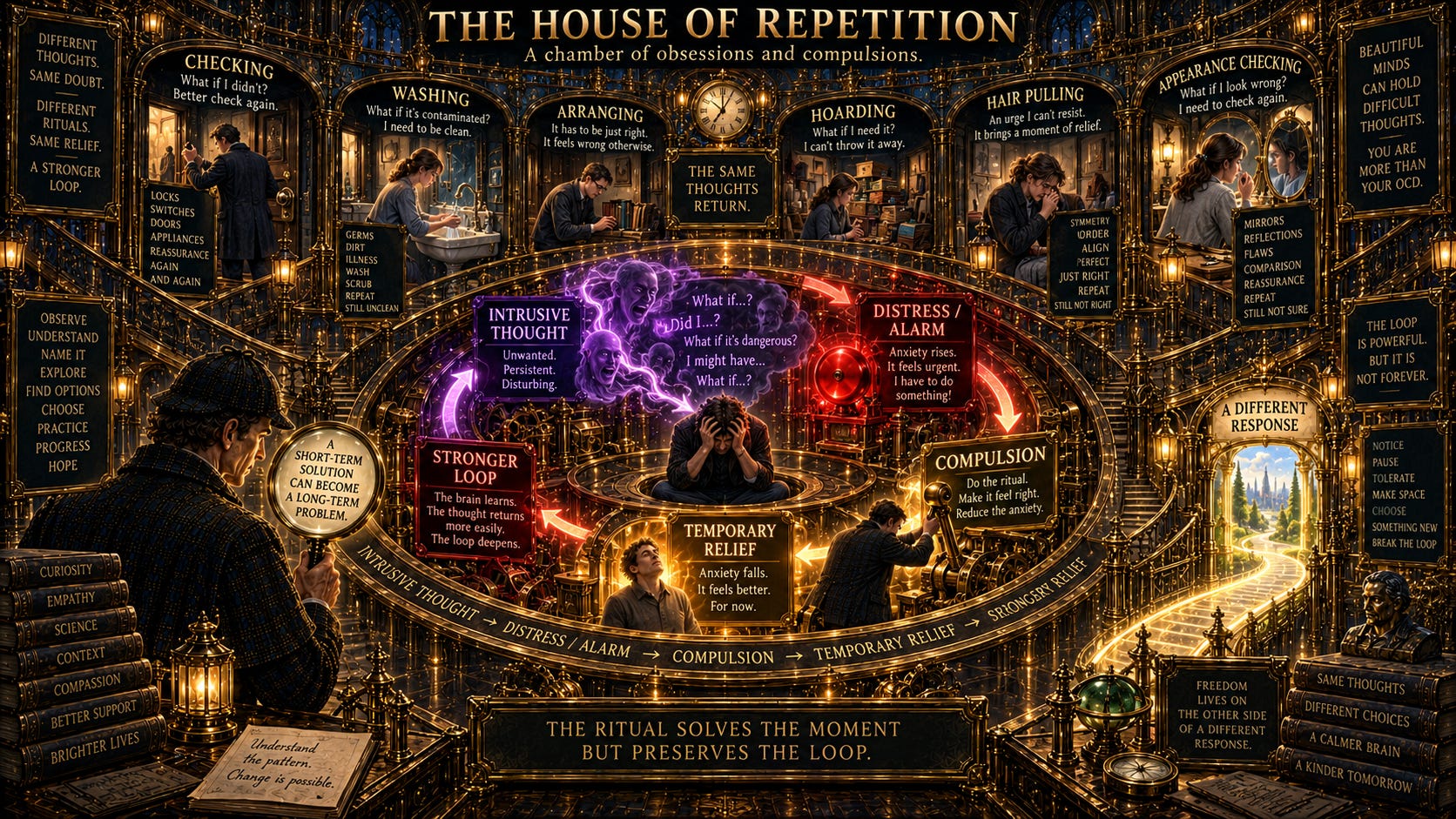
PSYCH 124: Obsessive-Compulsive and Related Disorders
Description
Medlock Holmes leaves the Grand Dispensary of Anxiety and enters an entirely different institution: The Grand House of Repetition.
At first, everything appears orderly. Doors are locked. Hands are washed. Objects are aligned. Possessions are carefully preserved.
Then Holmes notices something unsettling.
The same actions are happening again.
And again.
And again.
A man checks a locked door for the twentieth time. A woman washes already-clean hands. Another person stands before a mirror searching endlessly for an imperfection nobody else can see. Rooms disappear beneath possessions that cannot be discarded. In adjoining chambers, hair is repeatedly pulled and skin repeatedly picked.
Above the entrance is written:
“When repetition stops serving us, we begin serving the repetition.”
This is the world of obsessive-compulsive and related disorders (OCRDs) - a diagnostic family that includes obsessive-compulsive disorder, body dysmorphic disorder, hoarding disorder, trichotillomania and excoriation disorder. Their grouping reflects important phenomenological and biological overlaps, while recognising that each disorder has its own characteristic focus.
At the centre stands OCD.
Holmes discovers its fundamental machinery: obsessions - recurrent, intrusive, unwanted thoughts, urges or images - and compulsions - repetitive behaviours or mental acts performed in response.
The compulsion may reduce distress.
But only temporarily.
That relief reinforces the behaviour, helping the cycle continue.
Yet OCD is more than excessive anxiety. Modern models increasingly describe disturbances in cognitive control, habit formation, error monitoring and cortico-striatal-thalamic-cortical circuitry. The orbitofrontal cortex, anterior cingulate and striatum become major clues.
Holmes also discovers that insight exists on a spectrum. Many patients recognise that their fears are unreasonable. Others are less certain. A small minority become completely convinced of their obsessive beliefs. Poor insight does not automatically transform OCD into psychosis.
The investigation then expands.
In body dysmorphic disorder, repetition revolves around perceived defects in appearance.
In hoarding disorder, difficulty discarding possessions gradually overwhelms living spaces.
In trichotillomania, recurrent hair pulling becomes difficult to resist.
In excoriation disorder, the repetitive behaviour is skin picking.
Different objects.
Different behaviours.
But repeatedly, Holmes finds variations on a deeper theme:
thought → urge → behaviour → temporary consequence → repetition.
Treatment therefore aims to break the loop.
For OCD, SSRIs and clomipramine provide important pharmacological tools, often at substantial therapeutic doses and for sufficiently long trials. But one of the most powerful interventions lies in deliberately confronting the very thing the disorder commands the patient to avoid.
Exposure and Response Prevention - ERP.
Exposure activates the feared uncertainty.
Response prevention blocks the ritual.
The patient learns that distress can be tolerated without obeying the compulsion and that catastrophic expectations need not determine behaviour.
For severe treatment-resistant OCD, Holmes eventually reaches more specialised chambers: antipsychotic augmentation, glutamatergic strategies, intensive behavioural programmes and, in exceptionally refractory illness, neuromodulation or neurosurgical approaches.
The lesson of the Grand House of Repetition is therefore hopeful.
These disorders can become chronic and profoundly disabling.
But