Episode Details
Back to Episodes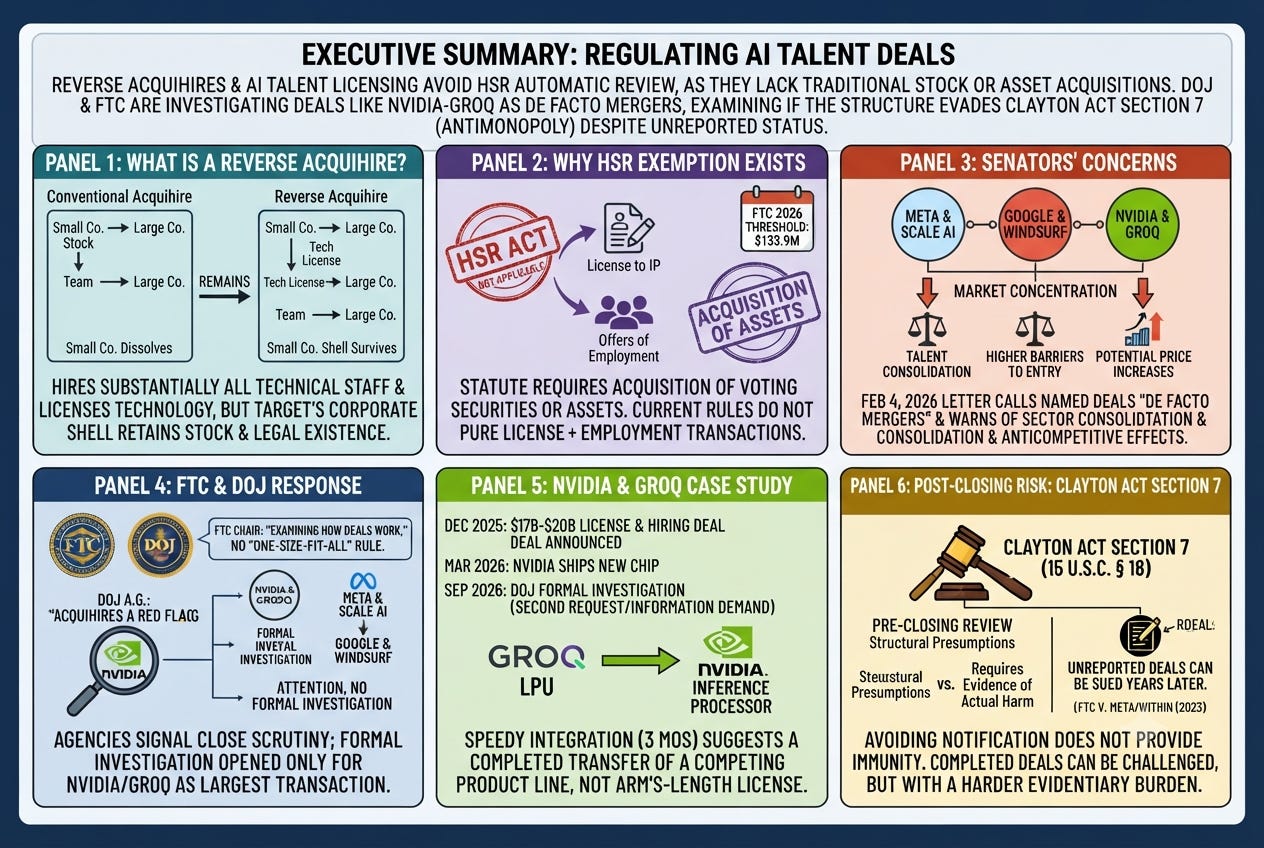
Reverse Acquihire Deals
Description
Nvidia paid Groq somewhere between seventeen billion and twenty billion dollars in December 2025 for a license to a chip design, hired the founder, and never filed a Hart Scott Rodino premerger notification, because on paper nothing that meets the statute’s definition of an acquisition ever changed hands. By September 10, 2026, the Department of Justice had opened a formal investigation anyway and sent Nvidia a civil demand for information, a step triggered in part by how fast Nvidia shipped a product built on the licensed technology: an inference chip incorporating Groq’s design reached the market within three months of the deal’s announcement. That speed is what the Department of Justice is now chasing, and it points to a question every company assembling a similar deal in 2026 needs answered before it signs: does hiring a rival’s engineers and licensing its technology, instead of buying the company outright, actually keep a transaction out of federal antitrust review.
The short answer is no, not entirely, and the distinction matters more than most deal memos currently acknowledge. The Hart Scott Rodino Act, 15 U.S.C. section 18a, requires a premerger filing only when a transaction involves the acquisition of voting securities or assets above a size threshold the Federal Trade Commission sets each year, a figure that rose to 133.9 million dollars for 2026, effective February 17. A reverse acquihire, the structure Nvidia used with Groq and the structure Microsoft used first with Inflection AI back in March 2024, is built from two components that sit outside that definition: an employment offer and a technology license. The target company’s shell keeps its stock. Nobody buys an asset in the sense the statute means. That is why Meta’s June 2025 arrangement with Scale AI, Google’s July 2025 arrangement with Windsurf, and Nvidia’s own December 2025 arrangement with Groq were never reported to the Federal Trade Commission, and why three United States Senators felt compelled to write to the agency and to the Department of Justice on February 4, 2026, describing all three as de facto mergers that consolidate technical talent while dodging the review a stock purchase of the same size would have triggered automatically.
Congress did not build the Hart Scott Rodino Act to catch this maneuver, and the Federal Trade Commission has said as much. The Chair of the Commission told reporters on February 20, 2026, that there is no one size fits all rule for when a talent focused deal crosses into premerger territory, and that the agency is beginning to look very closely at how these arrangements work. Read plainly, that is an admission that the current premerger notification form was not designed with a seventeen billion dollar chip license and a mass resignation in mind. A separate Commissioner went further, warning that a company can acquire a rival’s engineers not to put them to work but to keep a competitor from hiring the same people, the same preemptive logic antitrust law has long applied to pharmaceutical companies buying up early stage drug candidates they never intend to develop. The head of the Department of Justice’s Antitrust Division called acquihires generally a red flag. None of that, so far, is a rule, a filing requirement, or an enforcement action against Meta or Google.
What it is, instead, is the setup for a much older kind of antitrust fight, the kind that happens after a deal closes rather than before. Clayton Act Section 7, 15 U.S.C. section 18, bars any acquisition whose effect may substantially lessen competition, and that prohibition does not care whether a Hart Scott Rodino filing was ever made. A company that structures its way out of premerger notification has not structured its way out of Section 7 liability; it has only changed when and how that liability gets tested. Former Federal Trade Commission Commissioner Joshua D. Wright made exactly this point in a 2026 commentary, arguing that a rev