Episode Details
Back to Episodes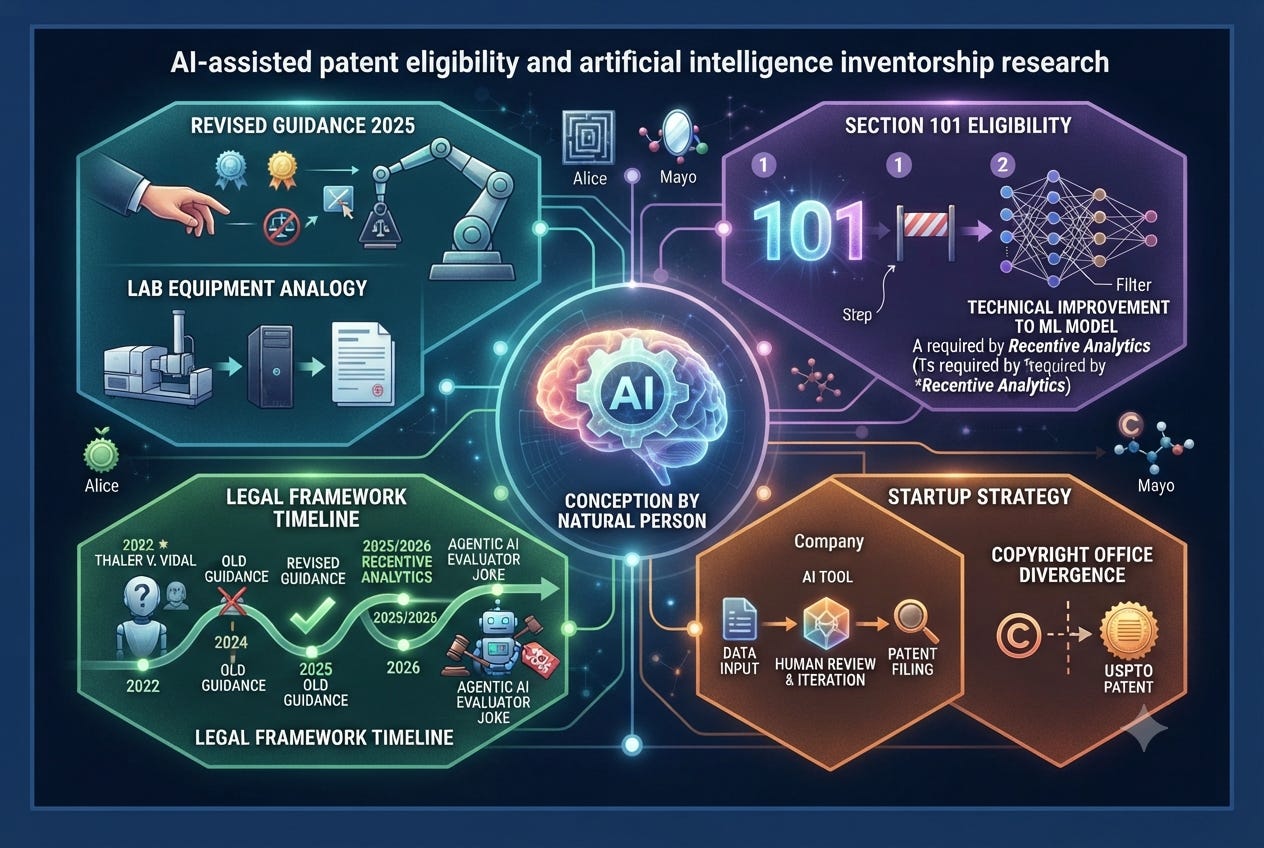
USPTO Splits AI Patent Rules
Description
The United States Patent and Trademark Office rescinded its own AI inventorship policy on November 28, 2025, and the replacement rule makes it easier for a startup to name a human inventor on a patent application built with large language models. On the same general subject, a separate April 18, 2025 Federal Circuit decision, Recentive Analytics, Inc. v. Fox Corp., made it harder for that same startup to survive a patent eligibility challenge to the underlying claims. A founder who reads only the inventorship headline could reasonably conclude that AI built inventions just became simpler to patent. On the claims themselves, the opposite is closer to the truth, and a widely shared story about a new agentic AI eligibility evaluator inside the patent office turns out to be a confirmed April Fools’ Day joke, not a tool an applicant can rely on.
Patent counsel have tracked two separate questions since large language models entered product development in earnest: who counts as the inventor when a machine generates text, code, or a candidate molecule, and whether the resulting claim describes patentable subject matter at all under 35 U.S.C. section 101. The USPTO answers the first question. The Federal Circuit, and eventually Congress, answer the second. A founder who conflates the two is the one most likely to file a defective application or lose a case on a motion to dismiss never seen coming.
Section 100(f) of the Patent Act defines an inventor as the individual who invented the claimed subject matter, and the Federal Circuit read that word literally in Thaler v. Vidal, holding in 2022 that a machine named DABUS could not appear as an inventor because the statute’s pronouns confine inventorship to natural persons. That case never answered the harder question a startup actually faces: what happens when a person uses an AI system as a drafting partner or a hypothesis generator but still directs and completes the inventive work. The USPTO’s February 2024 answer required examiners to weigh whether the human’s contribution was significant against the AI system’s output, borrowing the multi factor test from Pannu v. Iolab Corp., a case built to sort out competing claims among human co-inventors, not to score a person against a machine. The November 2025 guidance throws that weighing exercise out. It states plainly that the same inventorship standard applies to every invention regardless of whether AI was used, and it defines inventorship the old way: a natural person must form a definite and permanent idea of the complete invention, detailed enough that only ordinary skill would be needed to build it. An AI system, under this guidance, is a tool, no different in kind from a mass spectrometer or a compiler.
In thirty years of counseling companies developing technology that outruns the statute, the recurring failure point was never the doctrine itself. It was the invention disclosure form, the internal document that describes how an idea came to be. Engineers write down what the model produced. They rarely write down what they did to get there: the prompts they revised, the outputs they rejected, the moment a person recognized that one candidate structure actually solved the problem. Under the new guidance, that second story, the human one, is the entire inventorship case. A startup that wants the benefit of the loosened standard needs a contemporaneous record of iterative prompting, meaningful revision of AI output, and the specific decision point where a person, not the model, recognized the complete invention.
None of that solves the second question, and it is the one with real teeth. Section 101 asks whether a claim describes patentable subject matter before anyone reaches novelty or obviousness, and the governing test, drawn from the Supreme Court’s decisions in Mayo Collaborative Services v. Prometheus Laboratories and Alice Corp. v. CLS Bank International, runs in two steps. First, is the claim directed t