Episode Details
Back to Episodes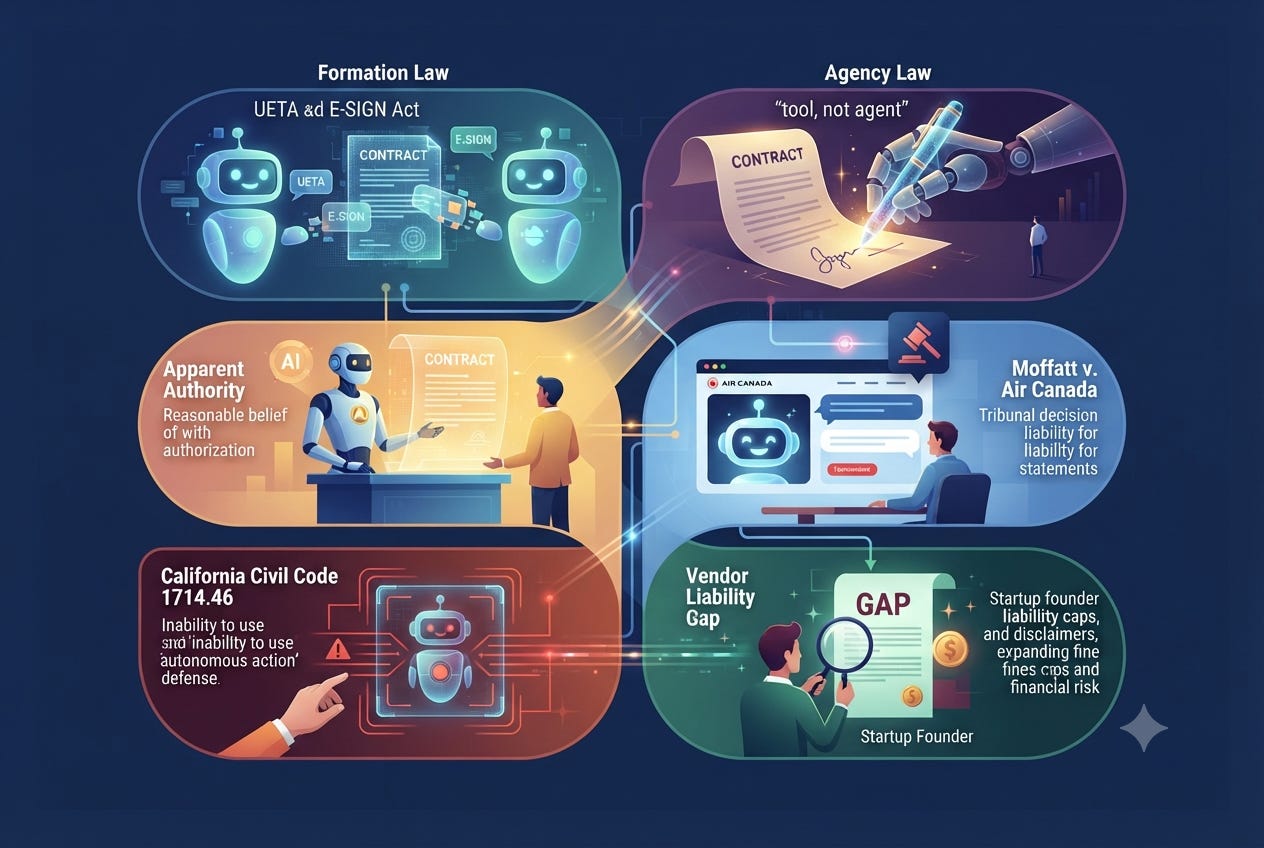
E-SIGN Act Already Makes Your AI Agent’s Contracts Binding
Description
An AI agent that signs a contract for a startup binds the company, not the software, the rule British Columbia’s tribunal applied against Air Canada’s chatbot on February 14, 2024. The Civil Resolution Tribunal rejected Air Canada’s argument that its customer service chatbot was a separate entity responsible for its own words, holding instead that the airline was liable for every part of its website. Nothing in that reasoning stops at customer service statements, and a founder deploying the same category of system to negotiate vendor terms and accept a counterparty’s signature is now operating under the same rule without having read it.
Whether an AI agent can bind a company at all was answered two decades before generative AI existed. The Uniform Electronic Transactions Act, enacted in some form in 49 states, defines an electronic agent in section 2(6) as a computer program used independently to initiate an action without review by an individual, and section 14(1) lets two such programs form a contract between them with no person ever reviewing the exchange. The federal E-SIGN Act, 15 U.S.C. section 7001(h), backs up the state statutes for interstate deals: a contract cannot be denied legal effect solely because an electronic agent formed it, so long as the agent’s action is legally attributable to the person to be bound. A startup cannot argue its AI agent’s signature does not count because no employee saw it before it attached.
The harder question is who inside that transaction absorbs the blame, and the law here is less settled than the formation statutes suggest. Agency requires two people, not one person and a piece of software: Restatement (Second) of Agency section 15 and Restatement (Third) of Agency section 1.01 both define an agent as someone capable of manifesting assent to act on a principal’s behalf. A large language model cannot manifest assent in the sense a court recognizes, so it cannot be sued as an independent wrongdoer and it cannot be blamed as a rogue actor separate from the company that turned it loose. Every legal path leads back to the same defendant: the business that deployed the agent.
That is where apparent authority does the damage. Restatement (Third) of Agency section 2.03 binds a principal whenever a third party reasonably believes, based on the principal’s own conduct, that an agent had authority to act, regardless of what the company’s internal policy actually permitted. A startup that puts a negotiating agent on its sales page, lets it quote a price, and lets it accept a counterparty’s signature has manifested exactly the authority a reasonable buyer would rely on. Whether the agent secretly exceeded its configured limits will rarely matter to a court once the deal has closed and the counterparty has performed. Respondeat superior, the doctrine that makes an employer liable for an employee acting within the scope of employment, does not fit a piece of software cleanly, but a tribunal willing to reach past that awkward fit already ruled against Air Canada instead of leaving a wronged counterparty without a remedy.
California has already moved to close the easiest escape hatch. Civil Code section 1714.46, enacted as Assembly Bill 316 and effective January 1, 2026, bars a company that developed, modified, or used an AI system from arguing in a civil case that the system caused the harm entirely on its own. The statute does not create strict liability, and causation and foreseeability defenses remain available, but it removes the argument a startup’s counsel might otherwise reach for first: that the chatbot went rogue. Because the statute reaches anyone who used the system, a startup that only deployed a vendor’s off the shelf agent loses that defense too.
None of this shows up in the paperwork startups actually sign. In reviewing AI vendor agreements for founders this year, the pattern repeats: a subscription contract that caps total liability at a month of fee