Episode Details
Back to Episodes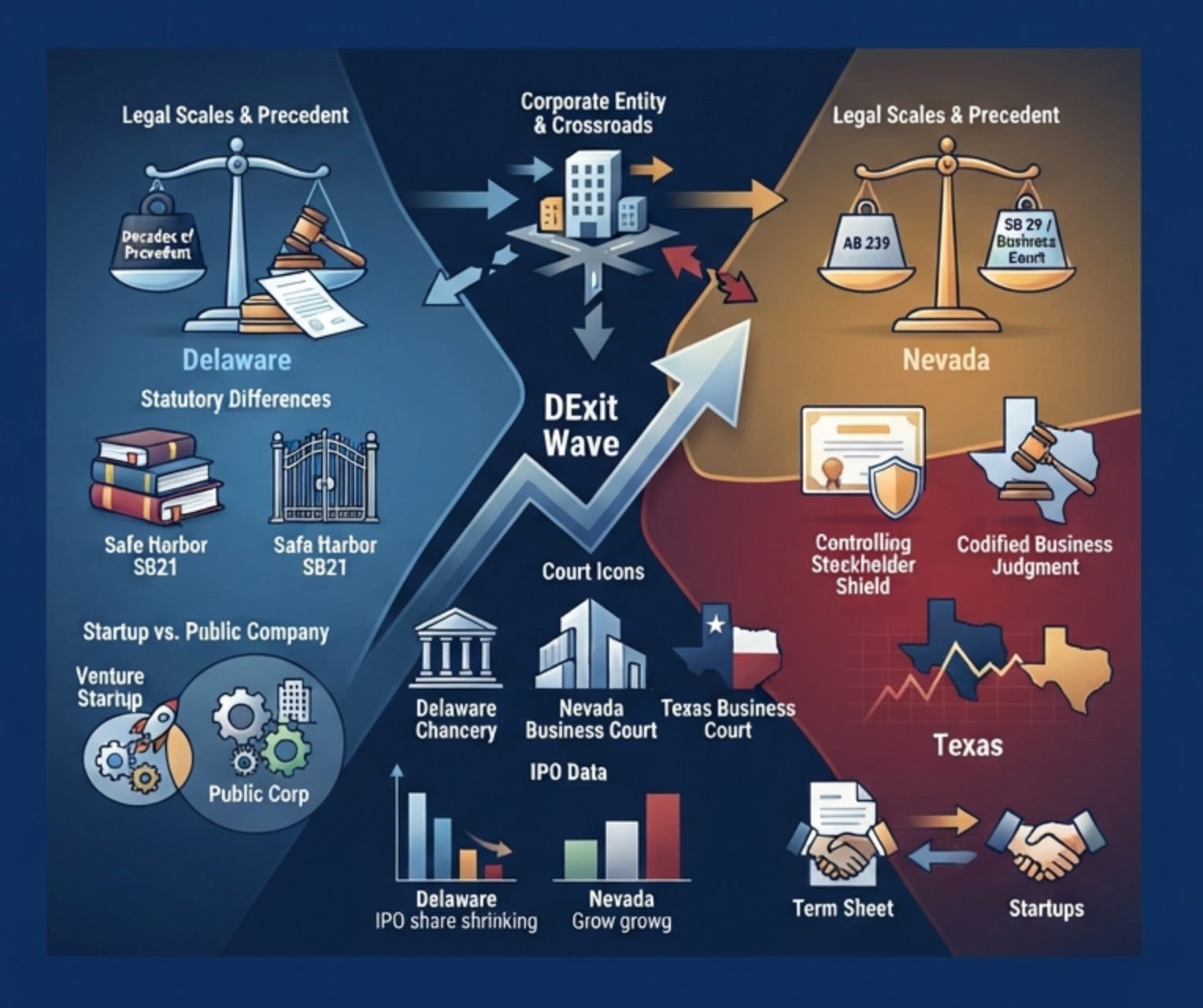
Delaware’s SB 21 Reforms Failed to Halt the 2026 Reincorporation Wave
Description
Delaware enacted Senate Bill 21 in March 2025 to curb the exodus of companies rewriting their corporate charters outside its borders, yet Coinbase Global completed its own move to Texas on December 15, 2025 regardless. The reform narrowed a stockholder’s ability to sue a controlling stockholder or a conflicted officer, and Delaware’s Supreme Court upheld it against a constitutional challenge in February 2026. None of that answers the question a venture backed founder actually has, because almost every company named in the reincorporation wave is a public company with a stockholder vote to hold, a controlling stockholder to protect, or both, and a seed stage or Series A company has neither.
The wave has a specific origin. In January 2024, the Delaware Court of Chancery rescinded a compensation package awarded to Tesla’s chief executive in Tornetta v. Musk, finding the approving board too close to the officer it was supposed to be overseeing. Tesla’s board put a move to Texas to a stockholder vote before the year was out. On December 19, 2025, the Delaware Supreme Court reversed the rescission itself in In re Tesla, Inc. Derivative Litigation, reasoning that undoing the package would leave a chief executive uncompensated for six years of work, but it cut the plaintiffs’ attorney fee award from $345 million to $54.5 million rather than eliminating it, so the flawed process finding survived even as the remedy did not. That fee award is the number every general counsel now has memorized, and the number Nevada and Texas built their pitch around.
Delaware’s fix, signed by the state’s governor on March 25, 2025, amended 8 Del. C. § 144 to create a safe harbor: a transaction with a controlling stockholder or a conflicted director or officer is immune from a duty of care damages claim if an independent committee of disinterested directors approves it, or a majority of disinterested stockholders ratify it, and a going private transaction now needs both. A companion amendment to Section 220 tightened access to books and records, letting the corporation withhold anything beyond an enumerated list absent a showing, by clear and convincing evidence, of a compelling need. A stockholder argued the changes unconstitutionally stripped the Court of Chancery of its own equitable jurisdiction after the fact. The Delaware Supreme Court disagreed on February 27, 2026, in Rutledge v. Clearway Energy Group LLC, comparing the safe harbor to the exculpation clauses Delaware has permitted under Section 102(b)(7) for decades and holding that a stockholder who must now sue under a new statutory standard has lost a favorable rule, not a remedy.
Nevada was already offering broader protection before Delaware acted. Its 1987 exculpation statute, NRS § 78.138(7), has been construed narrowly enough that a plaintiff alleging intentional misconduct rarely survives a motion to dismiss without particularized facts a stockholder lacking inspection rights cannot usually plead. In May 2025, Nevada extended that shield to controlling stockholders through Assembly Bill 239: a controlling stockholder who extracts value from the company without fraud, intentional misconduct, or a knowing violation of law faces no damages claim, a position more permissive than Delaware’s contested safe harbor and one that has not yet been tested by a Nevada appellate court the way Rutledge tested Delaware’s.
Texas built a different case. Its 2025 Senate Bill 29 codified a business judgment presumption at TBOC § 21.419: a director or officer is presumed to have acted properly unless a plaintiff pleads fraud, intentional misconduct, an ultra vires act, or a knowing legal violation. TBOC § 7.001, effective September 1, 2025, let a Texas corporation exculpate its officers from money damages for the first time. Texas paired the statute with a Texas Business Court that convened in September 2024 and finished its first bench trial, a dispute involving Marathon Oil Co., in