Episode Details
Back to Episodes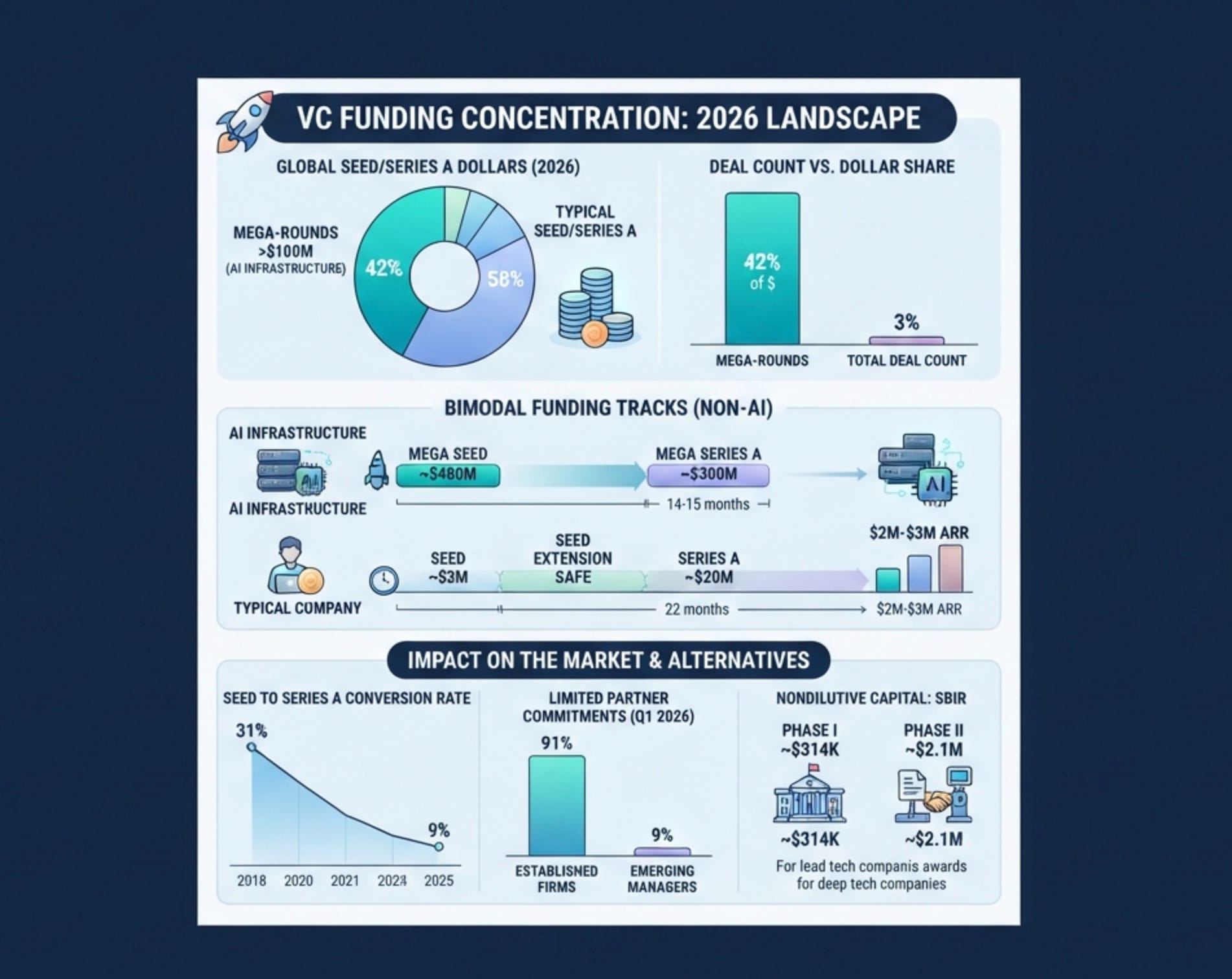
$100MM Seed and Series A Funding in 2026
Description
More than 40 percent of global seed and Series A dollars in 2026 went to rounds above 100 million dollars, concentrated in a handful of artificial intelligence labs like Humans&. That number describes a dollar weighted market dominated by a small set of very large checks, not a repricing of what a normal founder should expect to raise. The median United States seed round in 2026 still sits near 3 million dollars and the median Series A near 20 million dollars, and a founder building a software or hardware company outside frontier artificial intelligence infrastructure is still fundable on those terms, just on a longer clock and against a shorter list of active lead investors.
I have read enough term sheets over thirty years to know when a headline number is doing more work than the underlying deal. A 480 million dollar seed round for Humans& at a 4.48 billion dollar valuation, a 300 million dollar Series A for Ricursive Intelligence at a 4 billion dollar valuation, a 252 million dollar seed for Merge Labs backed by OpenAI: three deals, all closed in January 2026, all funding a capital intensive artificial intelligence or brain computer interface build. Add them together and you get roughly a billion dollars, closed inside a single month, by three companies. That kind of concentration moves an aggregate percentage more than a thousand ordinary seed rounds ever could, and it is why a founder reading that 40 percent statistic can feel like the ground shifted under their own raise when it did not.
The concentration is not new, only sharper. In 2021, roughly 60 percent of United States venture dollars already went to rounds of 100 million dollars or more, spread across several hundred companies. By 2025, roughly 70 percent of United States funding, over 200 billion dollars, went to just 389 companies, with six of those companies alone capturing 90 billion dollars in rounds exceeding 5 billion dollars each. Through the first four months of 2026, 80 percent of United States startup investment went to rounds of 500 million dollars or more, spanning only 29 companies. Five artificial intelligence companies captured roughly 73 percent of United States venture deal value in the first quarter of 2026 alone. Each year the same dollars pool into a smaller set of names.
None of that describes a market that stopped funding normal companies. It describes an aggregate statistic built almost entirely from the top of the distribution while the middle of the market keeps operating on its own terms. The median seed round in the United States in 2026 runs near 3 million dollars, roughly three times the 2018 median, with an upper quartile near 5.6 million dollars. The median Series A runs near 20 million dollars on a roughly 49 million dollar pre money valuation, with dilution in a single close landing near 23 percent. Those are the numbers that describe most seed and Series A companies, and none of them moved because Merge Labs raised 252 million dollars.
What did move is the clock and the bar. A company closing a Series A of 30 million dollars or more now typically does so 14 to 15 months after its seed round. A company closing a smaller Series A, under 10 million dollars, now typically takes about 22 months. The annual recurring revenue expected of a standard Series A has climbed to 2 to 3 million dollars, sometimes 4 million dollars, up from roughly 1 million dollars in 2020. The share of seed companies reaching a subsequent priced round within 24 months fell from roughly 31 percent for the 2018 vintage to roughly 15 percent for the 2022 vintage, and a separate measure of seed to Series A conversion found a comparable drop, from a historical range of 15 to 20 percent down to approximately 9 percent in the 2025 measurement period. A founder without an artificial intelligence pedigree, without at least 1 million dollars in annual recurring revenue, and without three times year over year growth should build a financing pla