Episode Details
Back to Episodes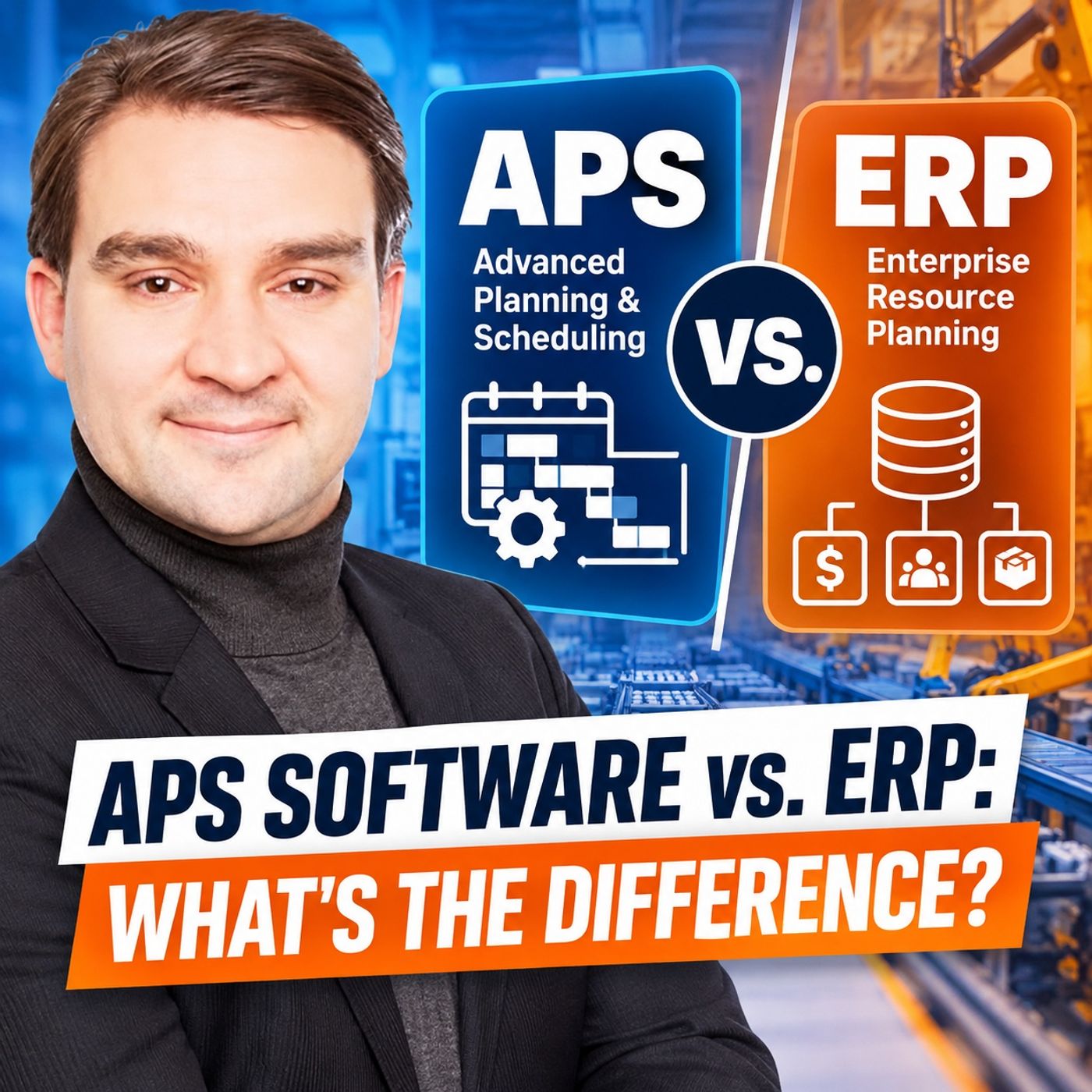
APS Software vs. ERP: What's the Difference?
Season 4
Published 1 month, 1 week ago
Description
Manufacturers often rely on ERP systems to manage orders, materials, inventory, purchasing, production orders, and financial transactions. But when a machine goes down, an urgent customer order arrives, or a critical operator is unavailable, a different question suddenly matters: Can the production plan actually run? That is where APS — Advanced Planning and Scheduling — differs fundamentally from ERP. ERP records and governs the business transaction. APS tests whether production can execute the plan under the real constraints of the factory. In this episode, we take a detailed look at APS software vs. ERP, why traditional ERP planning can create a false sense of certainty, and when manufacturers should consider adding finite-capacity scheduling to their production planning architecture.
ERP VS. APS: TWO DIFFERENT QUESTIONS
An ERP system provides the commercial and transactional backbone of manufacturing. It manages customer demand, bills of materials, routings, inventory, purchasing, production orders, costing, traceability, and financial records. APS looks at those same production requirements from another perspective: ERP asks: What needs to be produced? APS asks: Given our machines, people, materials, tools, calendars, setup rules, and existing workload, what can we actually produce — and when? That distinction becomes critical when several orders compete for the same constrained resources.
WHY ERP DATES AREN’T ALWAYS A FEASIBLE SCHEDULE
A production order can have a perfectly valid start date, finish date, routing, material list, and due date in ERP. That does not mean an empty machine exists at the required time. Traditional ERP and MRP planning often works with standard lead times, work-center capacity, calendars, and broader planning buckets. These assumptions are extremely useful for enterprise planning, material requirements planning, purchasing, and production control. But the real factory operates with much more specific constraints. A machine may already be occupied. The required operator may not be on shift. Material may technically be in inventory but still waiting for quality inspection. A fixture may be used somewhere else. Changing from one product family to another may require a long setup or cleaning process. This is the gap between a planned date and a feasible production schedule.
WHAT APS SOFTWARE ADDS
Advanced Planning and Scheduling software brings those physical constraints directly into the scheduling calculation. Instead of simply assigning work to dates, APS can consider finite machine capacity, resource calendars, operator qualifications, tools and fixtures, setup matrices, alternate machines, material readiness, maintenance windows, routing dependencies, campaign rules, changeovers, and production priorities. If a machine only has six available hours, a finite-capacity schedule cannot simply place ten hours of work into that shift and pretend the problem has disappeared. Something has to change. The order may move to another resource. Another order may be delayed. Overtime may be required. The production sequence may change. Or the customer promise may simply be impossible under the current constraints. APS makes those trade-offs visible before production discovers them.
FINITE CAPACITY SCHEDULING AND OPTIMIZATION
A major difference between APS and traditional production planning is finite capacity scheduling. But creating a feasible schedule is only the first step. A schedule can respect every physical constraint and still be commercially undesirable. Manufacturers may want to optimize for different objectives, including: On-time delivery, higher throughput, reduced setup time, lower work in process, bottleneck utilization, schedule stability, reduced changeovers, or protection of strategic customer orders. There is rarely one universally “best” production schedule. APS can calculate alternatives and expose their consequences. The b