Episode Details
Back to Episodes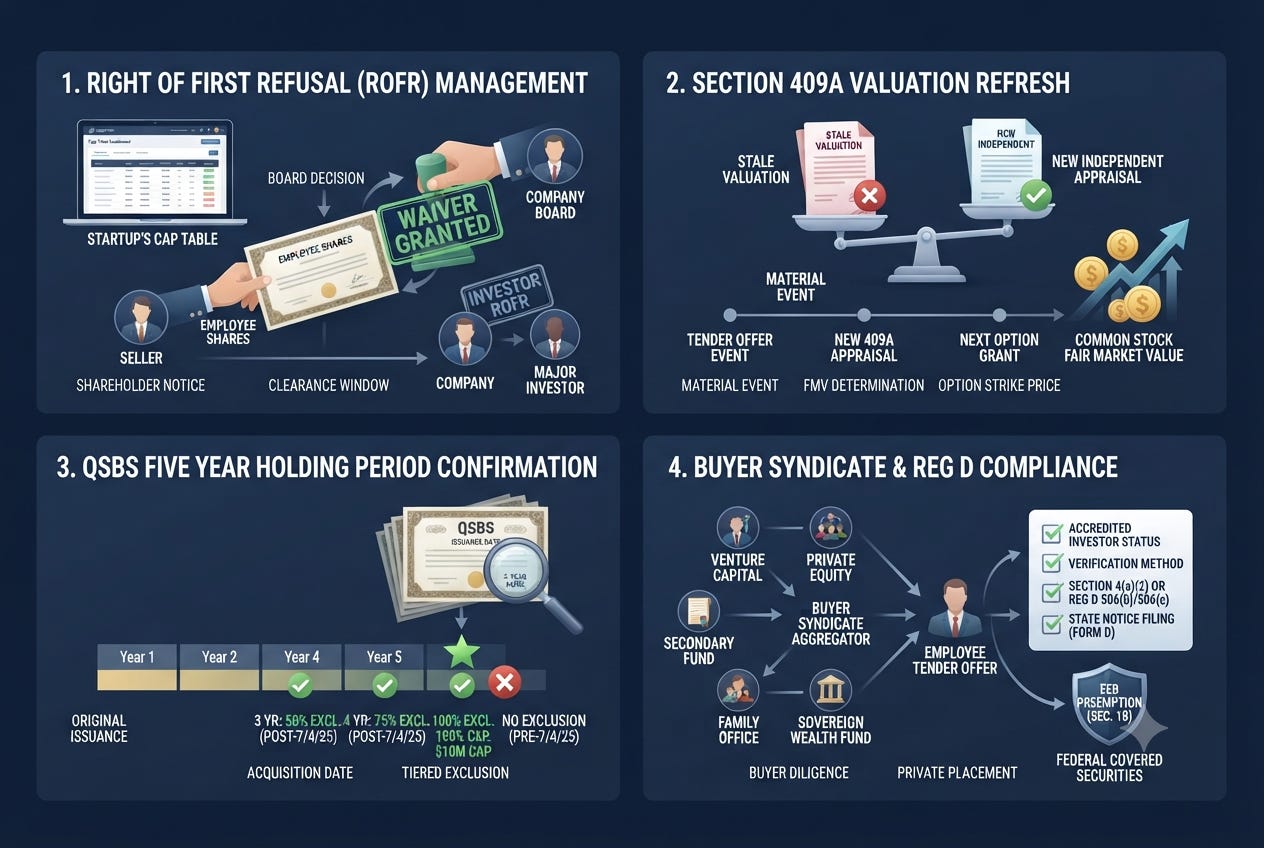
The Mechanics of Private Company Employee Secondary Sales
Description
Section 1202 Bars QSBS Relief for Tender Offers Before Year Five
what legal steps protect qsbs before an employee tender offer
A startup running a 2026 employee tender offer must waive its right of first refusal, refresh its Section 409A valuation, and confirm five year Section 1202 QSBS holding periods first, or the transaction can forfeit a seller’s federal capital gains exclusion and reset the company’s valuation for the next round. Every one of those three failure modes shows up in the same weekly call I get from a general counsel who just watched a board approve a tender program without asking who priced it, who timed it, and who is buying into it.
Start with the number employees actually care about. Internal Revenue Code Section 1202 excludes federal capital gains tax on qualified small business stock, but only after the stock has been held more than five years from its original issuance date. Sell a day short and the exclusion on that lot is gone, not reduced. The One Big Beautiful Bill Act, Public Law 119-21, signed July 4, 2025, softened that cliff for stock acquired after its effective date by adding interim tiers, 50 percent excluded at three years, 75 percent at four, and it also raised the per-issuer cap from 10 million dollars to 15 million dollars and the issuer’s gross asset ceiling from 50 million to 75 million dollars. Stock acquired before July 5, 2025 is still under the old all-or-nothing rule. A tender window that opens at month fifty-six for an employee four years and four months into the holding clock is not a liquidity event. It is a decision about whether six figures of gain gets taxed at capital gains rates or excluded entirely, and the company that opens that window without flagging the calendar math to affected employees has handed them a trap dressed as a benefit.
The next failure mode sits in the certificate of incorporation, not the tax code. Almost every venture backed company gives itself, and sometimes its investors, a right of first refusal over any proposed transfer of stock. A tender offer does not suspend that right. Each block of tendered shares still triggers a notice of proposed transfer, and the board has to waive, exercise, or assign the right before the sale can close. Skip that step and you have not run a tender offer. You have run a series of transfers that violate your own governing documents, which is the kind of defect that surfaces during the next financing’s diligence, at the worst possible moment to discover it.
Then there is the valuation problem, which is where the sophisticated founders I talk to are actually focused. A company sponsored tender offer is a material event under Section 409A, which means the existing common stock appraisal can no longer be relied on and a new one has to be commissioned before the next option grant. The tender price is not automatically the new fair market value. A credentialed appraiser still allocates the company’s actual enterprise value across its share classes and applies a discount for lack of marketability, but a completed transaction is powerful evidence, and documented liquidity tends to compress that discount. Industry tracking in 2026 puts tender prices matching the most recent preferred round in roughly 60 percent of deals, and puts the more common range at 50 to 80 percent of the preferred price, reflecting the liquidation preference and protective provisions common stock does not carry.
Here is the part that gets missed. A tender price set too close to the last preferred round moves more than the 409A. It hands a future Series A lead a transaction price, in the company’s own stock, negotiated at arm’s length with real buyers. That is exactly the kind of data point an investor cites when arguing the founder’s proposed pre-money is too aggressive. The court in Wellman v. Dickinson, 475 F. Supp. 783 (S.D.N.Y. 1979), affirmed at 682 F.2d 355 (2d Cir. 1982), laid out the factors, widespread solic