Episode Details
Back to Episodes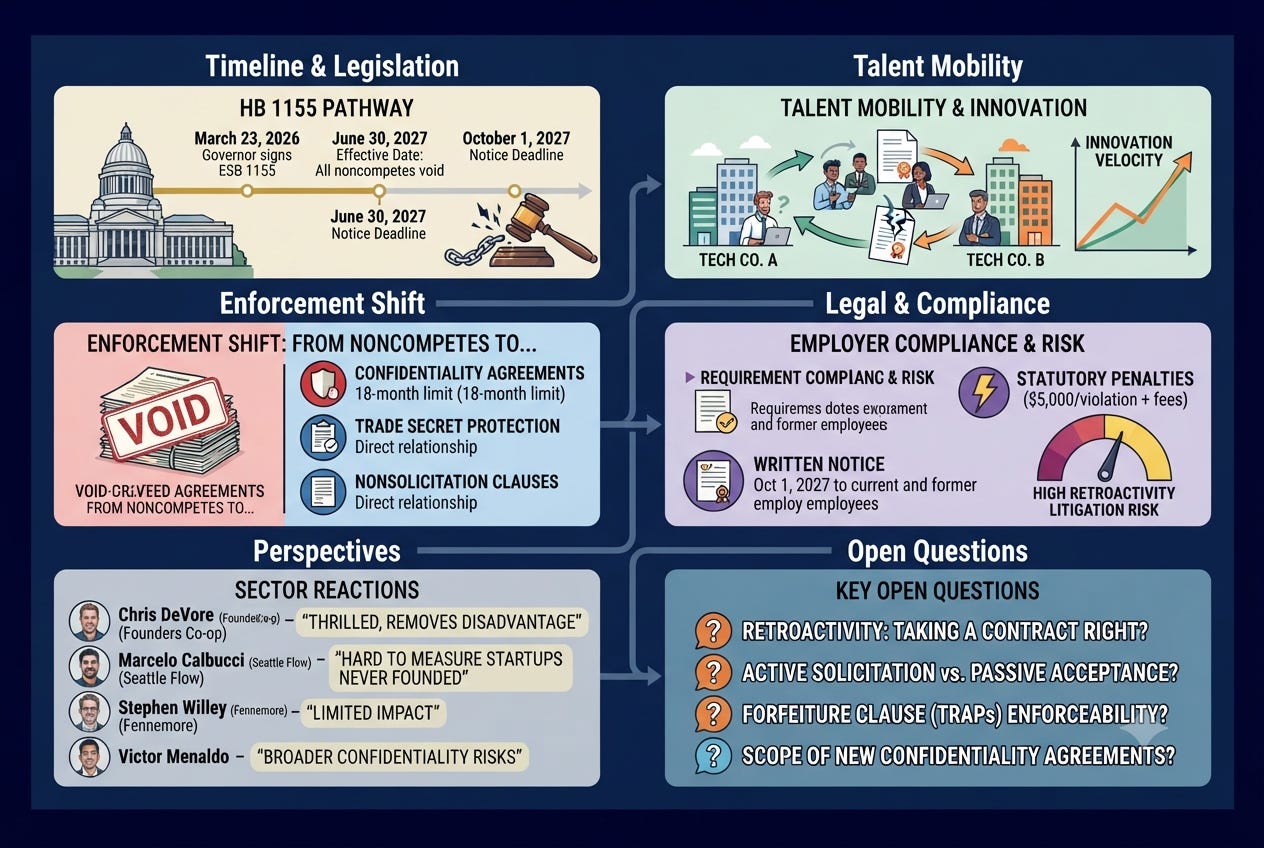
Washington’s Noncompete Ban: What Founders Need to Know
Description
Washington’s governor signed House Bill 1155 on March 23, 2026, and every noncompete in the state becomes void on June 30, 2027, regardless of when an employee signed it. Confidentiality agreements, trade secret claims, and nonsolicitation clauses capped at eighteen months are what remains for a founder trying to keep a departing engineer from carrying the product roadmap to a competitor down the street. Business sale agreements tied to at least one percent ownership survive too, along with narrowly structured educational expense repayment plans. Employers must notify every worker who signed a now void noncompete by October 1, 2027, or face a statutory penalty of $5,000 per violation, plus attorney fees.
Washington did not arrive here quickly. The state first regulated noncompetes in 2020, allowing them for workers earning above $100,000 a year, requiring written disclosure at the time of hire, and creating a presumption against any restriction longer than eighteen months. That regime got tightened again in 2024. House Bill 1155 does not tighten anything. It replaces the entire regulatory structure with a flat prohibition, joining California, which has barred noncompetes by statute since 1872, in treating the clause as unenforceable on its face rather than as a restraint to be balanced against an employer’s interest. The federal government tried a version of this in 2024 when the Federal Trade Commission issued a nationwide noncompete rule, and a federal court in Texas vacated it before it took effect. Washington did through its own legislature what the FTC could not do through regulation.
What survives is narrower than most founders assume. A confidentiality agreement built around Washington’s Uniform Trade Secrets Act still works, and it works the way it always has: the information has to carry independent economic value from staying secret, and the company has to make reasonable efforts to keep it that way. That standard, codified at RCW 19.108.010, does not care whether the employee who took the information also signed a noncompete. It cares whether the company treated the information as a secret before the employee walked out the door. The federal Defend Trade Secrets Act runs alongside it, giving a company a second forum and, in the right case, an emergency seizure remedy neither state law offers. Neither statute changed on March 23, 2026. What changed is that they are now doing work noncompetes used to do, for companies that never built the underlying record properly in the first place.
Nonsolicitation clauses are the other surviving tool, and the statute drew the line tighter than most employment lawyers expected. An eighteen month cap on soliciting the customers, patients, or clients a departing worker actually developed a relationship with while employed. The same cap applies to soliciting current employees. What crosses back into a voided noncompete is a clause that stops a former employee from accepting business a customer brings to them unprompted. Washington’s law protects a company from active pursuit. It does not protect a company from a customer who simply prefers to work with the person who used to handle the account.
I have spent thirty years drafting the paperwork that governs how a founder brings people into a company and how those people leave it, and the negotiating power in that relationship has always run through two clauses: what the departing employee can be stopped from doing, and what the departing employee can be stopped from taking. House Bill 1155 collapses the first clause almost entirely and leaves the second clause standing. Every Washington client who has called this year about a senior hire walking out the door has gotten a version of the same answer. Stop worrying about where they go next and start worrying about what they know when they get there.
The reaction inside Washington’s technology community splits along a predictable line. Chris DeVore, managing