Episode Details
Back to Episodes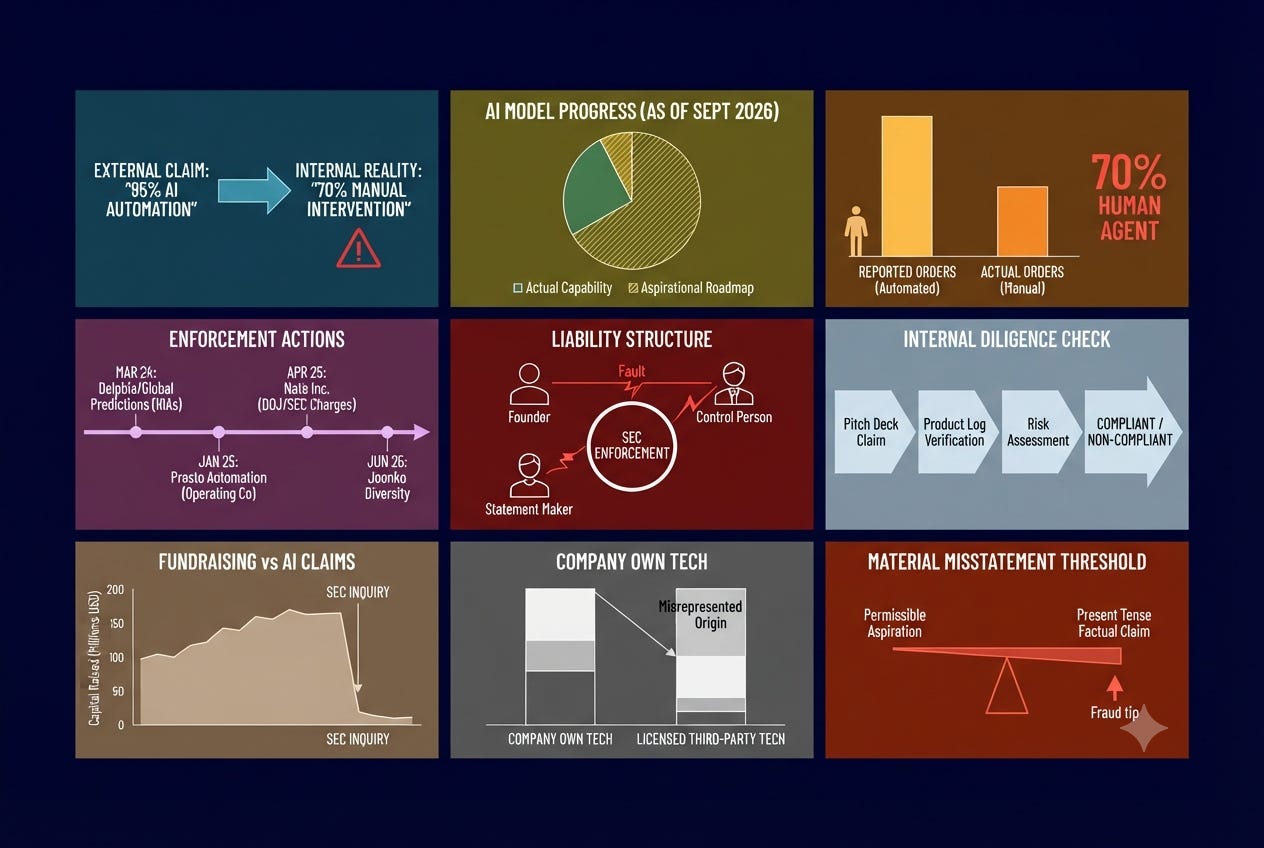
Securities Fraud Exposure for Pitch Decks and Investor Updates
Description
Pitch Deck AI Claims Now Carry SEC Securities Fraud Risk
Overstating AI automation to investors is securities fraud under Rule 10b-5, the theory prosecutors used against Nate Inc. founder Albert Saniger, who raised forty two million US Dollars. Saniger told investors the Nate shopping application completed purchases automatically using artificial intelligence. Contractors in the Philippines and Romania did the work by hand, and Saniger’s own staff processed orders manually during investor demonstrations to sustain the appearance of automation. Prosecutors in the Southern District of New York charged him in April 2025 with securities fraud and wire fraud, each carrying a statutory maximum sentence of 20 years, and the Securities and Exchange Commission filed a parallel civil case the same day.
The theory both agencies used, that a specific and checkable technical claim made to raise money must be true, is the same theory the Commission built a year earlier against two registered investment advisers. Delphia and Global Predictions paid a combined four hundred thousand US Dollars in March 2024 for describing artificial intelligence capability neither firm actually had. Delphia told investors it put their data to work to make its artificial intelligence smarter when it had not built that capability at all. Global Predictions called itself the first regulated artificial intelligence financial advisor and promised forecasts it did not deliver. Those cases were charged under the Investment Advisers Act Marketing Rule, a statute that applies only to registered advisers. The theory behind them did not stay confined to that industry.
Ten months later the Commission proved the point against a company with no investment adviser registration at all. Presto Automation, a publicly traded restaurant technology company, told investors its voice ordering product eliminated the need for a person to take an order and reached a 95 percent automated completion rate. A human agent actually stepped in on roughly 70 percent of orders through the end of 2023, and the product ran on a supplier’s technology rather than Presto’s own until September 2022. The Commission settled the case in January 2025 under a provision of the Securities Act that requires no proof anyone meant to deceive investors, and it imposed no monetary penalty because Presto had already built disclosure controls to check artificial intelligence claims before they reach the market. The lesson buried in that leniency is worth more than the penalty avoided: a company can be charged for a false claim it never intended to make, simply because nobody checked it.
Founders should read the statutory basis carefully rather than assume it applies only to public companies. Securities Act Section 17(a) and Exchange Act Section 10(b) and Rule 10b-5 prohibit a material misstatement made in connection with the offer or sale of any security. A Regulation D exemption removes the duty to register an offering with the Commission. It does not remove the duty to tell the truth about what the product does. A pitch deck circulated to a venture fund is a written communication made in connection with the sale of a security, and every factual sentence on it can support a fraud claim if it turns out to be false, whether or not the company ever files anything with the Commission.
Joonko Diversity Inc. shows what happens when a fabricated technical claim is paired with fabricated operating numbers. Founder Illit Raz described a recruiting product built on seven proprietary algorithms said to use natural language processing, computer vision, and machine learning to match candidates to employers automatically, and reported more than 200 corporate customers and revenue climbing toward eight and a half million US Dollars by the middle of 2023. Investors put 21 million US Dollars behind those numbers in 2021 and 2022. The Commission and the United States Attorney’s Office in Manhattan