Episode Details
Back to Episodes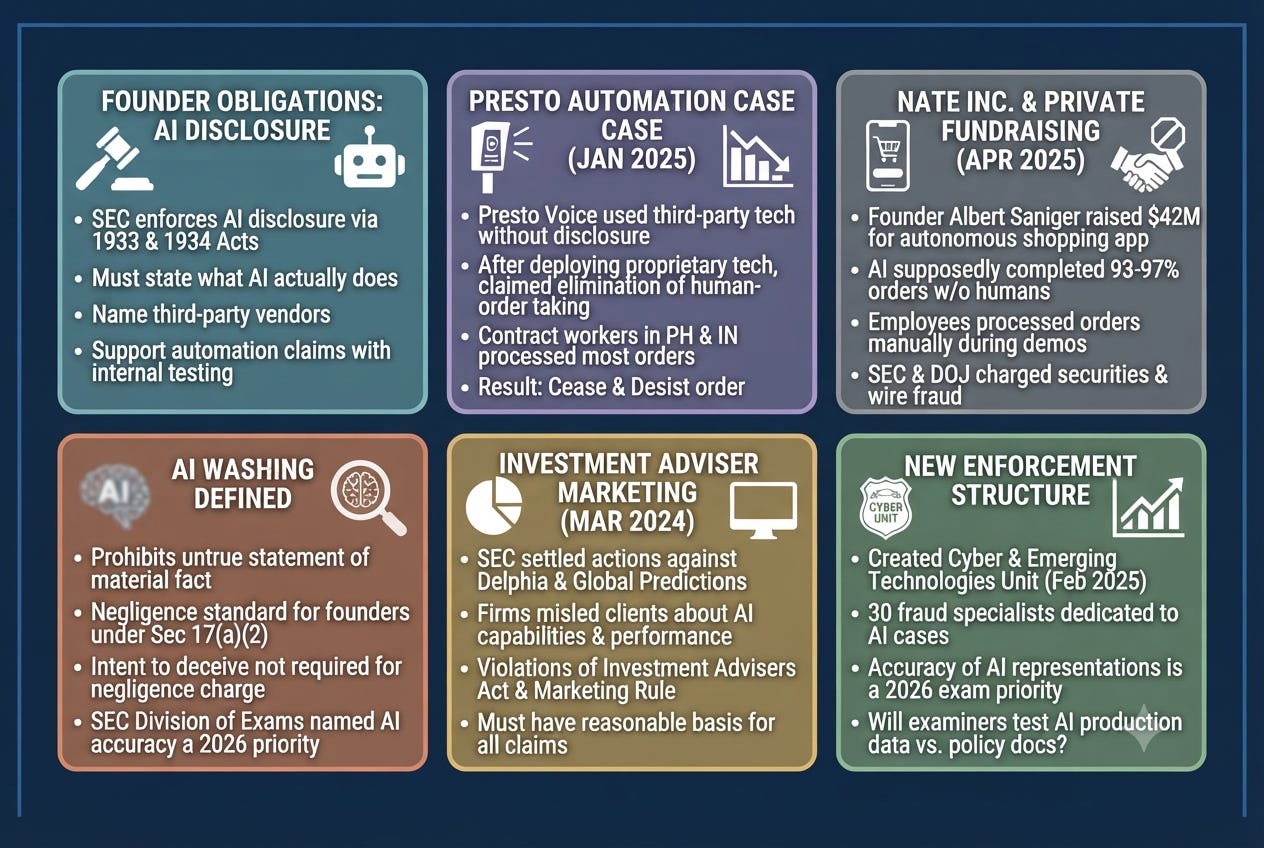
From Pitch Deck to Public Filing: The Cost of Overstating Artificial Intelligence Capabilities
Description
SEC Charges Show Founders Must Verify AI Claims Before Filing
The Securities and Exchange Commission charged Nate Inc. founder Albert Saniger with securities fraud on April 9, 2025 for concealing human labor behind an AI shopping app. Saniger had raised approximately 42 million US Dollars from 2019 through 2022 by telling investors the app’s technology completed 93 to 97 percent of purchases without a person touching them, then had engineers manually process orders during at least one live demonstration while contract workers in the Philippines handled the rest. Founders preparing a pitch deck, a Form D, or a Form S-1 face the exact standard that reached Saniger: state what the AI model actually does, name the vendor or the workforce standing behind it, and never let a demonstration show something the product cannot yet do on its own.
None of this required a new statute. The Commission built the entire AI washing docket on Section 17(a) of the Securities Act of 1933 and Section 10(b) of the Securities Exchange Act of 1934, the same antifraud provisions that have governed stock offerings since before the transistor existed. What changed is the subject matter, and the Commission’s Cyber and Emerging Technologies Unit, formed in February 2025 with roughly 30 fraud specialists, now exists specifically to apply those old statutes to the newest claims on a pitch deck.
Saniger’s company never went public. Nate Inc. raised its capital through a private placement under Regulation D, Rule 506(b), the exemption nearly every venture backed founder uses to avoid registering an offering with the Commission. That exemption removes the registration paperwork. It does not remove the antifraud provisions, which apply to the offer or sale of a security whether the buyer is a public shareholder or a seed stage investor writing a check on the strength of a demo. The Department of Justice filed a parallel criminal case the same day, charging Saniger with wire fraud under 18 U.S.C. Section 1343 alongside the securities counts, a reminder that an overstated automation rate can become a federal indictment, and it can become that on the same day as an SEC settlement.
does sec anti fraud law apply to private startups pitching investors
Yes, and Presto Automation Inc. shows what the disclosure failure looks like once a company does go public. The Commission’s January 14, 2025 order found that from November 2021 through September 2022 a third party supplier, not Presto, owned the voice recognition technology running the company’s largest customer account, a dependency Presto’s public statements never adequately disclosed. After Presto deployed its own AI in September 2022, the company told the market its technology eliminated human order taking. Contract workers based in the Philippines and India processed the large majority of drive through orders anyway. An internal message from October 2022, later quoted in the Commission’s order, shows an executive warning colleagues not to cite the automation rate to customers because it implied a level of independence the product did not have. The order charged Section 17(a)(2) of the Securities Act, a provision that does not require proof of intent, only negligence, alongside Section 13(a) of the Exchange Act governing periodic reports. No penalty was assessed given the company’s financial condition and its cooperation, but the disclosure standard the order sets is now the template: name the vendor, state the true completion rate, and describe the human review built into the process before the language reaches a filing.
what happens when an ai claim reaches a pitch deck instead of a filing
The Investment Advisers Act reaches the same slide a Series A founder shows a fund partner. On March 18, 2024 the Commission settled with Delphia (USA) Inc. for 225,000 US Dollars and Global Predictions Inc. for 175,000 US Dollars, both for AI capability claims that did not match what